Ercanbrack Carson W, Rahal Dania A, Chauhan Muhammad Z, Jabbehdari Sayena, Uwaydat Sami H
College of Medicine, University of Arkansas for Medical Sciences, Little Rock, AR, USA.
Harvey and Bernice Jones Eye Institute, University of Arkansas for Medical Sciences, Little Rock, AR, USA.
J Ophthalmic Inflamm Infect. 2024 Aug 1;14(1):37. doi: 10.1186/s12348-024-00419-9.
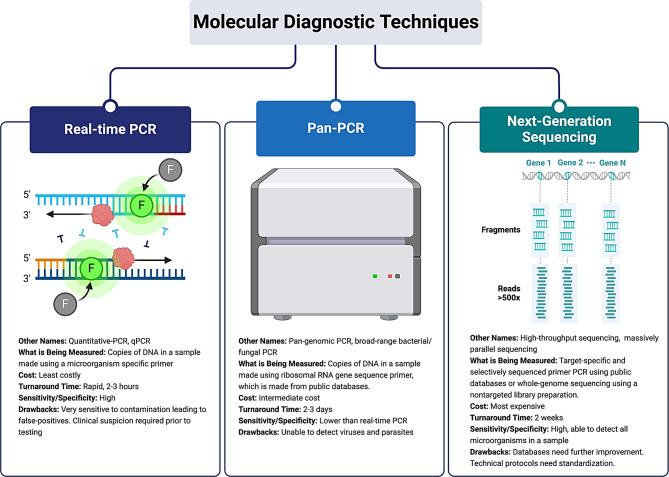
Endophthalmitis is a clinical diagnosis but identification of the disease-causing agent or agents allows for a more tailored treatment. This is routinely done through intraocular fluid cultures and staining. However, culture-negative endophthalmitis is a relatively common occurrence, and a causative organism cannot be identified. Thus, further diagnostic testing, such as pan-bacterial and pan-fungal polymerase chain reactions (PCRs), may be required. BODY: There are now newer, other testing modalities, specifically pan-bacterial and pan-fungal PCRs, that may allow ophthalmologists to isolate a causative agent when quantitative PCRs and cultures remain negative. We present a case report in which pan-fungal PCR was the only test, amongst quantitative PCRs, cultures, and biopsies, that was able to identify a pathogen in endophthalmitis. Pan-PCR has unique advantages over quantitative PCR in that it does not have a propensity for false-positive results due to contamination. Conversely, pan-PCR has drawbacks, including its inability to detect viruses and parasites and its increased turnaround time and cost. Based on two large retrospective studies, pan-PCR was determined not to be recommended in routine cases of systemic infection as it does not typically add value to the diagnostic workup and does not change the treatment course in most cases. However, in cases like the one presented, pan-bacterial and pan-fungal PCRs may be considered if empiric treatment fails or if the infective organism cannot be isolated. If pan-PCR remains negative or endophthalmitis continues to persist, an even newer form of testing, next-generation sequencing, may aid in the diagnostic workup of culture-negative endophthalmitis.
Pan-bacterial and pan-fungal PCR testing is a relatively new diagnostic tool with unique advantages and drawbacks compared to traditional culturing and PCR methods. Similar to the tests' use in non-ophthalmic systemic infections, pan-bacterial and pan-fungal PCRs are unlikely to become the initial diagnosis test and completely replace culture methods. However, they can provide useful diagnostic information if an infectious agent is unable to be identified with traditional methods or if empiric treatment of endophthalmitis continues to fail.
眼内炎是一种临床诊断,但确定致病病原体有助于进行更具针对性的治疗。这通常通过眼内液培养和染色来完成。然而,培养阴性的眼内炎较为常见,无法确定致病微生物。因此,可能需要进一步的诊断检测,如泛细菌和泛真菌聚合酶链反应(PCR)。
现在有更新的其他检测方法,特别是泛细菌和泛真菌PCR,当定量PCR和培养结果均为阴性时,这些方法可能使眼科医生能够分离出致病病原体。我们报告一例病例,在定量PCR、培养和活检中,泛真菌PCR是唯一能够在眼内炎中鉴定出病原体的检测方法。泛PCR相对于定量PCR具有独特优势,即它不会因污染而出现假阳性结果。相反,泛PCR也有缺点,包括无法检测病毒和寄生虫,以及周转时间延长和成本增加。基于两项大型回顾性研究,泛PCR在系统性感染的常规病例中不被推荐,因为它通常不会为诊断检查增加价值,且在大多数情况下不会改变治疗方案。然而,在如本文所述的病例中,如果经验性治疗失败或无法分离出感染性生物体,可以考虑进行泛细菌和泛真菌PCR检测。如果泛PCR结果仍为阴性或眼内炎持续存在,一种更新的检测形式,即下一代测序,可能有助于培养阴性眼内炎的诊断检查。
泛细菌和泛真菌PCR检测是一种相对较新的诊断工具,与传统培养和PCR方法相比具有独特的优缺点。与这些检测方法在非眼科系统性感染中的应用类似,泛细菌和泛真菌PCR不太可能成为初始诊断检测方法并完全取代培养方法。然而,如果用传统方法无法鉴定感染病原体,或眼内炎的经验性治疗持续失败,它们可以提供有用的诊断信息。