The Shraga Segal Department of Microbiology, Immunology & Genetics, Faculty of Health Sciences, Ben-Gurion University of the Negev, Beer-Sheva, Israel.
The National Institute for Biotechnology in the Negev, Ben-Gurion University of the Negev, Beer-Sheva, Israel.
Mol Genet Genomic Med. 2020 Jul;8(7):e1258. doi: 10.1002/mgg3.1258. Epub 2020 May 15.
Ubiquitin-Specific Peptidase 26 (USP26), located on the X chromosome, encodes a deubiquitinating enzyme expressed mainly in testis, where it regulates protein turnover during spermatogenesis and modulates the ubiquitination levels of the Androgen Receptor (AR), and as a consequence, affects AR signaling.
The patient was thoroughly characterized clinically. He was genetically tested by chromosome analysis and whole exome sequencing (WES).
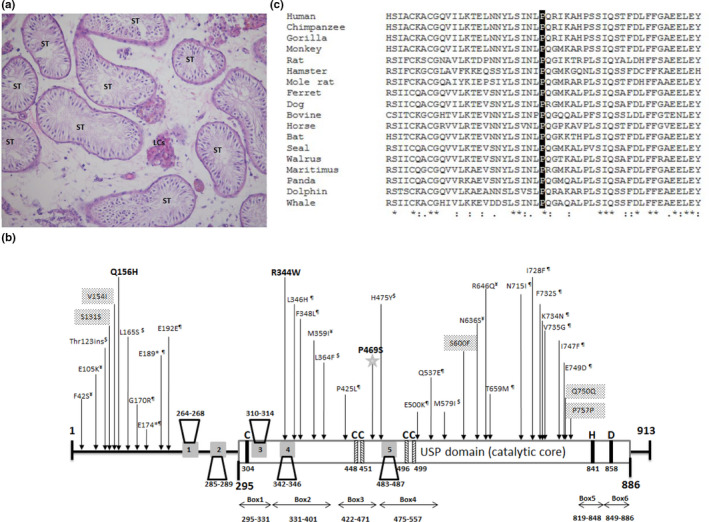
The patient was diagnosed with Sertoli cell-only syndrome pattern (SCOS). The WES analysis revealed only the variation in USP26: causing p.P469S in a highly evolutionary conserved amino acid as the possible cause for SCOS. The literature search identified 34 single variations and 14 clusters of variations in USP26 that were associated with male infertility. Only one of the 22 variations and of one cluster of three mutations tested for ubiquitination activity was found as damaging. Only one out of six variations tested for effect on AR function was found as damaging. Thus, the association of USP26 with male fertility was questioned.
The finding in our patient and the discussion on the reviewed literature support a possible role for USP26 in male fertility.
位于 X 染色体上的泛素特异性肽酶 26(USP26)编码一种去泛素化酶,主要在睾丸中表达,在那里它调节精子发生过程中的蛋白质周转,并调节雄激素受体(AR)的泛素化水平,从而影响 AR 信号。
对患者进行了全面的临床特征描述。通过染色体分析和全外显子组测序(WES)对其进行了基因检测。
患者被诊断为单纯性支持细胞综合征(SCOS)。WES 分析显示仅 USP26 发生变异:导致高度进化保守氨基酸中的 p.P469S 可能是 SCOS 的原因。文献检索发现 USP26 中有 34 个单变异和 14 个变异簇与男性不育有关。在测试的 22 个变异和 3 个突变簇中,只有一个被发现具有泛素化活性的破坏性。在测试的 6 个影响 AR 功能的变异中,只有一个被发现具有破坏性。因此,USP26 与男性生育力的关联受到质疑。
我们在患者中发现的情况以及对已审查文献的讨论支持 USP26 可能在男性生育力中发挥作用。