Department of Gastric Surgery, Sun Yat-sen University Cancer Center, State Key Laboratory of Oncology in South China, Collaborative Innovation Center for Cancer Medicine, Guangzhou, China.
Department of Ultrasound, Sun Yat-sen University Cancer Center, State Key Laboratory of Oncology in South China, Collaborative Innovation Center for Cancer Medicine, Guangzhou, China.
BMC Cancer. 2020 May 14;20(1):421. doi: 10.1186/s12885-020-06910-5.
We aimed to assess whether disease-free survival (DFS) could serve as a reliable surrogate endpoint for overall survival (OS) in adjuvant trials of pancreatic cancer.
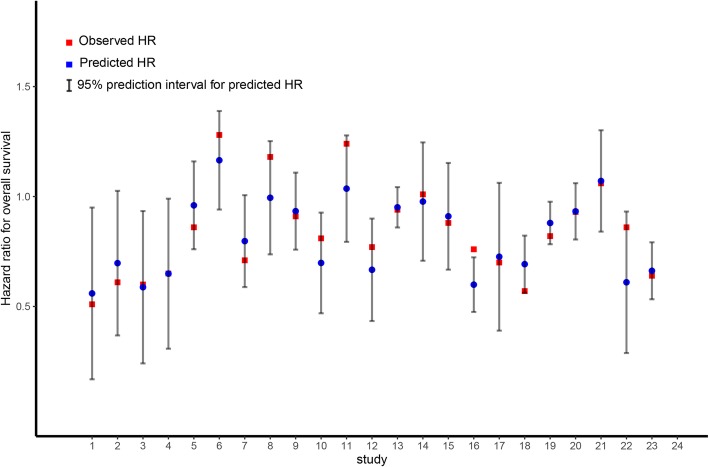
We systematically reviewed adjuvant randomized trials for non-metastatic pancreatic cancer after curative resection that reported a hazard ratio (HR) for DFS and OS. We assessed the correlation between treatment effect (HR) on DFS and OS, weighted by sample size or precision of hazard ratio estimate, assuming fixed and random effects, and calculated the surrogate threshold effect (STE). We also performed sensitivity analyses and a leave-one-out cross validation approach to evaluate the robustness of our findings.
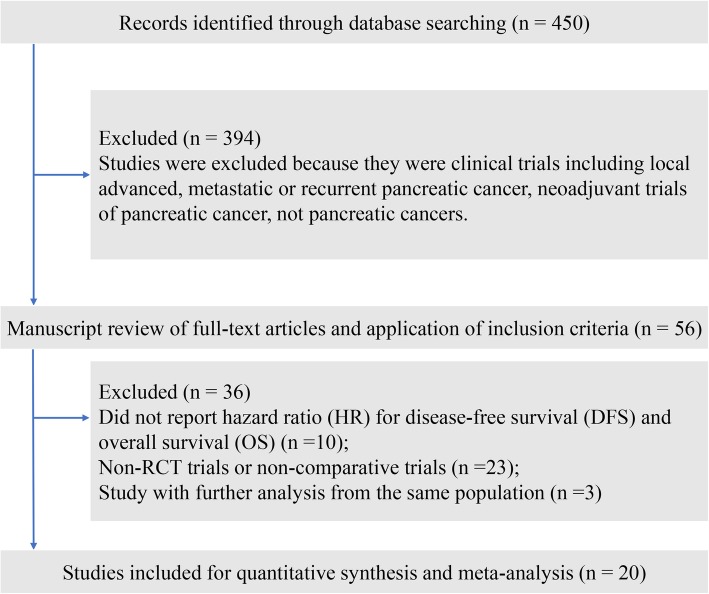
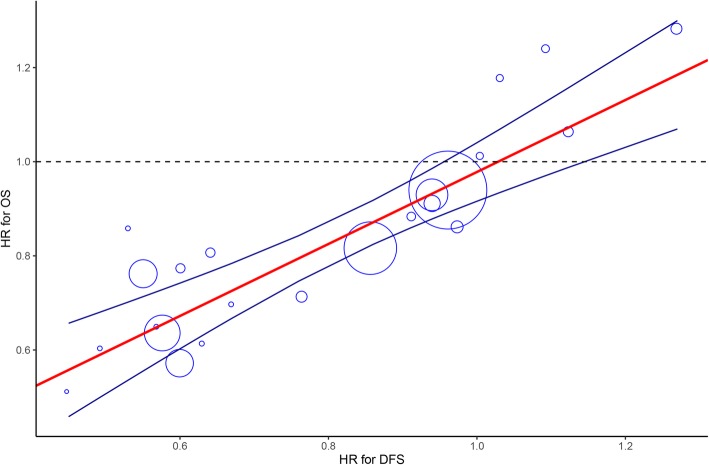
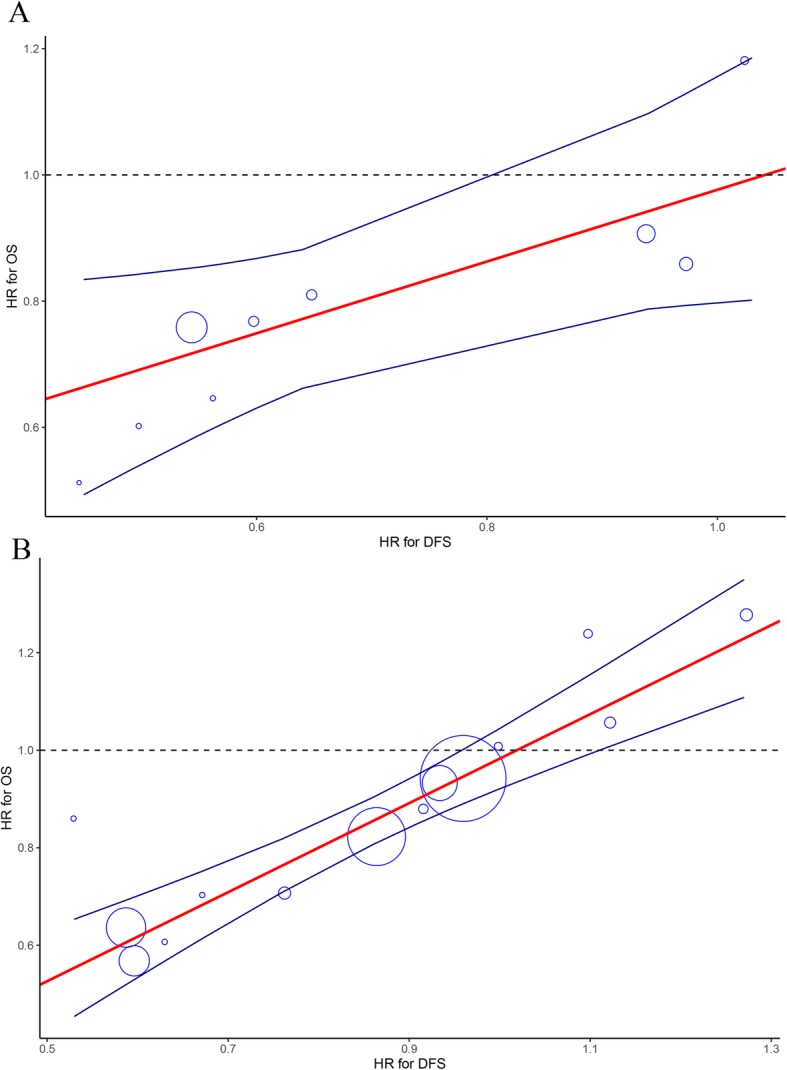
After screening 450 relevant articles, we identified a total of 20 qualifying trails comprising 5170 patients for quantitative analysis. We noted a strong correlation between the treatment effects for DFS and OS, with coefficient of determination of 0.82 in the random effect model, 0.82 in the fixed effect model, and 0.80 in the sample size weighting; the robustness of this finding was further verified by the leave-one-out cross-validation approach. Sensitivity analyses with restriction to phase 3 trials, large trials, trials with mature follow-up periods, and trials with adjuvant therapy versus adjuvant therapy strengthened the correlation (0.75 to 0.88) between DFS and OS. The STE was 0.96 for DFS.
Therefore, DFS could be regarded as a surrogate endpoint for OS in adjuvant trials of pancreatic cancer. In future similar adjuvant trials, a hazard ratio for DFS of 0.96 or less would predict a treatment impact on OS.
我们旨在评估无病生存(DFS)是否可以作为胰腺癌辅助治疗试验中总生存(OS)的可靠替代终点。
我们系统地回顾了根治性切除术后非转移性胰腺癌辅助随机试验,这些试验报告了DFS 和 OS 的风险比(HR)。我们评估了治疗效果(DFS 和 OS 的 HR)之间的相关性,权重为样本量或危险比估计的精度,假设固定和随机效应,并计算了替代阈值效应(STE)。我们还进行了敏感性分析和逐一剔除交叉验证方法,以评估我们研究结果的稳健性。
在筛选了 450 篇相关文章后,我们共确定了 20 项符合条件的试验,共纳入了 5170 例患者进行定量分析。我们注意到 DFS 和 OS 的治疗效果之间存在很强的相关性,在随机效应模型中决定系数为 0.82,在固定效应模型中为 0.82,在样本量权重中为 0.80;通过逐一剔除交叉验证方法进一步验证了这一发现的稳健性。敏感性分析限制在 3 期试验、大试验、随访时间成熟的试验和辅助治疗与辅助治疗的试验中,进一步加强了 DFS 和 OS 之间的相关性(0.75 至 0.88)。DFS 的 STE 为 0.96。
因此,DFS 可以作为胰腺癌辅助治疗试验中 OS 的替代终点。在未来类似的辅助治疗试验中,DFS 的危险比为 0.96 或更低将预示着对 OS 的治疗影响。