Leite Luís Felipe, Costa de Almeida Luiz F, Diniz da Conceição Lucas, Macambira Noronha Mariana, Belotto Marcos, Saldanha Erick F, Megid Thais Baccili Cury, D'Alpino Peixoto Renata, Gyawali Bishal
Department of Medical Sciences, Federal Fluminense University, Niterói, Brazil.
Department of Medical Oncology, Universidade Federal do Ceará, Fortaleza, Brazil.
BMJ Oncol. 2025 May 6;4(1):e000766. doi: 10.1136/bmjonc-2025-000766. eCollection 2025.
Disease-free survival (DFS) is frequently used as the primary endpoint in trials of adjuvant and neoadjuvant therapies for early-stage pancreatic cancer (PC), but its validity as a surrogate for overall survival (OS) remains uncertain. This study evaluates the strength and consistency of DFS as a surrogate for OS in early-stage PC trials.
This systematic review and meta-analysis followed the Preferred Reporting Items for Systematic Reviews and Meta-Analyses guidelines. Trials of early-stage PC involving drug therapy were identified through PubMed, Embase and Cochrane CENTRAL databases, and data on DFS and OS with HR and CIs were extracted. Trial-level surrogacy of DFS for OS was assessed using weighted linear regression, calculating the coefficient of determination (R²) and surrogate threshold effect (STE).
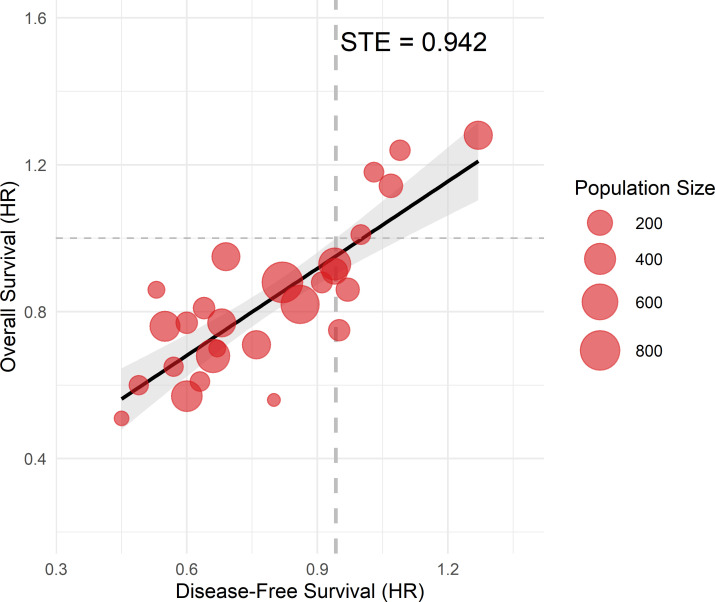
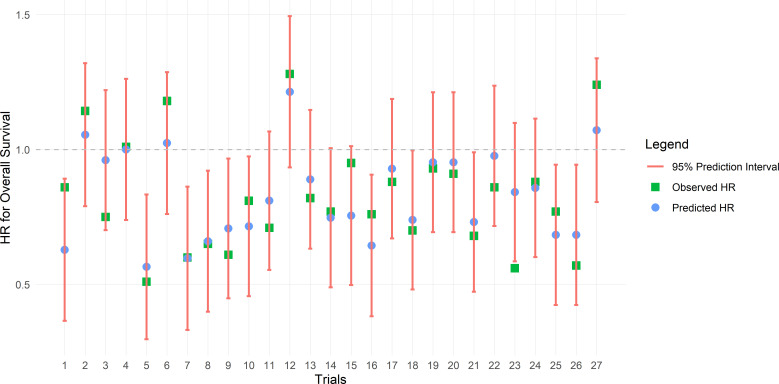
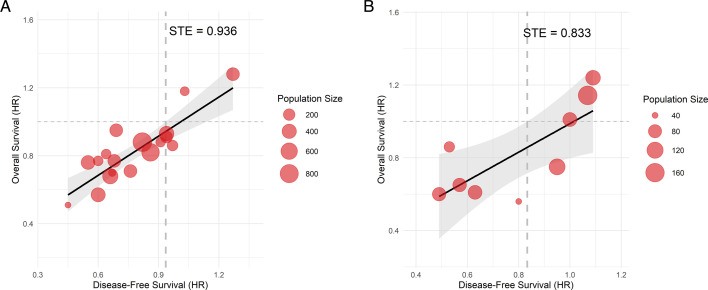
29 trials involving 6777 patients were included. In adjuvant trials, HR of DFS strongly correlated with HR of OS (R²=0.70) at trial-level, with the STE of 0.94 indicating the maximum DFS HR beyond which OS benefit was unlikely. The correlation strength differed between phase III (R²=0.71) versus phase II (R²=0.67) trials. This correlation was stronger in trials including radiation therapy (R²=0.81) and trials in the neoadjuvant setting (R²=0.90). No trial in our study was a registration trial of a new molecule and all involved chemotherapy.
Treatment effects on DFS had a strong correlation with treatment effects on OS, making DFS a potential surrogate endpoint for OS in early-stage PC trials of cytotoxic chemotherapies, but its use in registration trials requires careful consideration due to variability across treatment settings and trial designs.
CRD42024595441.
无病生存期(DFS)常被用作早期胰腺癌(PC)辅助和新辅助治疗试验的主要终点,但其作为总生存期(OS)替代指标的有效性仍不确定。本研究评估DFS作为早期PC试验中OS替代指标的强度和一致性。
本系统评价和荟萃分析遵循系统评价和荟萃分析的首选报告项目指南。通过PubMed、Embase和Cochrane CENTRAL数据库识别涉及药物治疗的早期PC试验,并提取DFS和OS的数据以及风险比(HR)和置信区间(CI)。使用加权线性回归评估DFS对OS的试验水平替代指标,计算决定系数(R²)和替代阈值效应(STE)。
纳入了29项试验,共6777例患者。在辅助试验中,DFS的HR与试验水平的OS的HR高度相关(R² = 0.70),STE为0.94,表明最大DFS HR超过此值则不太可能有OS获益。III期试验(R² = 0.71)与II期试验(R² = 0.67)之间的相关强度有所不同。在包括放射治疗的试验(R² = 0.81)和新辅助治疗试验(R² = 0.90)中,这种相关性更强。我们研究中的试验均不是新分子的注册试验,所有试验均涉及化疗。
对DFS的治疗效果与对OS的治疗效果密切相关,这使得DFS成为细胞毒性化疗早期PC试验中OS的潜在替代终点,但由于不同治疗背景和试验设计存在差异,在注册试验中使用时需要仔细考虑。
CRD42024595441。