Jiang Yue-Hua, Jiang Ling-Yu, Wang Yong-Cheng, Ma Du-Fang, Li Xiao
Central Laboratory, Affiliated Hospital of Shandong University of Traditional Chinese Medicine, Jinan, China.
First Clinical Medical College, Shandong University of Traditional Chinese Medicine, Jinan, China.
Front Pharmacol. 2020 Apr 28;11:512. doi: 10.3389/fphar.2020.00512. eCollection 2020.
Endothelial senescence is an important risk factor leading to atherosclerosis. The mechanism of quercetin against endothelial senescence is worth exploring.
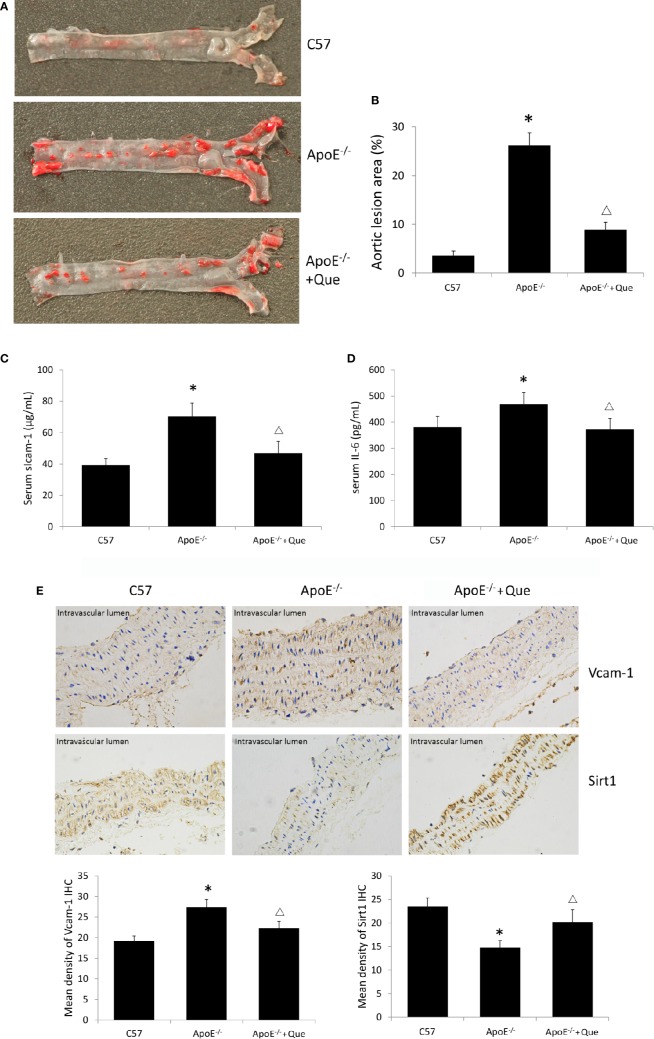
Quercetin (20 mg/kg/d) was administered to ApoE mice intragastrically to evaluate the effectiveness of quercetin on atherosclerotic lesion . , human aortic endothelial cells (HAECs) were used to assess the effect of quercetin on cellular senescence induced by oxidized low-density lipoprotein (ox-LDL). Transcriptome microarray and quantitative RT-PCR was conducted to study the pharmacological targets of quercetin.
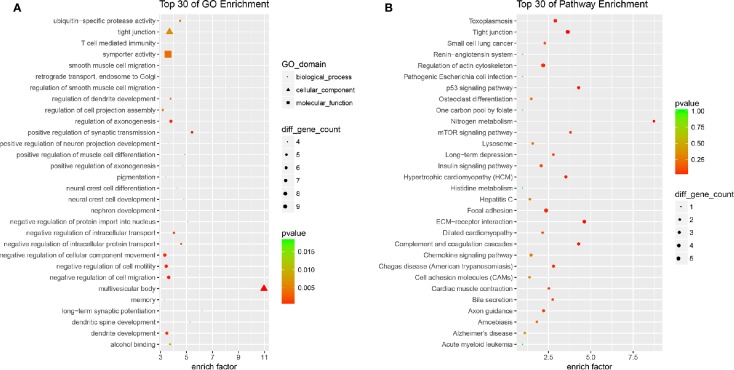
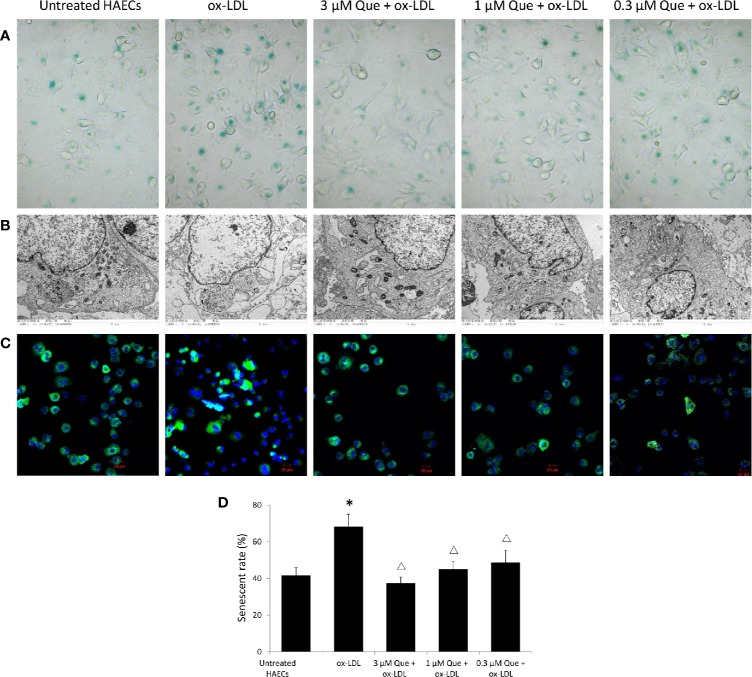
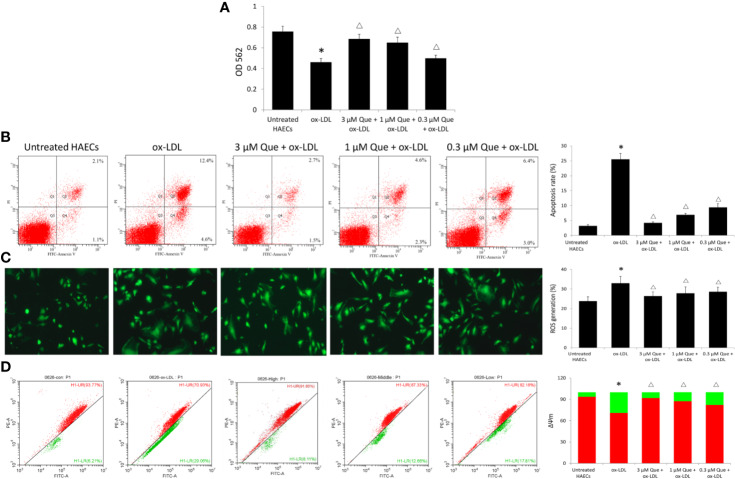
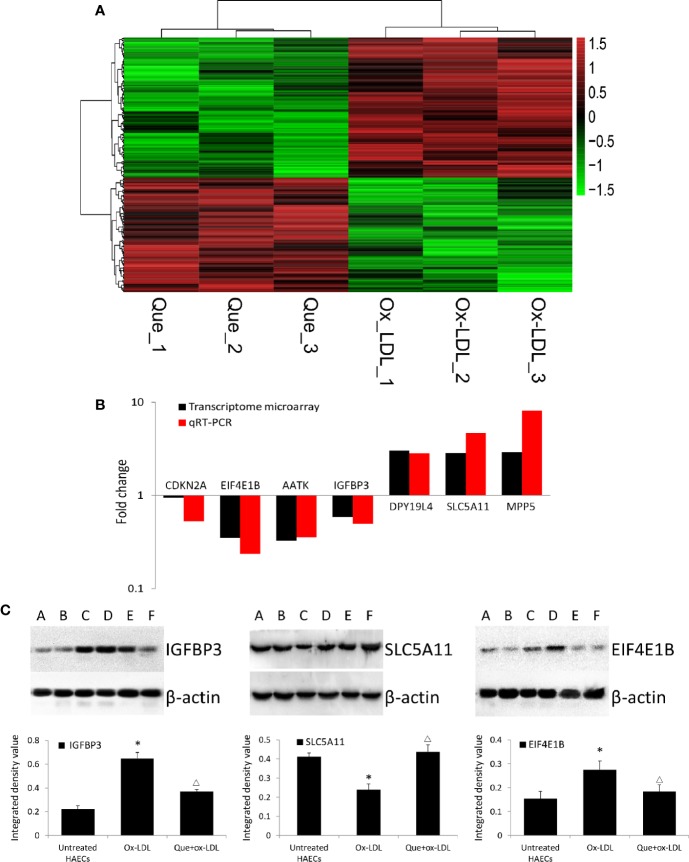
ApoE mice demonstrated obvious lipid deposition in arterial lumina, high level of serum sIcam-1 and IL-6, and high density of Vcam-1 and lower density of Sirt1 in aorta. Quercetin administration decreased lipid deposition in arterial lumina, serum sIcam-1, and IL-6 and Vcam-1 in aorta, while increased the density of Sirt1 in aorta of ApoE mice. , quercetin (0.3, 1, or 3 μmol/L) decreased the expression of senescence-associated β-galactosidase and improved cell morphology of HAECs. And quercetin decreased the cellular apoptosis and increased mitochondrial membrane potential (ΔΨm) in dose-dependent manner, and decreased ROS generation simultaneously. Transcriptome microarray suggested 254 differentially expressed (DE) mRNAs (110 mRNAs were upregulated and 144 mRNAs were downregulated) in HAECs after quercetin treatment (fold change > 1.5, < 0 .05, Que Ox-LDL). GO and KEGG analysis indicated nitrogen metabolism, ECM-receptor interaction, complement, and coagulation cascades, p53 and mTOR signaling pathway were involved in the pharmacological mechanisms of quercetin against ox-LDL.
Quercetin alleviated atherosclerotic lesion both and .
内皮细胞衰老为导致动脉粥样硬化的重要危险因素。槲皮素抗内皮细胞衰老的机制值得探究。
对载脂蛋白E(ApoE)小鼠进行槲皮素灌胃(20毫克/千克/天),以评估槲皮素对动脉粥样硬化病变的疗效。使用人主动脉内皮细胞(HAECs)评估槲皮素对氧化型低密度脂蛋白(ox-LDL)诱导的细胞衰老的影响。进行转录组微阵列和定量逆转录聚合酶链反应以研究槲皮素的药理靶点。
ApoE小鼠动脉管腔出现明显脂质沉积,血清可溶性细胞间黏附分子-1(sIcam-1)和白细胞介素-6(IL-6)水平升高,主动脉中血管细胞黏附分子-1(Vcam-1)密度高而沉默信息调节因子1(Sirt1)密度低。给予槲皮素可减少动脉管腔脂质沉积、血清sIcam-1以及主动脉中的IL-6和Vcam-1,同时增加ApoE小鼠主动脉中Sirt1的密度。此外,槲皮素(0.3、1或3微摩尔/升)可降低衰老相关β-半乳糖苷酶的表达并改善HAECs的细胞形态。槲皮素以剂量依赖性方式减少细胞凋亡并增加线粒体膜电位(ΔΨm),同时减少活性氧(ROS)生成。转录组微阵列显示,槲皮素处理后HAECs中有254个差异表达(DE)的信使核糖核酸(mRNA)(110个mRNA上调,144个mRNA下调)(倍数变化>1.5,P<0.05,槲皮素对比ox-LDL)。基因本体(GO)和京都基因与基因组百科全书(KEGG)分析表明,氮代谢、细胞外基质-受体相互作用、补体和凝血级联反应、p53和雷帕霉素靶蛋白(mTOR)信号通路参与了槲皮素抗ox-LDL的药理机制。
槲皮素在体内和体外均减轻了动脉粥样硬化病变。