Song Seon Beom, Jang So-Young, Kang Hyun Tae, Wei Bie, Jeoun Un-Woo, Yoon Gye Soon, Hwang Eun Seong
Department of Life Science, University of Seoul, Seoul 02504, Korea.
Department of Biomedical Science and Department of Biochemistry, Ajou University School of Medicine, Suwon 16499, Korea.
Mol Cells. 2017 Jul 31;40(7):503-514. doi: 10.14348/molcells.2017.0081. Epub 2017 Jul 24.
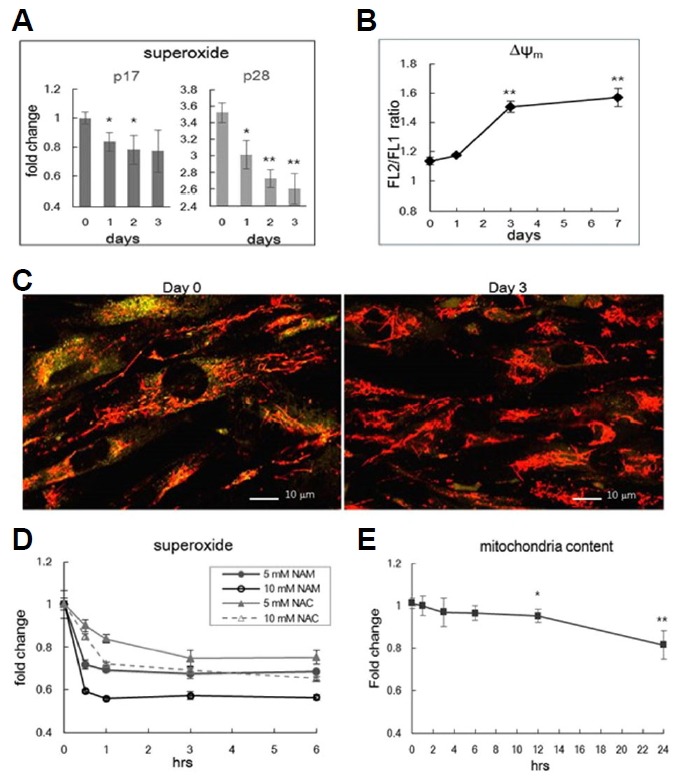
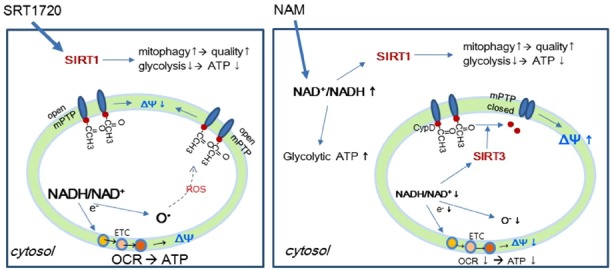
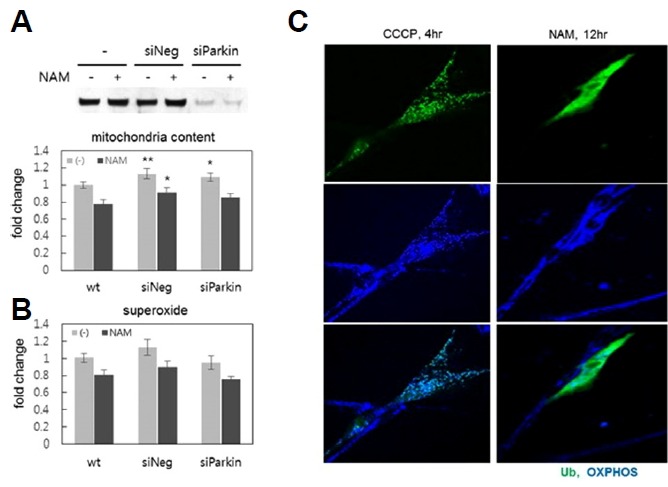
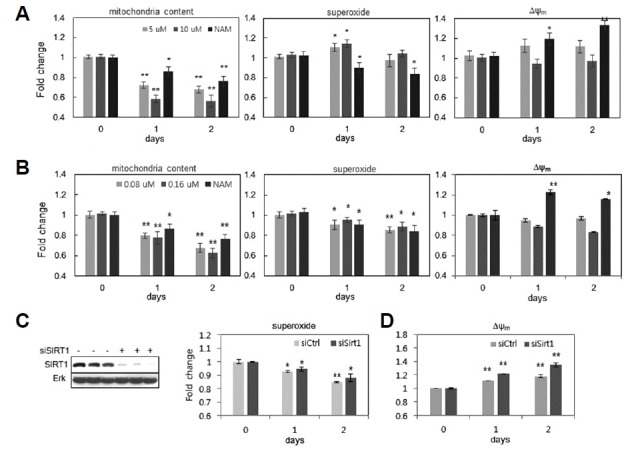
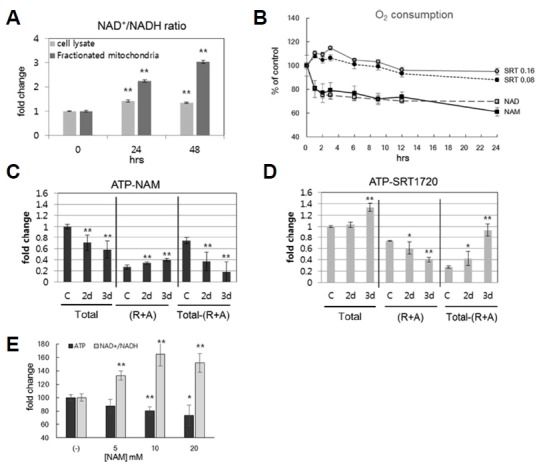
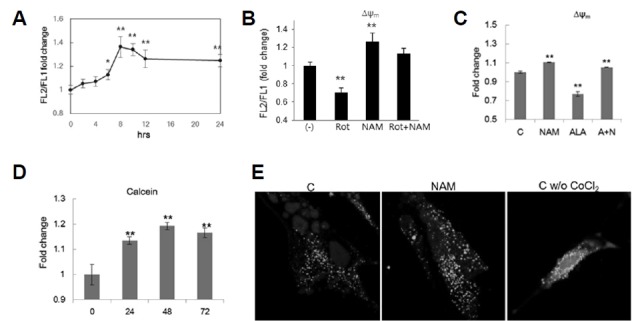
Nicotinamide (NAM) plays essential roles in physiology through facilitating NAD redox homeostasis. Importantly, at high doses, it protects cells under oxidative stresses, and has shown therapeutic effectiveness in a variety of disease conditions. In our previous studies, NAM lowered reactive oxygen species (ROS) levels and extended cellular life span in primary human cells. In the treated cells, levels of NAD/NADH and SIRT1 activity increased, while mitochondrial content decreased through autophagy activation. The remaining mitochondria were marked with low superoxide levels and high membrane potentials (Δψ); we posited that the treatment of NAM induced an activation of mitophagy that is selective for depolarized mitochondria, which produce high levels of ROS. However, evidence for the selective mitophagy that is mediated by SIRT1 has never been provided. This study sought to explain the mechanisms by which NAM lowers ROS levels and increases Δψ. Our results showed that NAM and SIRT1 activation exert quite different effects on mitochondrial physiology. Furthermore, the changes in ROS and Δψ were not found to be mediated through autophagy or SIRT activation. Rather, NAM suppressed superoxide generation via a direct reduction of electron transport, and increased Δψ via suppression of mitochondrial permeability transition pore formation. Our results dissected the effects of cellular NAD redox modulation, and emphasized the importance of the NAD/NADH ratio in the mitochondria as well as the cytosol in maintaining mitochondrial quality.
烟酰胺(NAM)通过促进NAD氧化还原稳态在生理学中发挥重要作用。重要的是,高剂量时,它能保护细胞免受氧化应激,并在多种疾病状况下显示出治疗效果。在我们之前的研究中,NAM降低了原代人类细胞中的活性氧(ROS)水平并延长了细胞寿命。在处理过的细胞中,NAD/NADH水平和SIRT1活性增加,而线粒体含量通过自噬激活而减少。剩余的线粒体具有低超氧化物水平和高膜电位(Δψ);我们推测,NAM处理诱导了对去极化线粒体具有选择性的线粒体自噬激活,而去极化线粒体产生高水平的ROS。然而,从未有证据表明存在由SIRT1介导的选择性线粒体自噬。本研究旨在解释NAM降低ROS水平并增加Δψ的机制。我们的结果表明,NAM和SIRT1激活对线粒体生理学产生截然不同的影响。此外,未发现ROS和Δψ的变化是通过自噬或SIRT激活介导的。相反,NAM通过直接减少电子传递来抑制超氧化物的产生,并通过抑制线粒体通透性转换孔的形成来增加Δψ。我们的结果剖析了细胞NAD氧化还原调节的作用,并强调了线粒体以及细胞质中NAD/NADH比值在维持线粒体质量方面的重要性。