Flatt Joanna F, Stevens-Hernandez Christian J, Cogan Nicola M, Eggleston Daniel J, Haines Nicole M, Heesom Kate J, Picard Veronique, Thomas Caroline, Bruce Lesley J
Bristol Institute for Transfusion Sciences, National Health Service (NHS) Blood and Transplant, Bristol, United Kingdom.
School of Biochemistry, University of Bristol, Bristol, United Kingdom.
Front Physiol. 2020 Apr 28;11:357. doi: 10.3389/fphys.2020.00357. eCollection 2020.
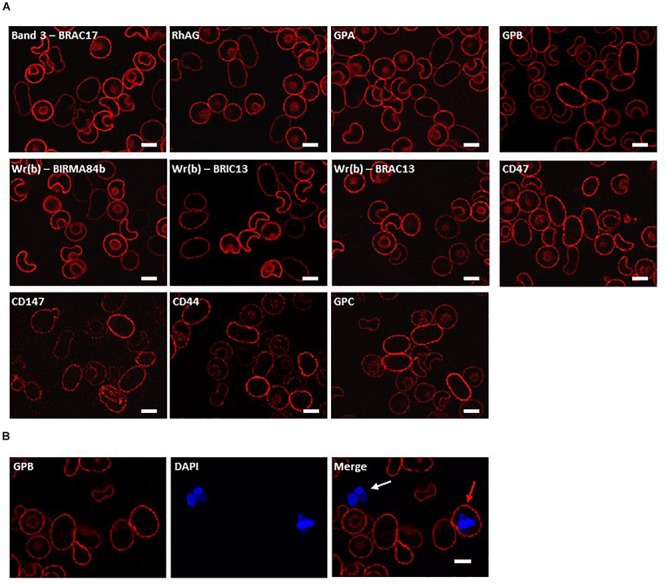
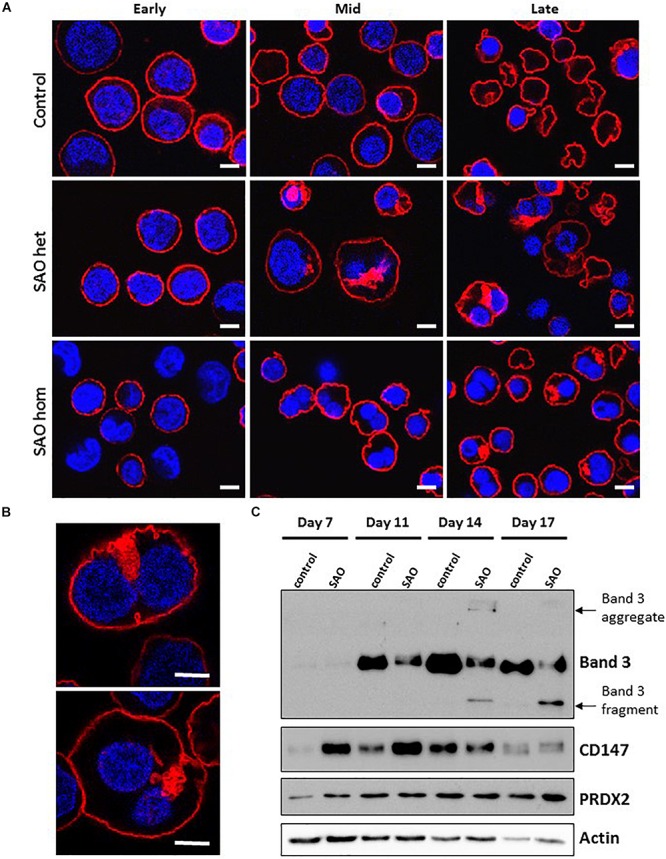
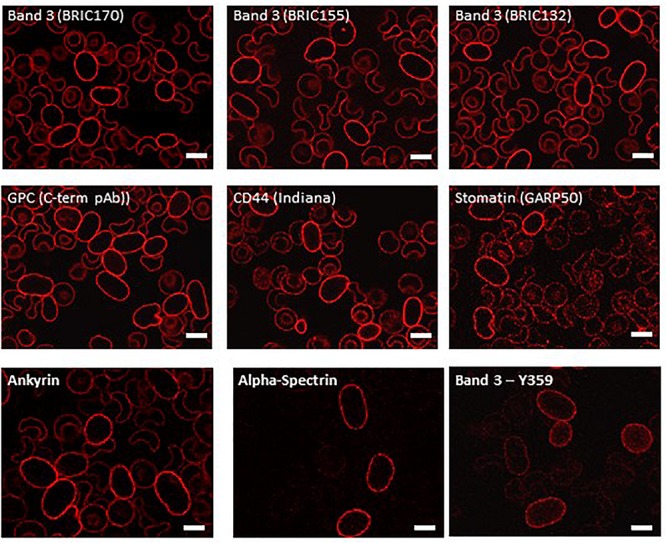
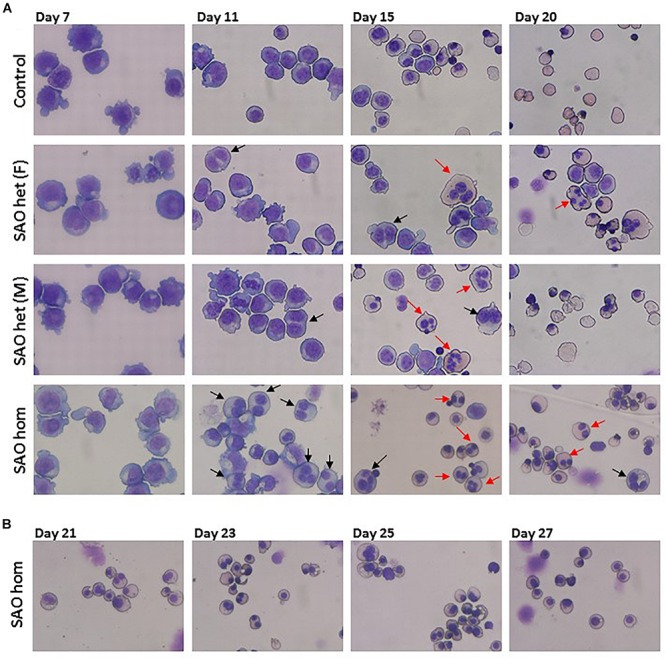
Southeast Asian Ovalocytosis results from a heterozygous deletion of 9 amino acids in the erythrocyte anion exchange protein AE1 (band 3). The report of the first successful birth of an individual homozygous for this mutation showed an association with severe dyserythropoietic anemia. Imaging of the proband's erythrocytes revealed the presence of band 3 at their surface, a reduction in Wr(b) antigen expression, and increases in glycophorin C, CD44, and CD147 immunoreactivity. Immunoblotting of membranes from heterozygous Southeast Asian Ovalocytosis red cells showed a quantitative increase in CD44, CD147, and calreticulin suggesting a defect in reticulocyte maturation, as well as an increase in phosphorylation at residue Tyr359 of band 3, and peroxiredoxin-2 at the membrane, suggesting altered band 3 trafficking and oxidative stress, respectively. culture of homozygous and heterozygous Southeast Asian Ovalocytosis erythroid progenitor cells produced bi- and multi-nucleated cells. Enucleation was severely impaired in the homozygous cells and reduced in the heterozygous cells. Large internal vesicular accumulations of band 3 formed, which co-localized with other plasma membrane proteins and with the autophagosome marker, LC3, but not with ER, Golgi or recycling endosome markers. Immunoprecipitation of band 3 from erythroblast cell lysates at the orthochromatic stage showed increased interaction of the mutant band 3 with heat shock proteins, ubiquitin and cytoskeleton proteins, ankyrin, spectrin and actin. We also found that the mutant band 3 forms a strong interaction with non-muscle myosins IIA and IIB, while this interaction could not be detected in wild type erythroblasts. Consistent with this, the localization of non-muscle myosin IIA and actin was perturbed in some Southeast Asian Ovalocytosis erythroblasts. These findings provide new insights toward understanding dyserythropoiesis caused by the expression of mutant membrane proteins.
东南亚椭圆形红细胞增多症是由于红细胞阴离子交换蛋白AE1(带3蛋白)发生9个氨基酸的杂合缺失所致。首例该突变纯合个体成功出生的报告显示其与严重的异常红细胞生成性贫血有关。对先证者红细胞的成像显示其表面存在带3蛋白,Wr(b)抗原表达减少,血型糖蛋白C、CD44和CD147免疫反应性增加。对杂合的东南亚椭圆形红细胞增多症红细胞膜进行免疫印迹分析显示,CD44、CD147和钙网蛋白的含量增加,提示网织红细胞成熟存在缺陷,同时带3蛋白第359位酪氨酸残基的磷酸化增加,膜上的过氧化物酶2增加,分别提示带3蛋白转运改变和氧化应激。纯合和杂合的东南亚椭圆形红细胞增多症红系祖细胞培养产生双核和多核细胞。纯合细胞的去核严重受损,杂合细胞的去核减少。形成了大量带3蛋白的内部囊泡聚集物,其与其他质膜蛋白和自噬体标志物LC3共定位,但不与内质网、高尔基体或再循环内体标志物共定位。对正染阶段成红细胞细胞裂解物中的带3蛋白进行免疫沉淀显示,突变的带3蛋白与热休克蛋白、泛素和细胞骨架蛋白、锚蛋白、血影蛋白和肌动蛋白的相互作用增加。我们还发现,突变的带3蛋白与非肌肉肌球蛋白IIA和IIB形成强烈相互作用,而在野生型成红细胞中未检测到这种相互作用。与此一致的是,一些东南亚椭圆形红细胞增多症成红细胞中非肌肉肌球蛋白IIA和肌动蛋白的定位受到干扰。这些发现为理解由突变膜蛋白表达引起的异常红细胞生成提供了新的见解。