Girelli Laura, Cavicchiolo Elisa, Alivernini Fabio, Manganelli Sara, Chirico Andrea, Galli Federica, Cozzolino Mauro, Lucidi Fabio
Department of Human, Philosophical, and Educational Sciences, University of Salerno, Salerno, Italy.
National Institute for the Evaluation of the Education System (INVALSI), Rome, Italy.
Front Psychol. 2020 Apr 28;11:663. doi: 10.3389/fpsyg.2020.00663. eCollection 2020.
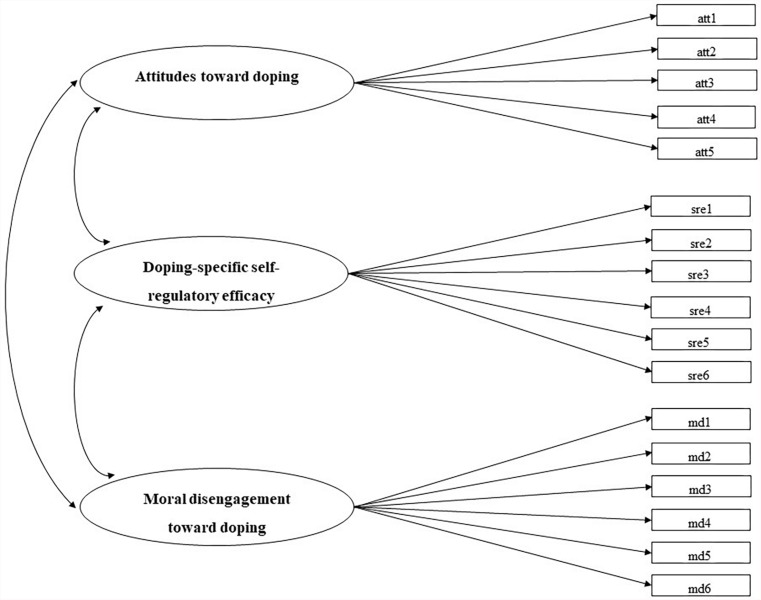
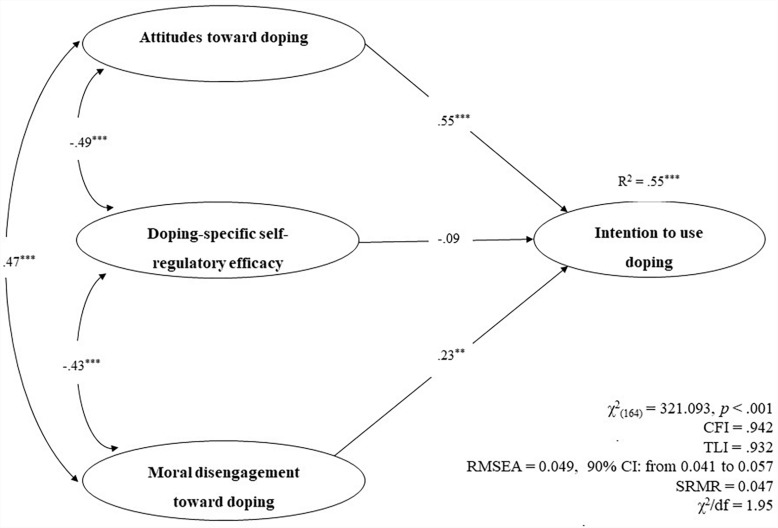
The main aim of this research was to test the factorial validity and measurement invariance across genders and countries of a set of instruments designed to assess high-school students' attitudes, self-regulatory efficacy, and moral disengagement with regard to doping. A second aim was to examine the criterion and predictive validity of these scales. In total, 402 high-school students from Italy, Romania, and Turkey (40.0, 25.1, and 34.9%, respectively; age 14.78 years old; SD = 1.04; 52.8% females) completed questionnaires measuring attitudes toward doping, self-regulatory efficacy in refraining from doping, doping-specific moral disengagement, and intention to use doping substances. A confirmatory factor analysis (CFA) supported our expectations with regard to the factor structure of the scales. Multigroup CFAs provided evidence for the full equivalence of the measures across males and females and partial equivalence of the measures across the three countries. The results of the latent mean comparison showed that male students had lower levels of self-regulatory efficacy than females and that Romanian and Turkish students had higher levels of moral disengagement and lower level of self-regulatory efficacy than Italian students. Finally, the results of a structural equation modeling supported the hypothesis that the proposed model predicted students' intentions to use doping, thus generally confirming the criterion and the predictive validity of the measures. These findings suggested the validity of a set of instruments measuring attitudes toward doping, self-regulatory efficacy to refrain from doping, and doping-specific moral disengagement in high-school students from a cross-gender and a cross-cultural perspective and provided meaningful estimates of the differences in the three factors between males and females as well as between Italian, Romanian, and Turkish high-school students.
本研究的主要目的是检验一套旨在评估高中生对使用兴奋剂的态度、自我调节效能以及道德推脱的工具在性别和国家之间的因素效度和测量不变性。第二个目的是检验这些量表的效标效度和预测效度。共有来自意大利、罗马尼亚和土耳其的402名高中生(分别占40.0%、25.1%和34.9%;年龄14.78岁;标准差=1.04;52.8%为女性)完成了测量对使用兴奋剂的态度、抵制使用兴奋剂的自我调节效能、特定于使用兴奋剂的道德推脱以及使用兴奋剂物质意图的问卷。验证性因素分析(CFA)支持了我们对量表因素结构的预期。多组CFA为男性和女性之间测量的完全等效性以及三个国家之间测量的部分等效性提供了证据。潜在均值比较的结果表明,男学生的自我调节效能水平低于女学生,罗马尼亚和土耳其学生的道德推脱水平高于意大利学生,自我调节效能水平低于意大利学生。最后,结构方程建模的结果支持了所提出的模型能够预测学生使用兴奋剂意图的假设,从而总体上证实了测量的效标效度和预测效度。这些发现表明,从跨性别和跨文化的角度来看,一套测量高中生对使用兴奋剂的态度、抵制使用兴奋剂的自我调节效能以及特定于使用兴奋剂的道德推脱的工具是有效的,并且提供了关于男性和女性以及意大利、罗马尼亚和土耳其高中生在这三个因素上差异的有意义估计。