Zang Hongjing, Peng Jinwu, Zheng Hongmei, Fan Songqing
Department of Pathology, The Second Xiangya Hospital, Central South University, Changsha, China.
Department of Pathology, Xiangya Basic Medical School, Central South University, Changsha, China.
Front Oncol. 2020 Apr 29;10:515. doi: 10.3389/fonc.2020.00515. eCollection 2020.
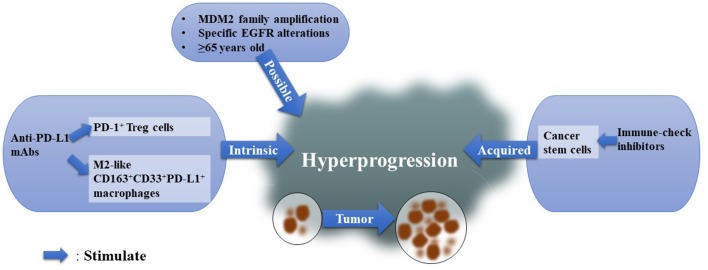
Immunotherapies in tumors have attracted increasing attention. They play an important role in precision medicine. Many immune-checkpoint inhibitors (ICIs) have obtained FDA approval and show good performance in the clinic. Hyperprogressive disease (HPD) after ICIs was first described in November 2016. Since then, a series of cases of HPD after ICIs have been reported. Notwithstanding that only a small subset of patients may experience this atypical response, HPD in affected patients means shorter survival times and worse prognoses. We summarized common standards for HPD diagnosis and profiled advantages and disadvantages. Elderly age, family amplification, infiltration of PD-1-positive regulatory effector T cells and M2-like macrophages, and cancer stem cells may take part in HPD occurrence. Overall, we should focus on investigating the early markers and pathogenic mechanisms of HPD to solve this issue in ICIs.
肿瘤免疫疗法已引起越来越多的关注。它们在精准医学中发挥着重要作用。许多免疫检查点抑制剂(ICI)已获得美国食品药品监督管理局(FDA)批准,并在临床上表现出良好效果。ICI治疗后出现的超进展性疾病(HPD)于2016年11月首次被描述。从那时起,陆续有ICI治疗后发生HPD的病例报道。尽管只有一小部分患者可能出现这种非典型反应,但受影响患者发生的HPD意味着生存时间缩短和预后更差。我们总结了HPD诊断的通用标准,并剖析了其优缺点。老年、基因扩增、PD-1阳性调节性效应T细胞和M2样巨噬细胞浸润以及癌症干细胞可能参与HPD的发生。总体而言,我们应着重研究HPD的早期标志物和致病机制,以解决ICI治疗中的这一问题。