Ciancia Sabrina, Cafarelli Andrea, Zahoranova Anna, Menciassi Arianna, Ricotti Leonardo
The BioRobotics Institute, Sant'Anna School of Advanced Studies, Pisa, Italy.
Departments of Excellence, Robotics & AI, Sant'Anna School of Advanced Studies, Pisa, Italy.
Front Bioeng Biotechnol. 2020 Apr 17;8:317. doi: 10.3389/fbioe.2020.00317. eCollection 2020.
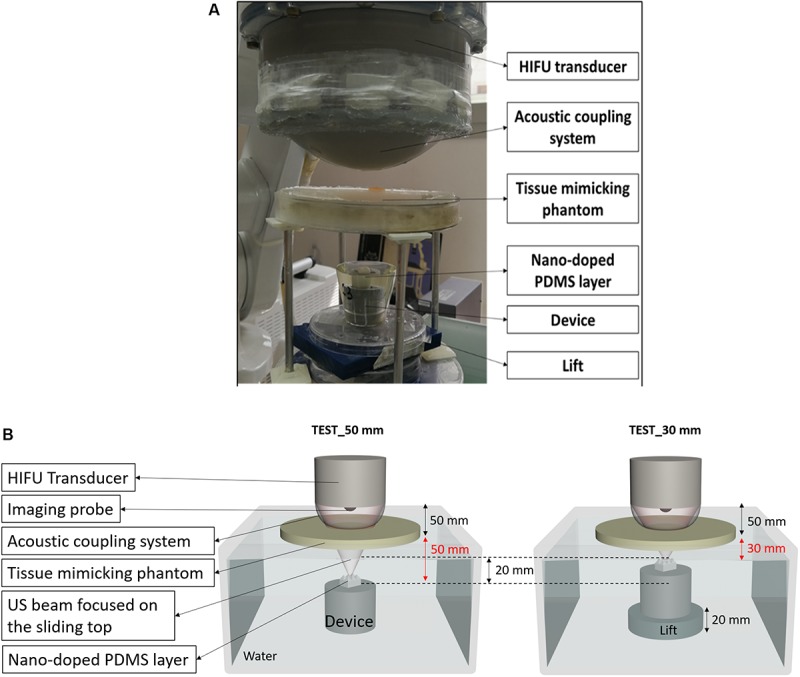
Since biological systems exhibit a circadian rhythm (24-hour cycle), they are susceptible to the timing of drug administration. Indeed, several disorders require a therapy that synchronizes with the onset of symptoms. A targeted therapy with spatially and temporally precise controlled drug release can guarantee a considerable gain in terms of efficacy and safety of the treatment compared to traditional pharmacological methods, especially for chronotherapeutic disorders. This paper presents a proof of concept of an innovative pulsatile drug delivery system remotely triggered by the acoustic radiation force of ultrasound. The device consists of a case, in which a drug-loaded gel can be embedded, and a sliding top that can be moved on demand by the application of an acoustic stimulus, thus enabling drug release. Results demonstrate for the first time that ultrasound acoustic radiation force (up to 0.1 N) can be used for an efficient pulsatile drug delivery (up to 20 μg of drug released for each shot).
由于生物系统呈现昼夜节律(24小时周期),它们易受给药时间的影响。事实上,几种疾病需要与症状发作同步的治疗方法。与传统药理学方法相比,具有空间和时间精确控制药物释放的靶向治疗可以在治疗的有效性和安全性方面保证显著提升,特别是对于时间治疗性疾病。本文展示了一种由超声声辐射力远程触发的创新型脉冲式药物输送系统的概念验证。该装置由一个可嵌入载药凝胶的外壳和一个可通过施加声刺激按需移动的滑动顶部组成,从而实现药物释放。结果首次证明超声声辐射力(高达0.1 N)可用于高效的脉冲式药物输送(每次注射释放高达20 μg药物)。