Giovannoni Moira, Gramegna Giovanna, Benedetti Manuel, Mattei Benedetta
Department of Life, Health and Environmental Sciences, University of L'Aquila, L'Aquila, Italy.
Front Bioeng Biotechnol. 2020 Apr 29;8:356. doi: 10.3389/fbioe.2020.00356. eCollection 2020.
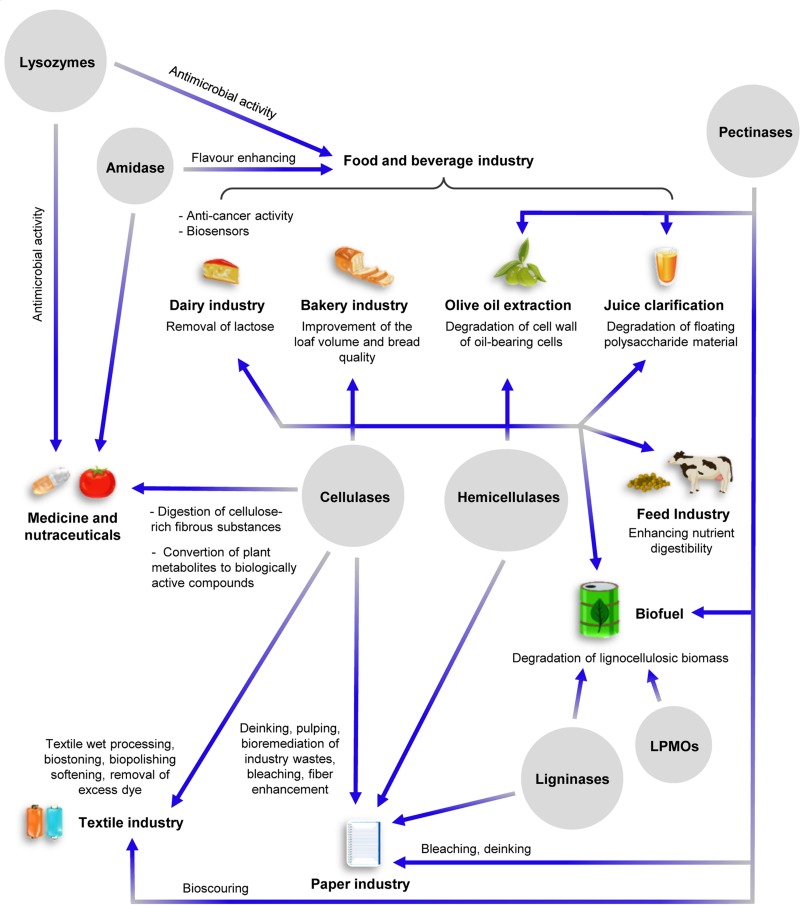
Cell Wall Degrading Enzymes (CWDEs) are a heterogeneous group of enzymes including glycosyl-hydrolases, oxidoreductases, lyases, and esterases. Microbes with degrading activities toward plant cell wall polysaccharides are the most relevant source of CWDEs for industrial applications. These organisms secrete a wide array of CWDEs in amounts strictly necessary for their own sustenance, nonetheless the production of CWDEs from wild type microbes can be increased at large-scale by using optimized fermentation strategies. In the last decades, advances in genetic engineering allowed the expression of recombinant CWDEs also in lab-domesticated organisms such as , yeasts and plants, dramatically increasing the available options for the large-scale production of CWDEs. The optimization of a CWDE-producing biofactory is a hard challenge that biotechnologists tackle by testing different expression strategies and expression-hosts. Although both the yield and production costs are critical factors to produce biomolecules at industrial scale, these parameters are often disregarded in basic research. This review presents the main characteristics and industrial applications of CWDEs directed toward the cell wall of plants, bacteria, fungi and microalgae. Different biofactories for CWDE expression are compared in order to highlight strengths and weaknesses of each production system and how these aspects impact the final enzyme cost and, consequently, the economic feasibility of using CWDEs for industrial applications.
细胞壁降解酶(CWDEs)是一类异质酶,包括糖基水解酶、氧化还原酶、裂解酶和酯酶。对植物细胞壁多糖具有降解活性的微生物是工业应用中CWDEs的最主要来源。这些生物体分泌大量自身生存所需的CWDEs,不过通过优化发酵策略,可以大规模提高野生型微生物CWDEs的产量。在过去几十年中,基因工程的进展使得重组CWDEs也能在实验室驯化的生物体(如酵母和植物)中表达,极大地增加了大规模生产CWDEs的可用选择。优化生产CWDEs的生物工厂是生物技术人员通过测试不同表达策略和表达宿主来应对的一项艰巨挑战。尽管产量和生产成本都是工业规模生产生物分子的关键因素,但在基础研究中这些参数常常被忽视。本综述介绍了针对植物、细菌、真菌和微藻细胞壁的CWDEs的主要特性和工业应用。比较了不同的CWDEs表达生物工厂,以突出每个生产系统的优缺点,以及这些方面如何影响最终的酶成本,进而影响将CWDEs用于工业应用的经济可行性。