Center for Genomics and Systems Biology, Department of Biology, New York University, New York, NY 10003.
Centro de Genómica y Bioinformática, Facultad de Ciencias, Universidad Mayor, Santiago 8580745, Chile.
Proc Natl Acad Sci U S A. 2020 Jun 9;117(23):12531-12540. doi: 10.1073/pnas.1918619117. Epub 2020 May 15.
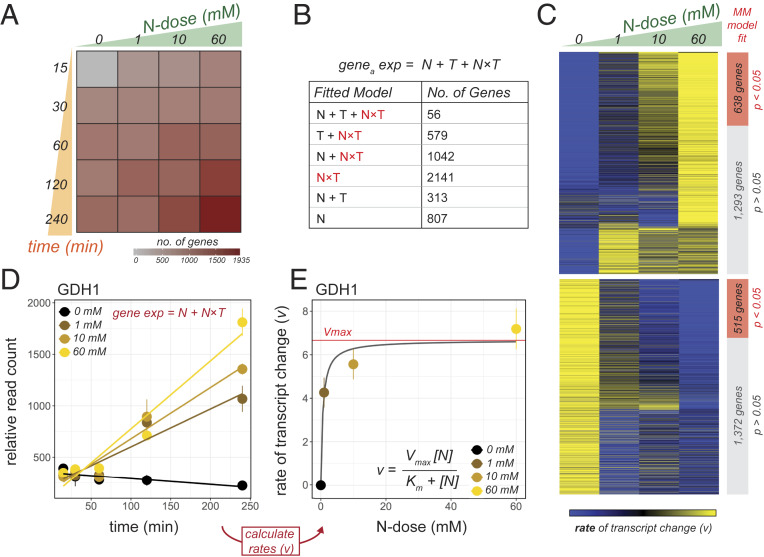
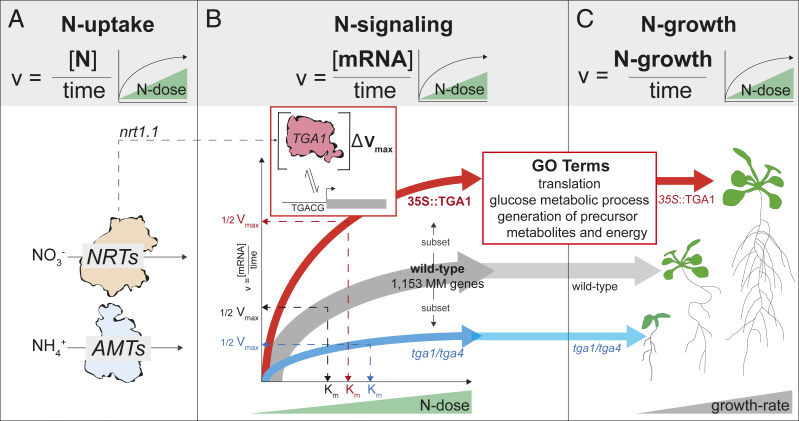
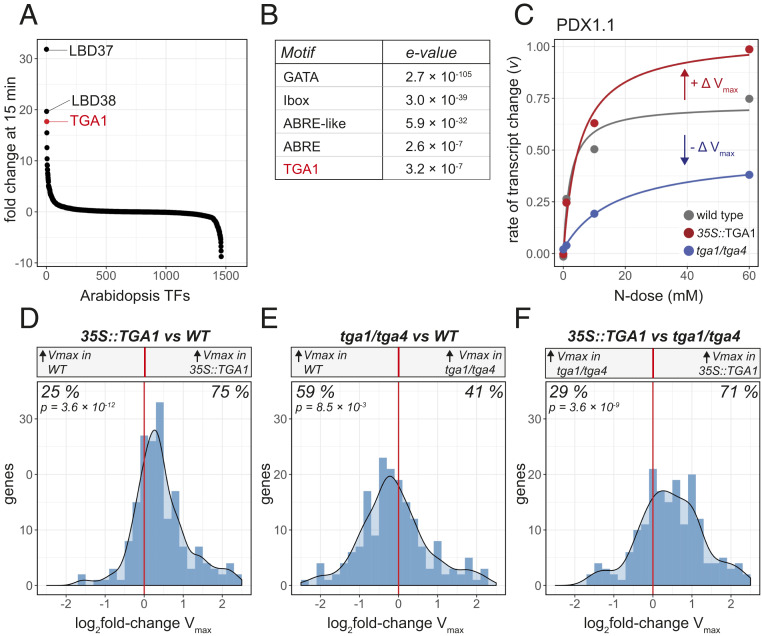
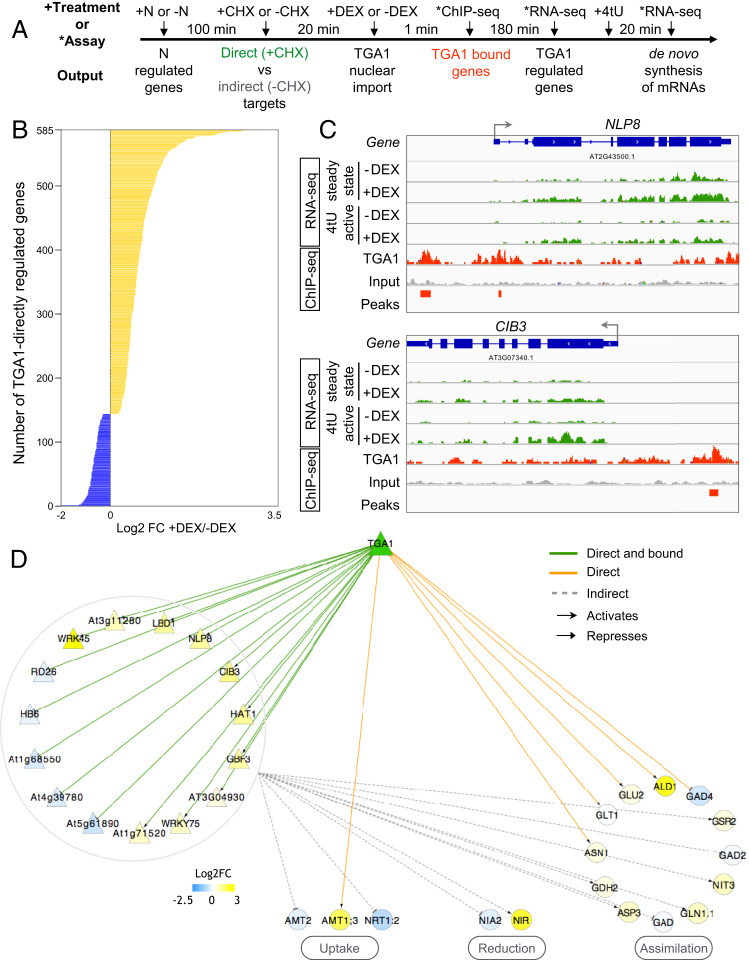
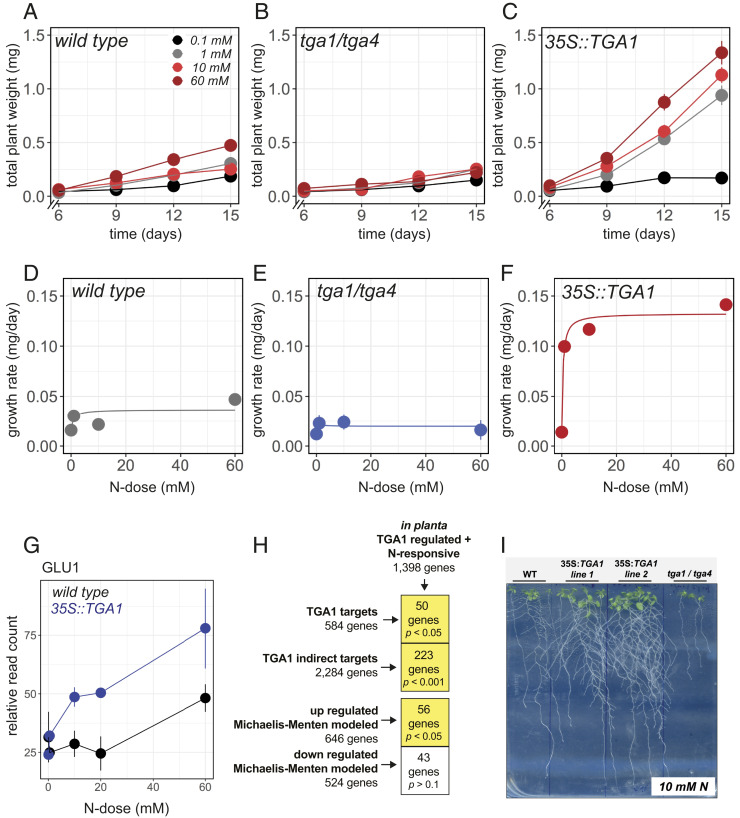
An increase in nutrient dose leads to proportional increases in crop biomass and agricultural yield. However, the molecular underpinnings of this nutrient dose-response are largely unknown. To investigate, we assayed changes in the root transcriptome to different doses of nitrogen (N)-a key plant nutrient-as a function of time. By these means, we found that rate changes of genome-wide transcript levels in response to N-dose could be explained by a simple kinetic principle: the Michaelis-Menten (MM) model. Fitting the MM model allowed us to estimate the maximum rate of transcript change (), as well as the N-dose at which one-half of was achieved () for 1,153 N-dose-responsive genes. Since transcription factors (TFs) can act in part as the catalytic agents that determine the rates of transcript change, we investigated their role in regulating N-dose-responsive MM-modeled genes. We found that altering the abundance of TGA1, an early N-responsive TF, perturbed the maximum rates of N-dose transcriptomic responses (), , as well as the rate of N-dose-responsive plant growth. We experimentally validated that MM-modeled N-dose-responsive genes included both direct and indirect TGA1 targets, using a root cell TF assay to detect TF binding and/or TF regulation genome-wide. Taken together, our results support a molecular mechanism of transcriptional control that allows an increase in N-dose to lead to a proportional change in the rate of genome-wide expression and plant growth.
养分剂量的增加会导致作物生物量和农业产量的相应增加。然而,这种养分剂量反应的分子基础在很大程度上是未知的。为了研究这一点,我们检测了不同氮(N)剂量下(一种关键的植物养分)根转录组随时间的变化。通过这些方法,我们发现,对 N 剂量的全基因组转录水平变化的速率变化可以用一个简单的动力学原理来解释:米氏-门捷列夫(MM)模型。拟合 MM 模型使我们能够估计转录变化的最大速率(),以及达到一半的 N 剂量(),对于 1153 个 N 剂量反应基因。由于转录因子(TFs)可以部分作为决定转录变化速率的催化因子发挥作用,我们研究了它们在调节 N 剂量反应 MM 模型基因中的作用。我们发现,改变早期 N 反应 TF TGA1 的丰度,会干扰 N 剂量转录组反应的最大速率(),以及 N 剂量响应植物生长的速率。我们使用根细胞 TF 测定法在全基因组范围内检测 TF 结合和/或 TF 调控,实验验证了 MM 模型化的 N 剂量反应基因包括直接和间接的 TGA1 靶标。综上所述,我们的结果支持了一种转录控制的分子机制,该机制允许 N 剂量的增加导致全基因组表达和植物生长速率的成比例变化。