Amity Institute of Biotechnology, Amity University, Uttar Pradesh, Sector-125, Noida, 201313, India.
National Institute of Biologicals, Plot No. A-32, Sector-62 Institutional Area, Noida, 201309, India.
Sci Rep. 2020 May 15;10(1):8053. doi: 10.1038/s41598-020-64997-z.
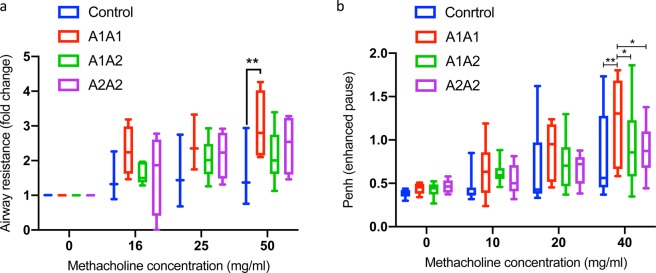
Milk is globally consumed as a rich source of protein and calcium. A major protein component of milk is casein, with β-casein having 2 major variants A1 and A2. Of these, A1 casein variant has been implicated as a potential etiological factor in several pathologies, but direct effect on lungs has not been studied. The objective of the present study was to evaluate the A1and A2 β casein variants of cow milk as factors causing allergic airway disease in murine model. Mice fed with A1A1 milk exhibited increased airway hyperresponsiveness with increasing concentration of bronchoconstrictor (methacholine), which was not observed in mice fed with A2A2 milk. Significantly elevated levels of IL-4 and IL-5 were found in bronchoalveolar lavage and serum of A1A1 variant fed mice. Increased IgE and IgG levels along with increased infiltration of lymphocytes and eosinophils, leading to peribronchial inflammation was also observed in A1A1 variant fed mice, although, no goblet cell hyperplasia or airway remodeling was observed. In contrast, A2A2 milk fed mice presented phenotype matching the control group, while A1A2 milk fed group presented an intermediate phenotype. In summary, our results show that A1 form of cow milk has a proinflammatory effect on the lung resulting in phenotype closely matching with the typical allergic asthma phenotype.
牛奶作为蛋白质和钙的丰富来源在全球范围内被消费。牛奶的主要蛋白质成分是酪蛋白,其中β-酪蛋白有 2 种主要变体 A1 和 A2。其中,A1 酪蛋白变体被认为是几种病理的潜在病因,但对肺部的直接影响尚未研究。本研究的目的是评估牛奶中的 A1 和 A2β-酪蛋白变体是否是引起小鼠模型中过敏性气道疾病的因素。用 A1A1 牛奶喂养的小鼠表现出气道高反应性增加,随着支气管收缩剂(乙酰甲胆碱)浓度的增加而增加,而用 A2A2 牛奶喂养的小鼠则没有观察到这种情况。在 A1A1 变体喂养的小鼠的支气管肺泡灌洗液和血清中发现了显著升高的 IL-4 和 IL-5 水平。在 A1A1 变体喂养的小鼠中还观察到 IgE 和 IgG 水平增加,淋巴细胞和嗜酸性粒细胞浸润增加,导致支气管周围炎症,尽管没有观察到杯状细胞增生或气道重塑。相比之下,用 A2A2 牛奶喂养的小鼠表现出与对照组匹配的表型,而用 A1A2 牛奶喂养的小鼠则表现出中间表型。总之,我们的结果表明,牛奶中的 A1 形式对肺部具有促炎作用,导致表型与典型的过敏性哮喘表型非常相似。