Sports Injury Centre, Safdarjung & VMMC, New Delhi 110029, India.
Department of Orthopaedics, PGIMER & Dr RML Hospital, New Delhi 110001, India.
Chin J Traumatol. 2020 Dec;23(6):341-345. doi: 10.1016/j.cjtee.2020.04.007. Epub 2020 Apr 30.
To avoid potential problems of double-bundle anterior cruciate ligament reconstruction (ACLR), various modifications have been reported. This study analyzed a novel technique of modified double-bundle (MDB) ACLR without implant on tibial side in comparison to single-bundle (SB) ACLR.
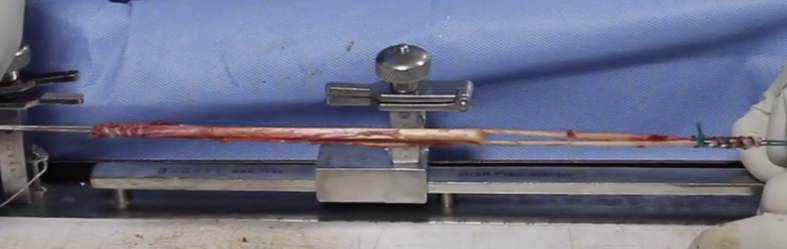
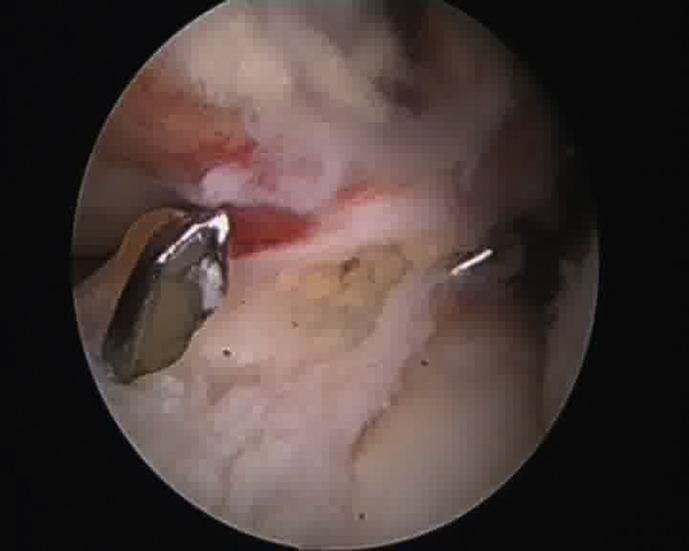
Eighty cases of isolated anterior cruciate ligament tear (40 each in SB group or MDB group) were included. SB ACLR was performed by outside in technique with quadrupled hamstring graft fixed with interference screws. In MDB group, ACLR harvested tendons were looped over each other at the center and free ends whipstitched. Femoral tunnel was created by outside in technique. Anteromedial tibial tunnel was created with tibial guide at 55°. The anatomic posterolateral aiming guide (Smith-Nephew) was used to create posterolateral tunnel. With the help of shuttle sutures, the free end of gracillis was passed through posterolateral tunnel to femoral tunnel followed by semitendinosus graft through anteromedial tunnel to femoral tunnel. On tibial side the graft was looped over bone-bridge between external apertures of anteromedial and posterolateral tunnel. Graft was fixed with interference screw on femoral side in 10° knee flexion. International Knee Documentation Committee (IKDC), Tegner score, Pivot shift and knee laxity test (KLT, Karl-Storz) were recorded pre- and post-surgery. At one year magnetic resonance imaging (MRI) was done. Statistical analysis was done by SPSS software.
Mean preoperative KLT reading of (10.00 ± 1.17) mm in MDB group improved to (4.10 ± 0.56) mm and in SB group it improved from (10.00 ± 0.91) mm to (4.80 ± 0.46) mm. The mean preoperative IKDC score in MDB group improved from (49.49 ± 8.00) to (92.5 ± 1.5) at one year and that in SB group improved from (52.5 ± 6.9) to (88.4 ± 2.6). At one-year 92.5% cases in MDB group achieved their preinjury Tegner activity level as compared to 60% in SB group. The improvement in IKDC, KLT and Tegner scale of MDB group was superior to SB group. MRI confirmed graft integrity at one year and clinically at 2 years.
MDB ACLR has shown better outcome than SB ACLR. It is a simple technique that does not require fixation on tibial side and resultant graft is close to native ACL.
为避免前交叉韧带重建(ACLR)双束的潜在问题,已经报道了各种改良方法。本研究分析了一种改良的双束(MDB)ACL 重建技术,该技术不使用胫骨侧植入物,与单束(SB)ACL 重建相比。
纳入 80 例孤立性前交叉韧带撕裂(SB 组或 MDB 组各 40 例)。采用四股腘绳肌腱 SB ACLR,采用外到内技术,用干扰螺钉固定。在 MDB 组,重建的 ACL 移植物在中心相互缠绕,游离端编织。采用外到内技术建立股骨隧道。采用胫骨导向器在 55°建立前内侧胫骨隧道。使用解剖后外侧瞄准导向器(Smith-Nephew)建立后外侧隧道。在 Shuttle 缝线的帮助下, gracillis 的游离端穿过后外侧隧道至股骨隧道,然后将半腱肌移植物穿过前内侧隧道至股骨隧道。在胫骨侧,移植物在前后外侧隧道外部开口之间的骨桥上缠绕。在 10°膝关节屈曲时,在股骨侧用干扰螺钉固定移植物。术前和术后记录国际膝关节文献委员会(IKDC)、Tegner 评分、膝关节旋转试验(KLT、Karl-Storz)和膝关节松弛试验(KLT)。术后 1 年行 MRI 检查。统计分析采用 SPSS 软件。
MDB 组术前 KLT 读数(10.00±1.17)mm 改善至(4.10±0.56)mm,SB 组从(10.00±0.91)mm 改善至(4.80±0.46)mm。MDB 组术前 IKDC 评分从(49.49±8.00)改善至 1 年时的(92.5±1.5),SB 组从(52.5±6.9)改善至(88.4±2.6)。术后 1 年,MDB 组 92.5%的病例恢复到受伤前的 Tegner 活动水平,而 SB 组为 60%。MDB 组在 IKDC、KLT 和 Tegner 评分方面的改善优于 SB 组。MRI 在术后 1 年和临床 2 年确认了移植物的完整性。
MDB ACLR 的结果优于 SB ACLR。它是一种简单的技术,不需要在胫骨侧固定,且重建的移植物更接近天然 ACL。