Department of Farm Animal Health, Faculty of Veterinary Medicine, Utrecht University, Utrecht, The Netherlands.
Sovon, Dutch Center for Field Ornithology, Nijmegen, The Netherlands.
Transbound Emerg Dis. 2021 Jan;68(1):76-87. doi: 10.1111/tbed.13595. Epub 2020 May 18.
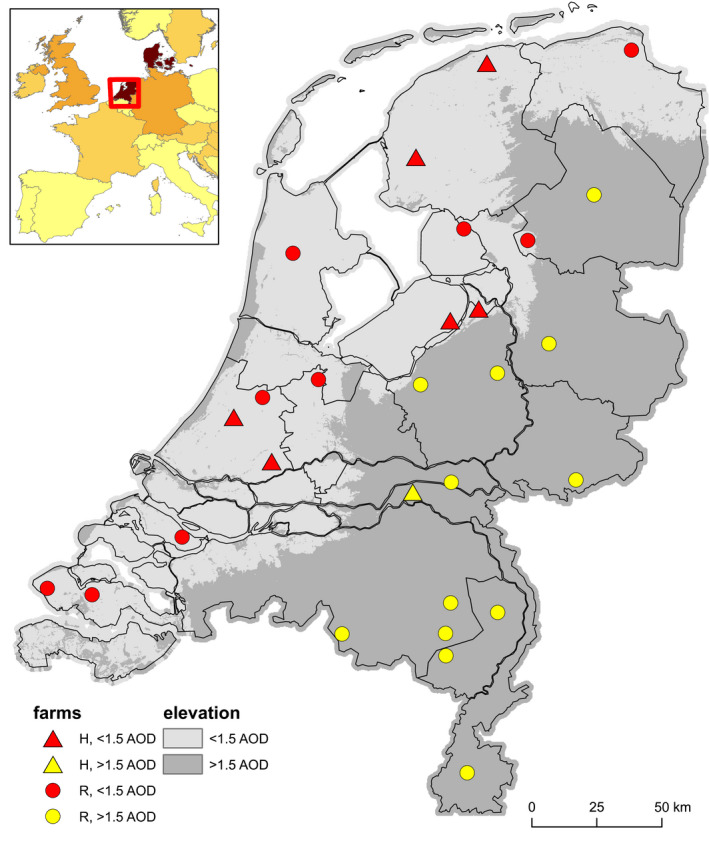
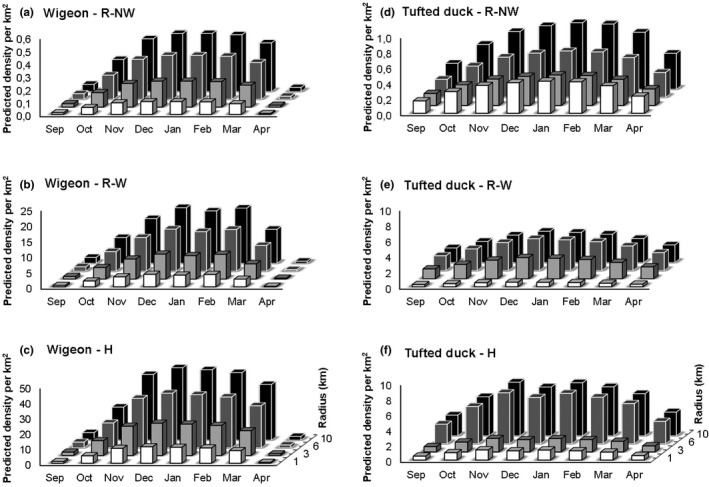
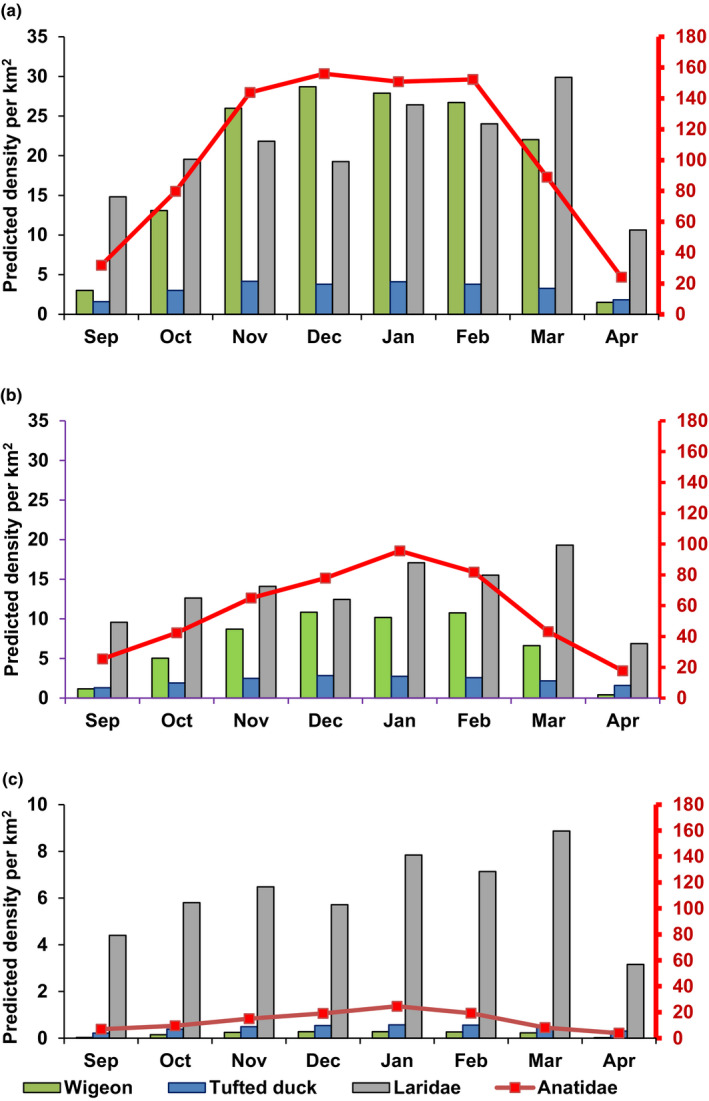
Highly pathogenic (HP) avian influenza viruses (AIV) can spread globally through migratory birds and cause massive outbreaks in commercial poultry. AIV outbreaks have been associated with proximity to waterbodies, presence of waterfowl or wild bird cases near poultry farms. In this study, we compared densities of selected HPAI high-risk wild bird species around 7 locations (H farms) infected with HPAIV H5N8 in the Netherlands in 2016-2017 to densities around 21 non-infected reference farms. Nine reference farms were in low-lying water-rich areas (R-W) and 12 in higher non-water-rich areas (R-NW). Average monthly numbers/km of Eurasian wigeons, tufted ducks, Anatidae (ducks, geese and swans) and Laridae (gulls) were calculated between September and April in rings of 0-1, 1-3, 3-6 and 6-10 km around the farms. Linear mixed model analyses showed generally higher bird densities for H and R-W compared to R-NW farms between October and March. This was most striking for Eurasian wigeons, with in peak month December 105 (95% CI:17-642) and 40 (7-214) times higher densities around H and R-W farms, respectively, compared to R-NW farms. Increased densities around H farms for Eurasian wigeons and Anatidae were more pronounced for distances up to 10 km compared to 0-1 km that mostly consists of the farm yard, which is an unattractive habitat for waterfowl. This distance effect was not observed in gulls, nor in tufted ducks that live on large open waterbodies which are unlikely to be within 0-1 km of farms. This study provides insights into spatio-temporal density dynamics of HPAI high-risk birds around farms and their associations with poultry outbreaks. The outcomes indicate that knowledge of environmental and ecological drivers for wild bird presence and abundance may facilitate identification of priority areas for surveillance and biosecurity measures and decisions on establishments of poultry farms to reduce risk of HPAI outbreaks.
高致病性(HP)禽流感病毒(AIV)可通过候鸟在全球传播,并导致商业家禽大规模爆发。AIV 爆发与靠近水体、水禽或野鸟病例靠近家禽养殖场有关。在这项研究中,我们比较了 2016-2017 年在荷兰感染 HPAIV H5N8 的 7 个地点(H 农场)周围选定的高风险野生鸟类物种的密度与 21 个未感染的参考农场周围的密度。9 个参考农场位于低水位富水地区(R-W),12 个位于较高非富水地区(R-NW)。在 9 月至 4 月期间,计算了农场周围 0-1、1-3、3-6 和 6-10 公里环内欧亚泽鹬、绒鸭、鸭科(鸭、鹅和天鹅)和 Laridae(海鸥)的每月平均数量/km。线性混合模型分析表明,与 R-NW 农场相比,H 和 R-W 农场在 10 月至 3 月期间鸟类密度普遍较高。这在欧亚泽鹬中最为明显,12 月高峰期 H 和 R-W 农场周围的密度分别比 R-NW 农场高 105 倍(95%CI:17-642)和 40 倍(7-214)。与 0-1 公里的农场院子相比,H 农场周围欧亚泽鹬和鸭科鸟类的密度增加更为明显,距离可达 10 公里,而 0-1 公里主要是不吸引水禽的栖息地。这种距离效应在海鸥或生活在大型开阔水体上的绒鸭中并未观察到,因为这些水体不太可能在 0-1 公里范围内。本研究提供了有关农场周围高致病性 AIV 高风险鸟类的时空密度动态及其与家禽爆发的关联的见解。研究结果表明,了解野生鸟类存在和丰度的环境和生态驱动因素可能有助于确定优先进行监测和生物安全措施的区域,并就建立家禽农场做出决策,以降低高致病性 AIV 爆发的风险。