Chen Zisheng, Xiong Shan, Li Jianfu, Ou Limin, Li Caichen, Tao Jinsheng, Jiang Zeyu, Fan Jianbing, He Jianxing, Liang Wenhua
Department of Respiratory Medicine, The Sixth Affiliated Hospital of Guangzhou Medical University, Qingyuan People's Hospital, Qingyuan 511518, China.
Department of Thoracic Surgery and Oncology, First Affiliated Hospital of Guangzhou Medical University, State Key Laboratory of Respiratory Disease and National Clinical Research Centre for Respiratory Disease, Guangzhou 510120, China.
Transl Lung Cancer Res. 2020 Apr;9(2):280-287. doi: 10.21037/tlcr.2020.03.13.
Lymph node (LN) metastasis status is the most important prognostic factor and determines treatment strategy. Methylation alteration is an optimal candidate to trace the signal from early stage tumors due to its early existence, multiple loci and stability in blood. We built a diagnostic tool to screen and identify a set of plasma methylation markers in early stage occult LN metastasis.
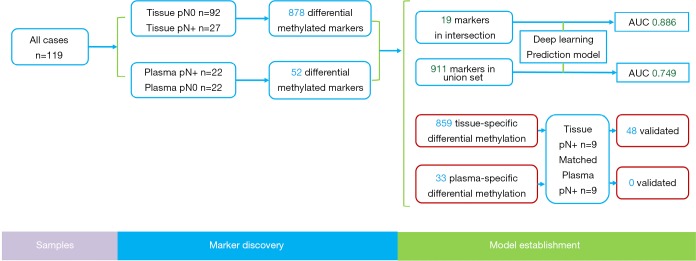
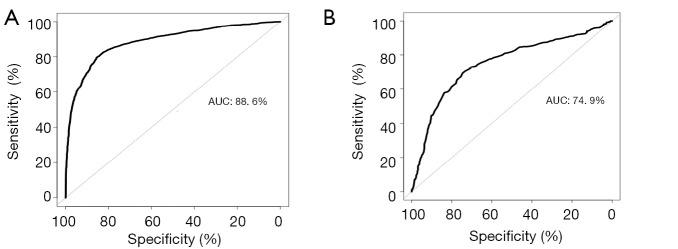
High-throughput targeted methylation sequencing was performed on tissue and matched plasma samples from a cohort of 119 non-small cell lung cancer (NSCLC) patients with a primary lesion of less than 3.0 cm in diameter. The methylation profiles were compared between patients with and without occult LN metastases. We carried out a set of machine-learning analyses on our discovery cohort to evaluate the utility of cell free DNA methylation profiles in early detection of LN metastasis. Two preliminary prognostic models predictive of LN metastasis were built by random forest with differentially methylated markers shared by plasma and tissue samples and markers present either in plasma or tissue samples respectively. The performance of these models was then evaluated using receiver operating characteristic (ROC) statistics derived from ten-fold cross validation repeated ten times.
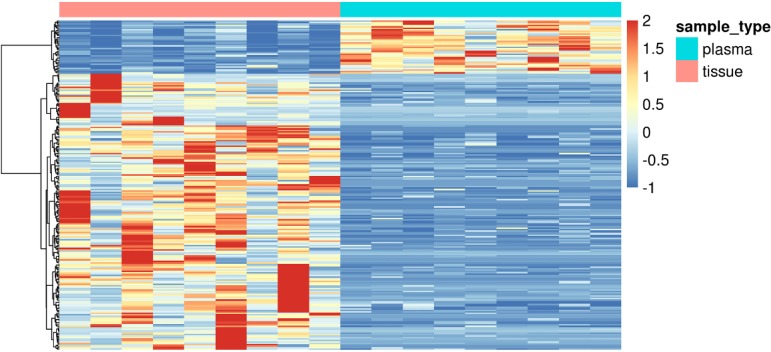
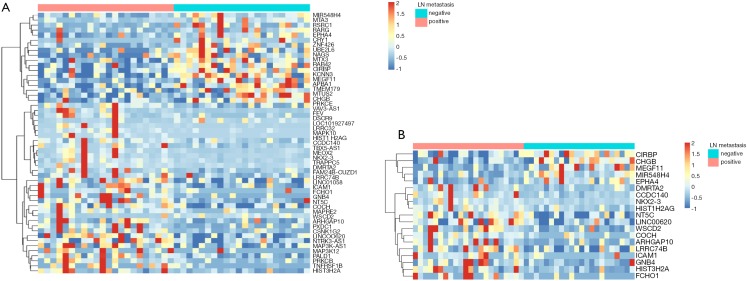
Within this cohort, 27 cases (27/119, 22.7%) were found to have occult LN metastases found by pathological examination. Compared with those without metastases, 878 and 52 genes were differentially methylated in terms of tissue (, etc.) and plasma (, etc.) respectively. 19 of these genes (, etc.) were overlapped. We selected 22 pairs of cases with or without occult LN metastasis by matching gender, age, smoking history and tumor histology to build and test the plasma model. The AUC of the preliminary prediction model using markers shared by plasma and tissue samples and markers present either in plasma or tissue samples is 88.6% (95% CI, 87.8-89.4%) and 74.9% (95% CI, 72.2-77.6%) respectively.
We identified a set of specific plasma methylation markers for early occult LN metastasis of NSCLC and established a preliminary non-invasive blood diagnostic tool.
淋巴结(LN)转移状态是最重要的预后因素,并决定治疗策略。甲基化改变因其早期存在、多个位点以及在血液中的稳定性,是追踪早期肿瘤信号的最佳候选指标。我们构建了一种诊断工具,用于筛查和识别早期隐匿性LN转移中的一组血浆甲基化标志物。
对119例直径小于3.0 cm原发性病变的非小细胞肺癌(NSCLC)患者的组织和匹配血浆样本进行高通量靶向甲基化测序。比较有和无隐匿性LN转移患者的甲基化谱。我们对发现队列进行了一系列机器学习分析,以评估游离DNA甲基化谱在早期检测LN转移中的效用。通过随机森林构建了两个预测LN转移的初步预后模型,分别使用血浆和组织样本共有的差异甲基化标志物以及仅存在于血浆或组织样本中的标志物。然后使用十次重复十折交叉验证得出的受试者工作特征(ROC)统计量评估这些模型的性能。
在该队列中,经病理检查发现27例(27/119,22.7%)有隐匿性LN转移。与无转移患者相比,组织(如等)和血浆(如等)中分别有878个和52个基因差异甲基化。其中19个基因(如等)重叠。我们通过匹配性别、年龄、吸烟史和肿瘤组织学,选择了22对有或无隐匿性LN转移的病例来构建和测试血浆模型。使用血浆和组织样本共有的标志物以及仅存在于血浆或组织样本中的标志物的初步预测模型的AUC分别为88.6%(95%CI,87.8 - 89.4%)和74.9%(95%CI,72.2 - 77.6%)。
我们鉴定出一组用于NSCLC早期隐匿性LN转移的特异性血浆甲基化标志物,并建立了一种初步的非侵入性血液诊断工具。