Department of Environmental and Occupational Health and Safety, Institute of Public Health, College of Medicine and Health Sciences, University of Gondar, Ethiopia.
Biomed Res Int. 2020 Apr 26;2020:6152612. doi: 10.1155/2020/6152612. eCollection 2020.
Occupational injuries pose a major public health and socioeconomic developmental problems. Globally, 160 million people encounter occupational injuries; the International Labour Organization estimates that the cost is 4 of the global gross domestic product (GDP) or 1.25 trillion United States Dollar (USD). The second-largest number of occupational injuries was reported from the construction industries. There are limited studies about the prevalence and factors associated with occupational injuries among dam construction workers in Ethiopia. Hence, this study was undertaken to determine the prevalence and associated factors of occupational injury among Genale Dawa hydropower dam construction workers.
Institutional-based cross-sectional study was conducted in Genale Dawa 3D hydropower dam construction project from April 1 to 22, 2018. Four hundred and five workers were included in the study. An Oromiffa version pretested, semistructured questionnaire was used to collect data. Data were entered into Epi-info version 7, and analysis was done using SPSS version 20 software. Bivariable and multivariate binary logistic regression was used to see the association between predictors and the dependent variable. The 95% CI and adjusted odds ratio with a value of 0.05 was used to fit the final model.
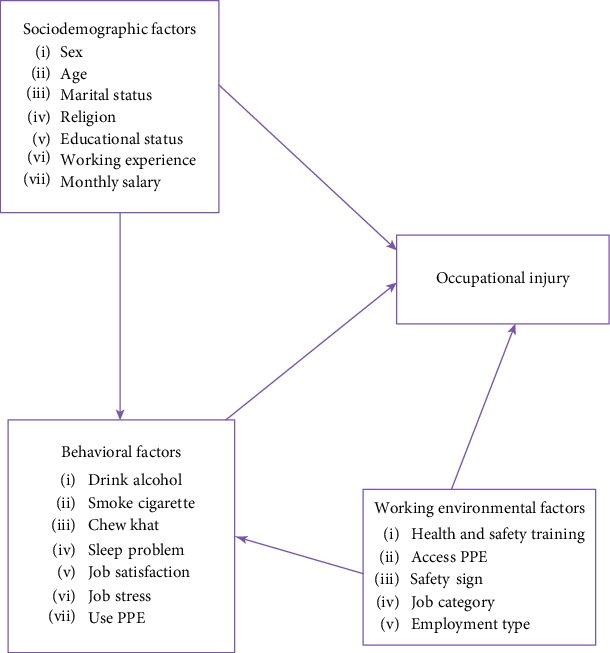
The prevalence of occupational injuries in the earlier 12 months before the study was 57.8% with (95% CI (52.8, 62.7)). Age, educational status, alcohol consumption, job stress, work shift, and working hours per week were factors significantly associated with occupational injury. . Occupational injuries were common among dam construction workers. Conducting regular monitoring of substance abuse, avoiding overtime work, rotation of the work shift, and considering age and the educational status during employee recruitment can be effective to decrease the prevalence of occupational injuries.
职业伤害是一个主要的公共卫生和社会经济发展问题。在全球范围内,有 1.6 亿人遭遇职业伤害;国际劳工组织估计,其成本占全球国内生产总值(GDP)的 4%,即 1.25 万亿美元。报告的职业伤害数量第二多的是建筑行业。关于埃塞俄比亚大坝建筑工人职业伤害的流行率和相关因素,研究有限。因此,本研究旨在确定 Genale Dawa 水电站大坝建筑工人职业伤害的流行率和相关因素。
2018 年 4 月 1 日至 22 日,在 Genale Dawa 3D 水电站建设项目中进行了基于机构的横断面研究。共有 405 名工人被纳入研究。使用经过奥罗莫语测试的半结构式预测试问卷收集数据。将数据输入 Epi-info 版本 7,并使用 SPSS 版本 20 软件进行分析。使用双变量和多变量二元逻辑回归来观察预测因子与因变量之间的关联。使用 95%CI 和调整后的比值比( 值为 0.05)来拟合最终模型。
在研究前的 12 个月内,职业伤害的流行率为 57.8%(95%CI(52.8,62.7))。年龄、教育程度、饮酒、工作压力、工作班次和每周工作小时数是与职业伤害显著相关的因素。职业伤害在大坝建筑工人中很常见。定期监测物质滥用、避免加班、轮班工作以及在招聘员工时考虑年龄和教育程度,可以有效降低职业伤害的流行率。