ASST Fatebenefratelli - Sacco.
.
Acta Biomed. 2020 May 11;91(2):297-304. doi: 10.23750/abm.v91i2.8608.
The incidence of periprostethic femur fractures has increased over the last years; the treatment includes an open reduction and internal fixation or revision implant. The treatment of these fractures can be complex, expensive and associated with risks of systemic and local complications.
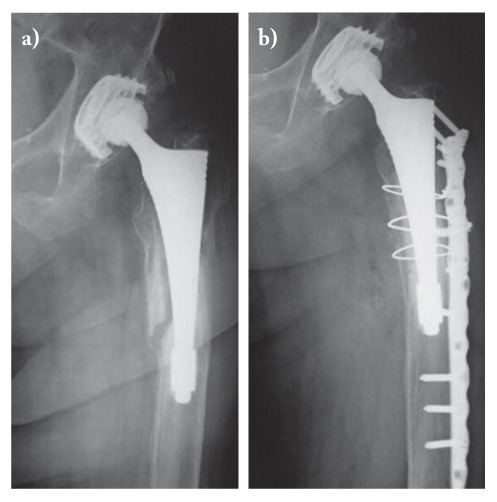
We evaluated clinical and radiological results in patients treated in our department for periprosthetic femoral fractures from 2011 to 2017. We included 52 cases of periprosthetic fractures regardless of their classification with a mean follow-up of 2 years. The analisys of the result was performed using Harris Hip Score and searching for radiographic signs of loosening, infections or mechanical failure of the implants.
There was no evidence of septic complications or mechanical failure in cases treated. The average HHS was equal to 92 points with a certificate pain relief and a sufficient independence in daily living activities.
The treatment of periprosthetic fractures is complex: it depends on type of fracture, on stability of the stem and on the bone quality. A right classification of the fractures, a good experience of the surgeon in prosthetic and trauma surgery is the basis for the best treatment.
近年来,人工假体周围股骨骨折的发病率有所增加;其治疗方法包括切开复位内固定或翻修植入物。这些骨折的治疗可能很复杂,费用高昂,并伴有全身和局部并发症的风险。
我们评估了 2011 年至 2017 年期间在我科治疗的人工假体周围股骨骨折患者的临床和影像学结果。我们纳入了 52 例人工假体周围骨折,无论其分类如何,平均随访 2 年。使用 Harris 髋关节评分分析结果,并寻找假体松动、感染或机械故障的放射学迹象。
治疗的病例均无感染性并发症或机械故障的证据。平均 HHS 等于 92 分,疼痛缓解,日常生活活动有足够的独立性。
人工假体周围骨折的治疗较为复杂:它取决于骨折的类型、柄的稳定性和骨的质量。正确的骨折分类、外科医生在假体和创伤外科方面的丰富经验是获得最佳治疗效果的基础。