Department of Medical, Oral and Biotechnological Sciences, University "Gabriele d'Annunzio", Chieti-Pescara, Chieti, Italy.
Department of Medicine and Aging Sciences, University "Gabriele d'Annunzio", Chieti-Pescara, Chieti, Italy.
Am J Hypertens. 2020 Aug 4;33(8):726-733. doi: 10.1093/ajh/hpaa078.
Masked uncontrolled hypertension (MUCH), that is, nonhypertensive clinic but high out-of-office blood pressure (BP) in treated patients is at increased cardiovascular risk than controlled hypertension (CH), that is, nonhypertensive clinic and out-of-office BP. Using ambulatory BP, MUCH can be defined as daytime and/or nighttime and/or 24-hour BP above thresholds. It is unclear whether different definitions of MUCH have similar prognostic information. This study assessed the prognostic value of MUCH defined by different ambulatory BP criteria.
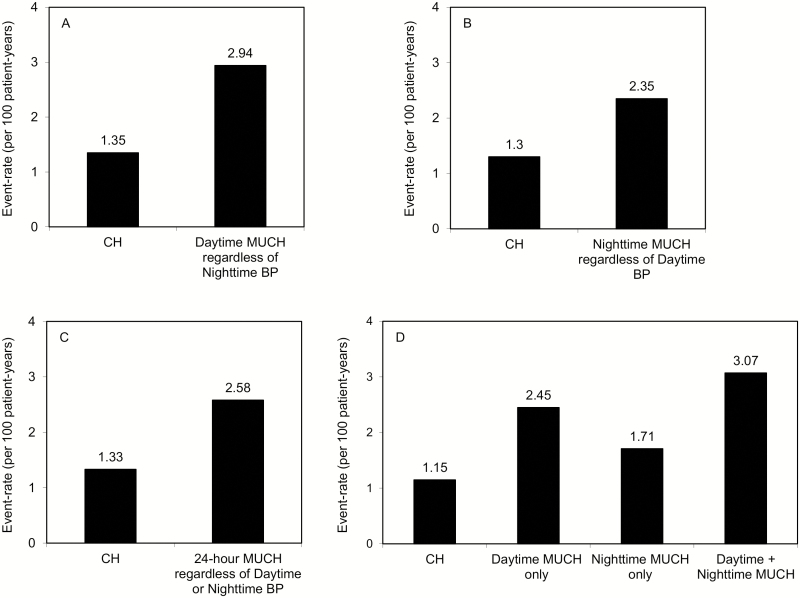
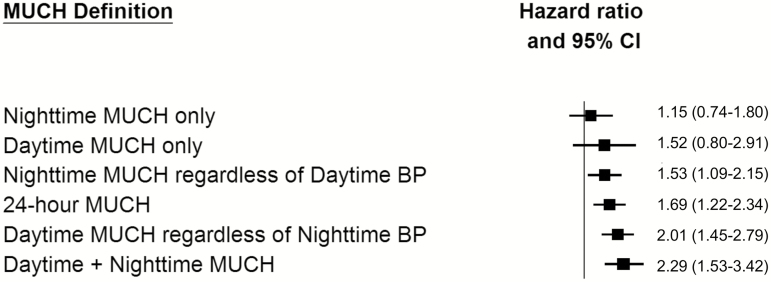
Cardiovascular events were evaluated in 738 treated hypertensive patients with nonhypertensive clinic BP. Among them, participants were classified as having CH or daytime MUCH (BP ≥135/85 mm Hg) regardless of nighttime BP (group 1), nighttime MUCH (BP ≥120/70 mm Hg) regardless of daytime BP (group 2), 24-hour MUCH (BP ≥130/80 mm Hg) regardless of daytime or nighttime BP (group 3), daytime MUCH only (group 4), nighttime MUCH only (group 5), and daytime + nighttime MUCH (group 6).
We detected 215 (29%), 357 (48.5%), 275 (37%), 42 (5.5%),184 (25%) and 173 (23.5%) patients with MUCH from group 1 to 6, respectively. During the follow-up (10 ± 5 years), 148 events occurred in patients with CH and MUCH. After adjustment for covariates, compared with patients with CH, the adjusted hazard ratio (95% confidence interval) for cardiovascular events was 2.01 (1.45-2.79), 1.53 (1.09-2.15), 1.69 (1.22-2.34), 1.52 (0.80-2.91), 1.15 (0.74-1.80), and 2.29 (1.53-3.42) from group 1 to 6, respectively.
The prognostic impact of MUCH defined according to various ambulatory BP definitions may be different.
被掩盖的未控制高血压(MUCH),即诊室血压不高但治疗患者的诊室外血压高,心血管风险高于控制良好的高血压(CH),即诊室血压和诊室外血压均不高。使用动态血压,MUCH 可定义为日间和/或夜间和/或 24 小时血压高于阈值。目前尚不清楚不同 MUCH 定义是否具有相似的预后信息。本研究评估了不同动态血压标准定义的 MUCH 的预后价值。
在 738 例诊室血压不高的高血压患者中评估心血管事件。其中,无论夜间血压如何,参与者均被分类为 CH 或日间 MUCH(BP≥135/85mmHg)(第 1 组),无论日间血压如何,均被分类为夜间 MUCH(BP≥120/70mmHg)(第 2 组),无论日间或夜间血压如何,均被分类为 24 小时 MUCH(BP≥130/80mmHg)(第 3 组),仅日间 MUCH(第 4 组),仅夜间 MUCH(第 5 组)和日间+夜间 MUCH(第 6 组)。
我们分别从第 1 至 6 组检测到 215(29%)、357(48.5%)、275(37%)、42(5.5%)、184(25%)和 173(23.5%)例 MUCH 患者。在随访期间(10±5 年),CH 合并 MUCH 的患者发生 148 例事件。在调整协变量后,与 CH 患者相比,第 1 至 6 组心血管事件的调整后的危险比(95%置信区间)分别为 2.01(1.45-2.79)、1.53(1.09-2.15)、1.69(1.22-2.34)、1.52(0.80-2.91)、1.15(0.74-1.80)和 2.29(1.53-3.42)。
根据不同的动态血压定义定义的 MUCH 的预后影响可能不同。