Department of Social Medicine and Health Management, Xiangya School of Public Health, Central South University, Changsha 410078, Hunan, China.
Department of Urban-Global Public Health, Rutgers School of Public Health, Rutgers University, Newark, NJ 07102, USA.
Int J Environ Res Public Health. 2020 May 14;17(10):3414. doi: 10.3390/ijerph17103414.
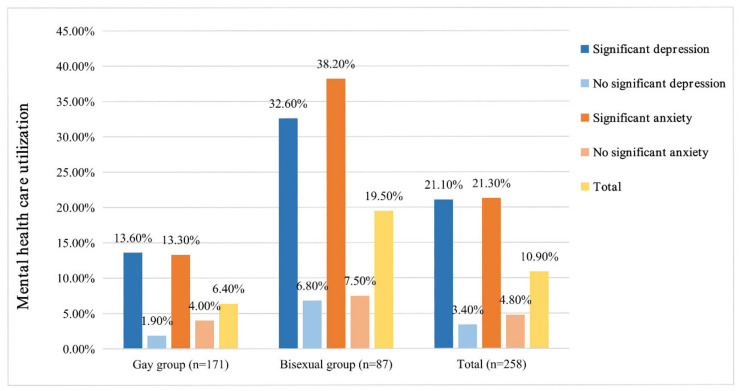
This study aimed to determine the change in mental health (depression and anxiety) among HIV-positive gay and bisexual men (GBM) one year after diagnosis and the disparities in trajectories of mental health between them. The potential factors contributing to the disparities were also investigated. This was a one-year follow-up study focusing on the mental health of newly diagnosed HIV-positive individuals. Participants rated their depression, anxiety, stress, and social support levels at baseline and one year later. Information on the utilization of mental healthcare and the initiation of antiretroviral therapy (ART) after diagnosis was collected at one-year follow-up. A total of 171 and 87 HIV-positive gay and bisexual men, respectively, completed two-time points surveys in this study. The depressive and anxiety symptoms experienced by HIV-positive GBM improvement one year after diagnosis. These improvements tended to be smaller in gay participants. Other factors including mental health care utilization and ART status during the one-year follow-up period, changes in social stress scores and objective social support scores were also associated with the changes in depression and anxiety, and all these factors, except for change in objective support, were found to be statistically different between HIV-positive GBM. Special attention should be given to the mental health of HIV-positive gay men. Promoting HIV-positive gay men to assess to mental health services and ART may be important for these populations to improve mental health. Enhancing social support and reducing stress levels may also be necessary for the vulnerable HIV-positive sexual minority groups.
本研究旨在确定 HIV 阳性男同性恋和双性恋者(GBM)在诊断后一年心理健康(抑郁和焦虑)的变化,以及他们之间心理健康轨迹的差异。还调查了导致差异的潜在因素。这是一项为期一年的随访研究,重点关注新诊断的 HIV 阳性个体的心理健康。参与者在基线和一年后评估他们的抑郁、焦虑、压力和社会支持水平。在一年的随访中收集了有关心理健康保健的使用情况以及诊断后开始抗逆转录病毒治疗(ART)的信息。共有 171 名和 87 名 HIV 阳性男同性恋和双性恋者分别完成了这项研究的两次调查。HIV 阳性 GBM 在诊断后一年的抑郁和焦虑症状有所改善。同性恋参与者的改善趋势较小。其他因素包括在一年随访期间的心理健康保健利用和 ART 状况、社会压力评分和客观社会支持评分的变化,与抑郁和焦虑的变化相关,除了客观支持的变化外,所有这些因素在 HIV 阳性 GBM 之间均存在统计学差异。应特别关注 HIV 阳性男同性恋者的心理健康。促进 HIV 阳性男同性恋者评估心理健康服务和 ART 可能对这些人群改善心理健康很重要。增强社会支持和降低压力水平对于脆弱的 HIV 阳性少数性群体也是必要的。