Institute of Basic Medical Sciences, Chinese Academy of Medical Sciences / School of Basic Medicine, Peking Union Medical College, Beijing, 100005, China.
School of Public Health & Management, Ningxia Medical University, Yinchuan, 750004, Ningxia, China.
Nutr J. 2020 May 18;19(1):45. doi: 10.1186/s12937-020-00564-6.
To explore the gender differences in the relationship between dietary energy and macronutrients intake and body weight outcomes in Chinese adults.
Data from the China Health and Nutrition Survey (CHNS, 2015) for10,898 participants aged 18-64 years. Three consecutive 24-h dietary recalls was used to assess the dietary intake. Quantile regression models for body mass index (BMI) and waist circumference (WC) were performed separately for each sex.
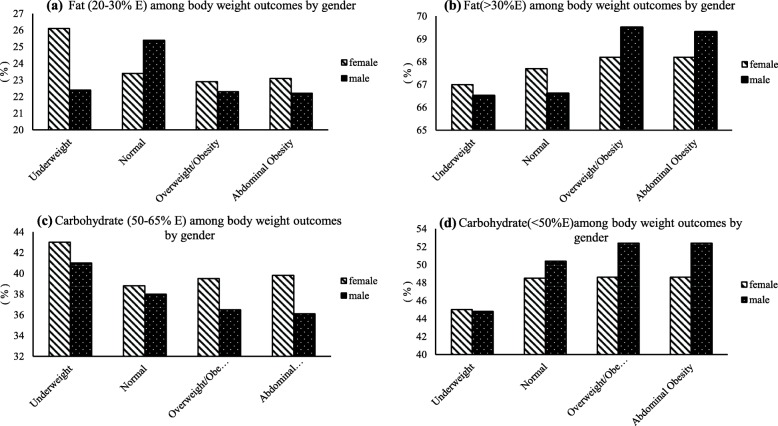
Adult males showed greater absolute intakes of energy and macronutrients as compared to females as per the body weight outcomes. A 10% increase in BMI resulted in an additional intake of 0.002-0.004 kcal/d of dietary energy, 0.032-0.057 g/d of fats, 0.039-0.084 g/d of proteins, and 0.018-0.028 g/d of carbohydrates across all quantiles in males (p < 0.05). A 10% increase in WC lead to an additional intake of 0.004-0.008 kcal/d of dietary energy, 0.051-0.052 g/d of carbohydrates across the entire quantile in males (p < 0.05), and an increased intake of 0.060-0.150 kcal/d of fat in females (p < 0.05).
Dietary fat intake could be the risk factor of abdominal obesity in women. The importance of gender-specific evidence should be considered before promoting macronutrient allocation for the prevention and treatment of obesity.
探讨中国成年人中饮食能量和宏量营养素摄入与体重变化之间的性别差异。
本研究使用了中国健康与营养调查(CHNS,2015 年)的数据,共纳入 10898 名 18-64 岁的参与者。采用连续 3 天 24 小时膳食回忆法评估膳食摄入量。分别针对男性和女性进行体质量指数(BMI)和腰围(WC)的分位数回归模型分析。
就体重变化而言,成年男性的能量和宏量营养素的绝对摄入量均高于女性。BMI 每增加 10%,男性各分位数水平的膳食能量、脂肪、蛋白质和碳水化合物的摄入量分别额外增加 0.002-0.004kcal/d、0.032-0.057g/d、0.039-0.084g/d 和 0.018-0.028g/d(p<0.05)。WC 每增加 10%,男性各分位数水平的膳食能量和碳水化合物的摄入量分别额外增加 0.004-0.008kcal/d、0.051-0.052g/d(p<0.05),女性脂肪的摄入量额外增加 0.060-0.150kcal/d(p<0.05)。
膳食脂肪摄入可能是女性腹型肥胖的危险因素。在推广宏量营养素分配以预防和治疗肥胖症之前,应该考虑基于性别的具体证据的重要性。