Thunstedt Dennis C, Young Peter, Küpper Clemens, Müller Katharina, Becker Regina, Erbert Franziska, Lehner Katharina, Rheinwald Marika, Pfahler Angelika, Dieterich Marianne, Kellert Lars, Feil Katharina
Department of Neurology, Ludwig Maximilians University (LMU), Munich, Germany.
Department of Neurology, Medical Park Bad Feilnbach, Reithofpark, Germany.
Front Neurol. 2020 Apr 30;11:294. doi: 10.3389/fneur.2020.00294. eCollection 2020.
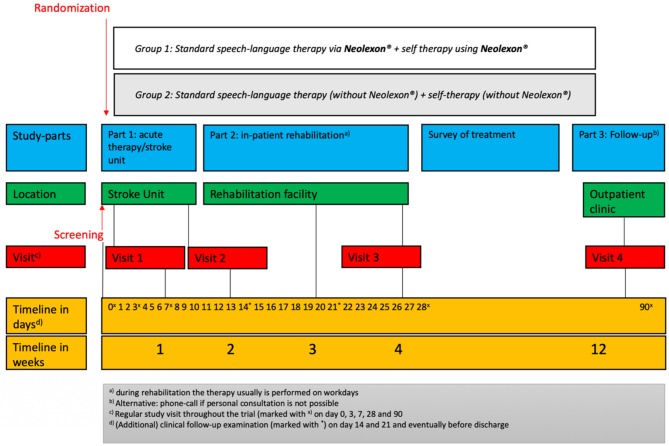
Treatment of aphasia is still challenging for clinicians and patients. So far, there is proven evidence for "face-to-face" speech therapy. However, the digital age potentially offers new and complementary strategies that may add to treatment outcome in a cost-effective way. Neolexon® is a commercial tablet-based software for treatment of aphasia, which can be applied with the help of a therapist or as self-training by the patient. In the Lexi study, we aim to determine whether treatment with Neolexon® is superior to standard therapy in acute post-stroke aphasia. A sample size of 180 patients, 90 for each group, will be included with an assumed dropout rate of ~20%. Prospective, randomized, parallel group, open-label, blinded-endpoint clinical, and experimental controlled non-invasive trial (PROBE). Adult German native speakers with acute aphasia after stroke are included. Computer-generated, blocked, and stratified randomization by aphasia severity will assign patients to one of two groups: 4 weeks of either standard logopedic speech therapy or logopedic speech therapy with the app version of Neolexon®. Both groups will be instructed in self-training: the frequency and duration of self-training will be documented. Screening for aphasia will be performed using the Language Screening Test (LAST). The severity of aphasia in general and in subitems will be assessed using the Bielefelder Aphasie Screening (BIAS) and the Aphasia Check List (ACL). Follow-up will be assessed after 3 months. Based on the consensus in our study team, we considered a 10% mean difference in the change of percentile rank (PR) of BIAS to be a minimal and clinically important difference. The primary endpoint is defined as a significant difference in BIAS comparing the two groups. Differences in quality of life, Beck Depression Inventory (BDI), and modified Ranking Scale (mRS) will be evaluated as secondary outcome parameters. This trial will determine whether speech therapy with the use of Neolexon® is superior to standard logopedic therapy. Subgroups with the greatest response to Neolexon® will be described. The trial was prospectively registered on the "EU Clinical Trials Register" (NCT04080817).
失语症的治疗对临床医生和患者来说仍然具有挑战性。到目前为止,“面对面”言语治疗已有确凿证据。然而,数字时代可能提供新的补充策略,这些策略可能以具有成本效益的方式提高治疗效果。Neolexon®是一款用于治疗失语症的商用平板软件,可在治疗师的帮助下应用,也可由患者进行自我训练。在Lexi研究中,我们旨在确定Neolexon®治疗与标准治疗相比,在急性卒中后失语症治疗中是否更具优势。将纳入180名患者的样本量,每组90名,假定脱落率约为20%。前瞻性、随机、平行组、开放标签、盲终点临床和实验对照非侵入性试验(PROBE)。纳入成年德国母语者,他们在卒中后患有急性失语症。根据失语症严重程度进行计算机生成、分组和分层随机化,将患者分为两组之一:为期4周的标准语言治疗或使用Neolexon®应用程序版本的语言治疗。两组都将接受自我训练指导:记录自我训练的频率和持续时间。将使用语言筛查测试(LAST)进行失语症筛查。将使用比勒费尔德失语症筛查(BIAS)和失语症检查表(ACL)评估失语症总体及各子项的严重程度。3个月后进行随访评估。根据我们研究团队的共识,我们认为BIAS百分位排名(PR)变化的平均差异为10%是最小且具有临床意义的差异。主要终点定义为两组在BIAS上的显著差异。生活质量、贝克抑郁量表(BDI)和改良Rankin量表(mRS)的差异将作为次要结局参数进行评估。该试验将确定使用Neolexon®的言语治疗是否优于标准语言治疗。将描述对Neolexon®反应最大的亚组。该试验已在“欧盟临床试验注册中心”(NCT04080817)进行前瞻性注册。