Spielmann Kerstin, van de Sandt-Koenderman W Mieke E, Heijenbrok-Kal Majanka H, Ribbers Gerard M
Rijndam Rehabilitation Institute, PO Box 23181, 3001, KD, Rotterdam, The Netherlands.
Department of Rehabilitation Medicine, Erasmus MC, University Medical Center Rotterdam, PO Box 2040, 3000, CA, Rotterdam, The Netherlands.
Trials. 2016 Aug 2;17:380. doi: 10.1186/s13063-016-1505-z.
Transcranial direct current stimulation (tDCS) is a promising new technique to optimize the effect of regular Speech and Language Therapy (SLT) in the context of aphasia rehabilitation. The present study focuses on the effect of tDCS provided during SLT in the sub-acute stage after stroke. The primary aim is to evaluate the potential effect of tDCS on language functioning, specifically on word-finding, as well as generalization effects to verbal communication. The secondary aim is to evaluate its effect on social participation and quality of life, and its cost-effectiveness.
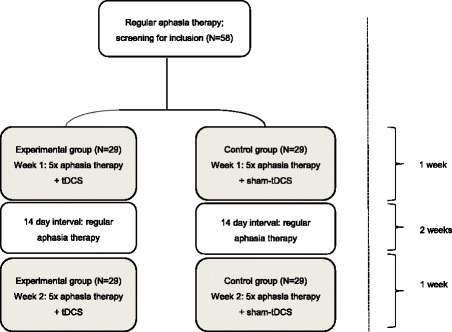
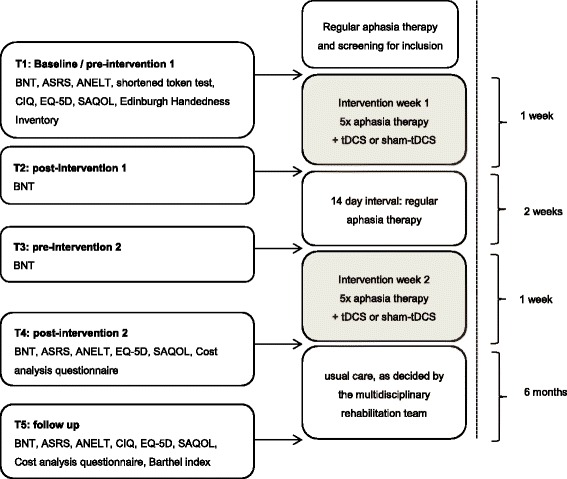
We strive to include 58 stroke patients with aphasia, enrolled in an inpatient or outpatient stroke rehabilitation program, in a multicenter, double-blind, randomized controlled trial with two parallel groups and 6 months' follow-up. Patients will participate in two separate intervention weeks, with a pause of 2 weeks in between, in the context of their regular aphasia rehabilitation program. The two intervention weeks comprise daily 45-minute sessions of word-finding therapy, combined with either anodal tDCS over the left inferior frontal gyrus (1 mA, 20 minutes; experimental condition) or sham-tDCS over the same region (control condition). The primary outcome measure is word-finding. Secondary outcome measures are verbal communication, social participation, quality of life, and cost-effectiveness of the intervention.
Our results will contribute to the discussion on whether tDCS should be implemented in regular aphasia rehabilitation programs for the sub-acute post-stroke population in terms of (cost-)effectiveness.
Nederlands Trail Register: NTR4364 . Registered on 21 February 2014.
经颅直流电刺激(tDCS)是一种很有前景的新技术,可在失语症康复过程中优化常规言语和语言治疗(SLT)的效果。本研究聚焦于中风亚急性期在SLT期间给予tDCS的效果。主要目的是评估tDCS对语言功能的潜在影响,特别是对词汇查找的影响,以及对言语交流的泛化效应。次要目的是评估其对社会参与和生活质量的影响及其成本效益。
我们力求纳入58名患有失语症的中风患者,这些患者参加了住院或门诊中风康复项目,参与一项多中心、双盲、随机对照试验,该试验有两个平行组并进行6个月的随访。在常规失语症康复项目背景下,患者将参加两个独立的干预周,中间间隔2周。这两个干预周包括每天45分钟的词汇查找治疗课程,同时在左侧额下回进行阳极tDCS(1毫安,20分钟;实验组)或在同一区域进行伪tDCS(对照组)。主要结局指标是词汇查找。次要结局指标是言语交流、社会参与、生活质量以及干预的成本效益。
我们的结果将有助于就是否应根据(成本)效益在中风亚急性期人群的常规失语症康复项目中实施tDCS展开讨论。
荷兰试验注册库:NTR4364。于2014年2月21日注册。