Gklinos Panagiotis, Mitsikostas Dimos D
Neurology Department, KAT General Hospital, Athens, Greece.
First Neurology Department, Aeginition Hospital, Medical School, National and Kapodistrian University of Athens, 74 V. Sofia's Avenue, Athens 11528, Greece.
Ther Adv Neurol Disord. 2020 Apr 28;13:1756286420918088. doi: 10.1177/1756286420918088. eCollection 2020.
Galcanezumab, along with three other monoclonal antibodies targeting the calcitonin gene-related peptide (CGRP) pathway, represents the latest disease-specific and mechanism-based treatment for the prophylaxis of migraine. Galcanezumab shares data also for the prophylaxis of cluster headache.
To provide a pooled safety and efficacy analysis of all phase III randomized controlled trials of galcanezumab in the preventive therapy of migraine.
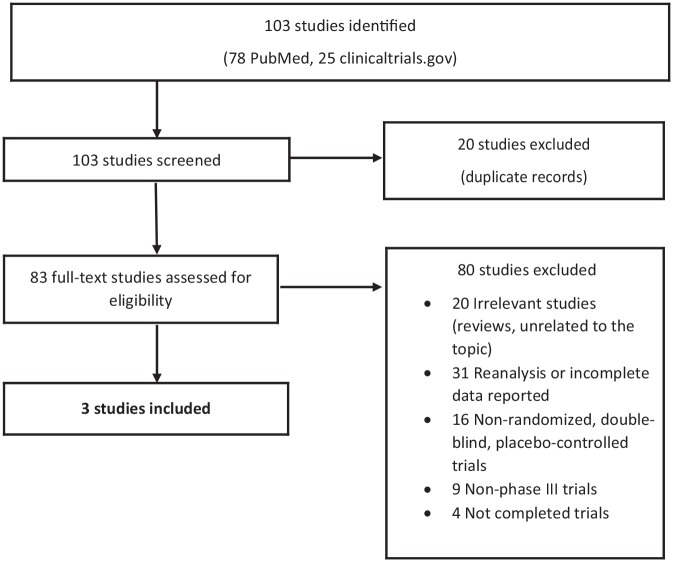
A computer-based literature search was conducted on MEDLINE and the US National Institutes of Health Clinical Trials Registry for phase III randomized controlled trials of galcanezumab in migraine prevention. The primary outcome was the mean change in monthly migraine days (MMDs). The proportions of patients who reported at least one adverse event (AE), at least one serious adverse event (SAE) or withdrew from the study were used as safety outcomes.
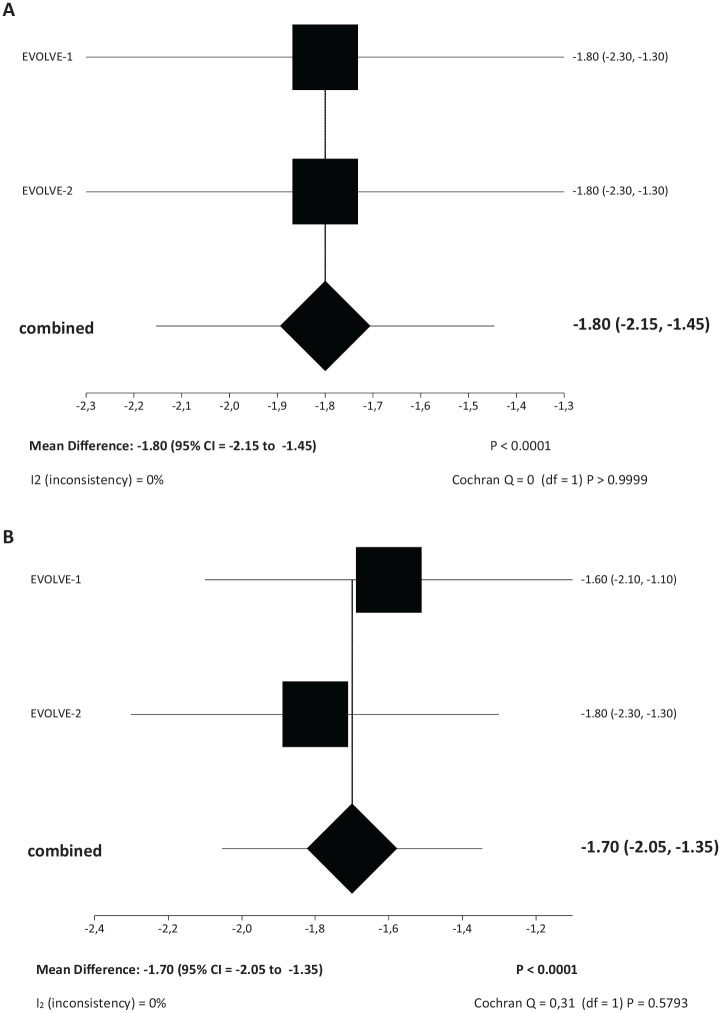
Two trials were included in the efficacy meta-analysis and three in the safety meta-analysis. Migraine preventive treatment with subcutaneous galcanezumab, at both 120 mg and 240 mg dosages, was associated with a significantly greater reduction in the mean number of MMDs placebo (120 mg, MD = -1.98, 95% CI = -2.33 to -1.63; < 0.0001) or (240 mg, MD = -1.86, 95% CI = -2.20 to -1.53; < 0.0001). Galcanezumab was found to be more efficacious in all key secondary outcomes as well. Regarding safety, most of the adverse events were mild to moderate, while drop-out rates and serious adverse events were low.
Galcanezumab is an efficacious and well-tolerated preventive treatment for migraine. Larger clinical trials with longer follow-up periods need to be conducted in order to provide more safety data of the above-mentioned drug.
加卡尼单抗与其他三种靶向降钙素基因相关肽(CGRP)途径的单克隆抗体一起,代表了预防偏头痛的最新疾病特异性和基于机制的治疗方法。加卡尼单抗在预防丛集性头痛方面也有相关数据。
对加卡尼单抗预防偏头痛的所有III期随机对照试验进行汇总安全性和疗效分析。
在MEDLINE和美国国立卫生研究院临床试验注册库中进行基于计算机的文献检索,以查找加卡尼单抗预防偏头痛的III期随机对照试验。主要结局是每月偏头痛天数(MMD)的平均变化。报告至少一次不良事件(AE)、至少一次严重不良事件(SAE)或退出研究的患者比例用作安全性结局。
两项试验纳入疗效荟萃分析,三项纳入安全性荟萃分析。皮下注射加卡尼单抗120mg和240mg剂量进行偏头痛预防性治疗,与安慰剂相比,MMD的平均数量显著减少更多(120mg,MD = -1.98,95%CI = -2.33至-1.63;P < 0.0001)或(240mg,MD = -1.86,95%CI = -2.20至-1.53;P < 0.0001)。加卡尼单抗在所有关键次要结局中也更有效。在安全性方面,大多数不良事件为轻度至中度,而退出率和严重不良事件较低。
加卡尼单抗是一种有效且耐受性良好的偏头痛预防性治疗药物。需要进行更长随访期的更大规模临床试验,以提供上述药物更多的安全性数据。