Jansen Lynn, Maina Geoffrey, Horsburgh Beth, Kumaran Maha, Mcharo Kasha, Laliberte George, Kappel Joanne, Bullin Carol Ann
College of Nursing, University of Saskatchewan, Prince Albert, Canada.
College of Nursing, University of Saskatchewan, Saskatoon, Canada.
Can J Kidney Health Dis. 2020 May 4;7:2054358120916394. doi: 10.1177/2054358120916394. eCollection 2020.
Canadian Indigenous populations experience significantly more chronic kidney disease (CKD) than the general population. Indigenous people who live in rural and remote areas may also have difficulty accessing both information and care for their CKD. Informed decision making about treatment options for advancing kidney disease may be delayed, which can result in poor health outcomes and decreased quality of life. Moreover, Indigenous people may experience marginalization within Western health care systems.
The objective of this scoping review is to identify culturally appropriate and co-developed Indigenous educational tools that will ultimately support CKD learning and end-stage kidney treatment decision making.
Scoping Review.
Databases included Embase, CINAHL, Medline (OVID), ERIC, and the Canadian Agency for Drugs and Technology Gray Matters.
Community-based Indigenous patients, families, health care workers, and community members.
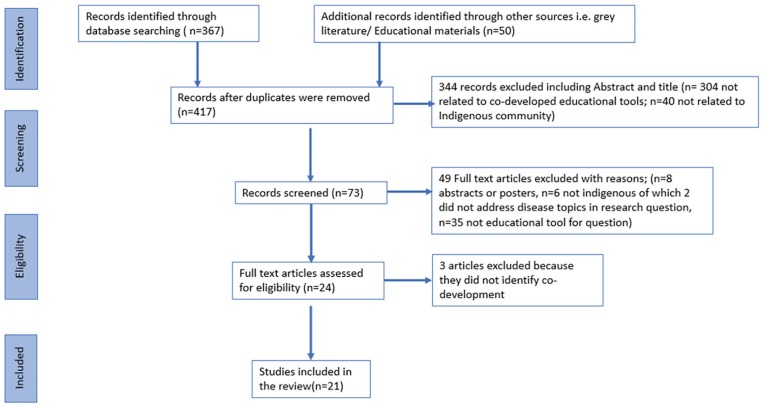
We systematically reviewed the literature to explore the availability of co-developed Indigenous educational tools and material for CKD treatment options. Titles, abstracts, and full texts were reviewed independently by 2 reviewers with disagreements resolved through a third. All aspects of this project, including searching the databases were done in consultation with an Indigenous Elder.
Only one retrieved article identified a comprehensive CKD tool co-developed by researchers, health care providers, and an Indigenous community. Three themes emerged from the scoping review that may inform characteristics of co-developed tools: cultural appropriateness; appraisal of utility and effectiveness and; content informed by co-development of traditional and Western chronic disease knowledge.
Consistent with scoping review methodology, the methodological quality of included studies was not assessed. In addition, it was difficult to synthesize the findings from the research and gray literature.
Little is known about the co-development of Indigenous educational tools for CKD. Further in-depth understanding is required about how to best engage with Indigenous communities, specifically to co-develop contextualized CKD tools that are acceptable to Indigenous people.Trial registration: Not applicable as this review described secondary data.
加拿大原住民患慢性肾脏病(CKD)的比例明显高于普通人群。生活在农村和偏远地区的原住民在获取CKD相关信息和护理方面也可能存在困难。关于晚期肾病治疗方案的明智决策可能会延迟,这可能导致健康状况不佳和生活质量下降。此外,原住民在西方医疗保健系统中可能会受到边缘化。
本范围综述的目的是确定文化上合适且共同开发的原住民教育工具,这些工具最终将支持CKD学习和终末期肾病治疗决策。
范围综述。
数据库包括Embase、CINAHL、Medline(OVID)、ERIC以及加拿大药品和技术局灰色文献库。
以社区为基础的原住民患者、家庭、医护人员和社区成员。
我们系统地回顾了文献,以探索共同开发的用于CKD治疗方案的原住民教育工具和材料的可用性。标题、摘要和全文由两名审稿人独立审查,如有分歧则通过第三名审稿人解决。该项目的所有方面,包括搜索数据库,都是在与一位原住民长者协商后进行的。
仅一篇检索到的文章确定了一个由研究人员、医疗保健提供者和一个原住民社区共同开发的全面的CKD工具。范围综述中出现了三个主题,可能为共同开发的工具的特点提供参考:文化适宜性;效用和有效性评估;由传统和西方慢性病知识共同开发提供信息的内容。
与范围综述方法一致,未评估纳入研究的方法学质量。此外,难以综合研究和灰色文献的结果。
关于CKD原住民教育工具的共同开发知之甚少。需要进一步深入了解如何最好地与原住民社区合作,特别是共同开发原住民可接受的情境化CKD工具。试验注册:由于本综述描述的是二次数据,因此不适用。