Conway Jessica, Tsourtos George, Lawn Sharon
Flinders University, Adelaide, Australia.
Discipline of Public Health, Flinders University, Adelaide, Australia.
BMC Health Serv Res. 2017 May 3;17(1):319. doi: 10.1186/s12913-017-2265-5.
The inequality in health outcomes between Indigenous (Throughout the paper, the term Indigenous will be used to represent both Aboriginal Australians and Torres Strait Islander Australians.) and non-Indigenous Australians continues to be a major public health issue. Chronic conditions are responsible for the majority of the gap in life expectancy for this population. Evidence suggests that chronic condition management models focusing on self-management have led to improved health outcomes in Indigenous populations. The Flinders Closing the Gap Program (FCTGP) is a chronic condition care planning tool which aims to engage Indigenous people in self-managing their chronic conditions. Indigenous health workers (IHWs) can provide culturally appropriate self-management support; however there is paucity in current literature describing specific barriers and facilitators that they may experience when attempting to deliver this support. This study aimed to explore IHWs' perceptions of the effectiveness and appropriateness of the FCTGP, as an evidence-based example of self-management support, and to explore the barriers and facilitators that IHWs experience in their workplace and communities in providing self-management support.
In-depth interviews were undertaken with five IHWs, drawn from five different states in Australia. Their selection was aided by key informants from the FCTGP training unit. Interviews were recorded and transcribed verbatim, and were analysed using thematic analysis.
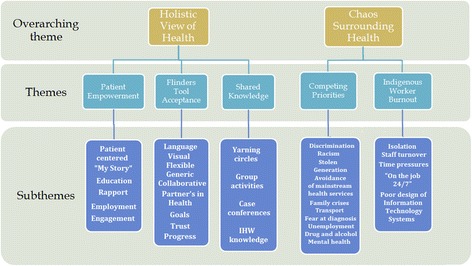
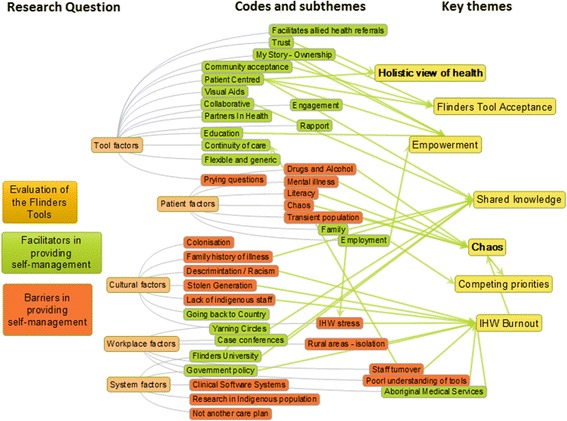
The following themes were identified. IHWs reported that the FCTGP was appropriate, flexible and acceptable in their communities. Facilitators included factors improving client and worker empowerment, and activities around sharing knowledge. Barriers included competing priorities that clients experience relating to social determinants of health, and negative experiences within mainstream health services. IHW burnout from time pressures, lack of support, and high staff turnover were also considered important barriers.
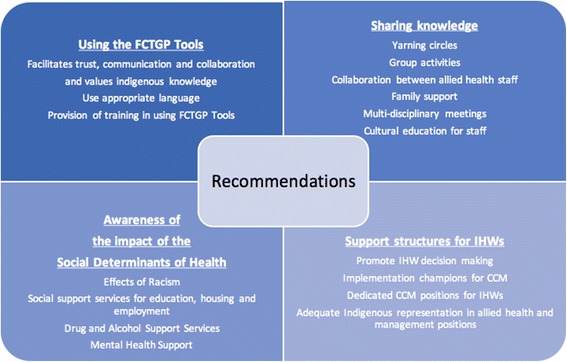
This study contributes an insight into the experiences of IHWs who are considered important stakeholders in implementation and sustainability of chronic condition management programs, including the FCTGP. Recommendations focus on supporting and supplementing the role of IHWs and identify the FCTGP as a facilitator in providing self-management support to a population with complex needs.
澳大利亚原住民(在本文中,“原住民”一词将用于代表澳大利亚原住民和托雷斯海峡岛民)与非原住民之间的健康结果不平等仍然是一个主要的公共卫生问题。慢性病是造成该人群预期寿命差距的主要原因。有证据表明,侧重于自我管理的慢性病管理模式已使原住民人群的健康结果得到改善。弗林德斯缩小差距计划(FCTGP)是一种慢性病护理规划工具,旨在让原住民参与慢性病的自我管理。原住民健康工作者(IHWs)可以提供符合文化习惯的自我管理支持;然而,目前的文献中很少描述他们在尝试提供这种支持时可能遇到的具体障碍和促进因素。本研究旨在探讨原住民健康工作者对FCTGP作为自我管理支持的循证范例的有效性和适用性的看法,并探讨原住民健康工作者在其工作场所和社区中提供自我管理支持时所遇到的障碍和促进因素。
对来自澳大利亚五个不同州的五名原住民健康工作者进行了深入访谈。FCTGP培训单位的关键信息提供者协助了他们的选择。访谈进行了录音并逐字转录,并采用主题分析法进行分析。
确定了以下主题。原住民健康工作者报告说,FCTGP在他们的社区中是合适、灵活且可接受的。促进因素包括提高客户和工作者权能的因素以及围绕知识共享的活动。障碍包括客户在与健康的社会决定因素相关方面遇到的相互竞争的优先事项,以及主流卫生服务中的负面经历。由于时间压力、缺乏支持和高人员流动导致的原住民健康工作者倦怠也被认为是重要障碍。
本研究深入了解了原住民健康工作者的经历,他们被认为是慢性病管理计划(包括FCTGP)实施和可持续性的重要利益相关者。建议侧重于支持和补充原住民健康工作者的作用,并将FCTGP确定为向有复杂需求人群提供自我管理支持的促进因素。