Dawson Shoba, Ruddock Angela, Parmar Veena, Morris Rebecca, Cheraghi-Sohi Sudeh, Giles Sally, Campbell Stephen
1Centre for Academic Primary Care, Population Health Sciences, Bristol Medical School, University of Bristol, Bristol, UK.
2NIHR Greater Manchester Patient Safety Translational Research Centre, Centre for Primary Care, Division of Population Health, HSR & Primary Care, School of Health Sciences, Faculty of Biology, Medicine and Health, University of Manchester, Manchester, UK.
Res Involv Engagem. 2020 May 11;6:23. doi: 10.1186/s40900-020-00201-w. eCollection 2020.
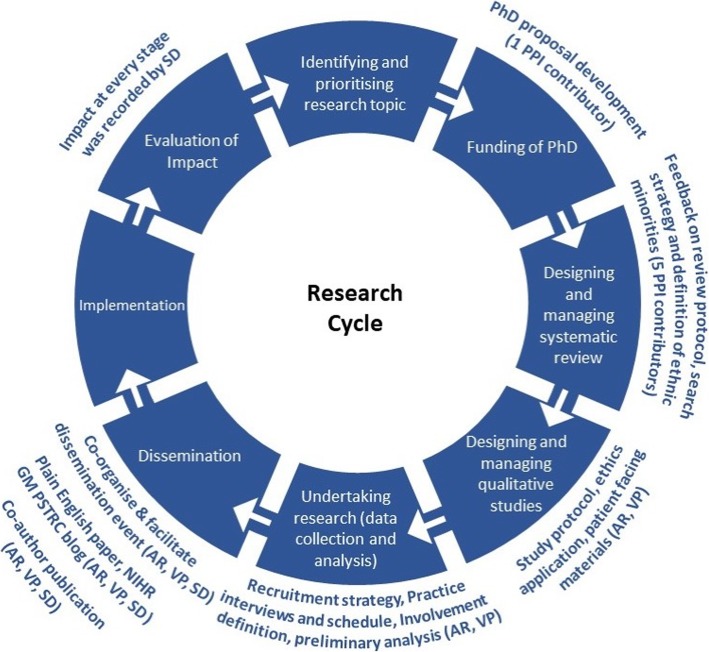
There is evidence in the literature showing that involving patients and the public in health research can have a positive influence on quality, relevance and impact of research. However, patients and the public are not always involved in all stages of the research. There is often no explanation as to why they were only involved in some stages of the research and not others. Additionally, there is often no description of researchers' or PPI contributor's experiences of involvement. This also raises another issue which is a lack of recording of impact such involvement can have on the research process and the people involved in the research. In this paper, we present what PPI in a doctoral research should look like by providing a detailed description of how involvement occurred from pre-funding to dissemination stages of the research process. We provide some practical examples of how this was done and how involving patients made a difference to the research project. Finally, we present reflections from the patient and public contributors and the researcher on involvement in this project along with some recommendations for future doctoral and postdoctoral researchers considering involving public/patient contributors in their research.
Patient and Public Involvement (PPI) has received considerable attention in the last two decades and working in partnership and co-design have now become a prerequisite in health services research in the UK. However, there is a lack of evidence and consistency in recording PPI and related activities. Researchers and PPI contributors are encouraged to record and reflect on the impact of PPI on research. There is significant variation in the way PPI contributors are involved, and it is often limited to some stages of the research cycle than others, without any reflections on the decision-making process for such involvement or any transferable learning. This has resulted in failure to provide a narrative of the research journey including researchers' and PPI contributors' personal reflections of involvement. Therefore, this paper provides an exemplar of what PPI in a doctoral research context should look like by providing a detailed account of how PPI was embedded in a doctoral research project, the PPI contributors and researcher's reflections and key recommendations for involving people specifically in doctoral research. A reflective approach was taken using data from PPI contributor and researcher notes, e-mail correspondence, meeting notes. Data is presented narratively to reflect on the experiences of involvement throughout the research cycle. Undertaking PPI enhanced the quality and relevance of the doctoral research, contributed to the recruitment of study participants, data analysis and dissemination. Building trust and relationships with PPI contributors was key to continued involvement throughout the life of the project and beyond. There is a need to adopt flexible approaches rather than a one-size-fits-all model when working with PPI contributors. Reflections by PPI contributors and the researcher emphasises that involvement was a rewarding experience. This paper contributes to the wider literature by providing an exemplar of how PPI can be embedded in doctoral research and demonstrates the value of PPI to the research process and the individuals involved. We also present recommendations on how PPI can be incorporated by doctoral and postdoctoral researchers when planning PPI in their research project.
文献中有证据表明,让患者和公众参与健康研究可对研究的质量、相关性和影响力产生积极影响。然而,患者和公众并非总是参与研究的所有阶段。对于他们为何仅参与某些阶段而非其他阶段,往往没有解释。此外,对于研究人员或患者与公众参与贡献者的参与经历,通常也没有描述。这还引发了另一个问题,即缺乏对这种参与可能对研究过程及参与研究的人员产生的影响的记录。在本文中,我们通过详细描述从研究过程的预资助到传播阶段参与是如何发生的,展示了博士研究中的患者与公众参与应该是什么样的。我们提供了一些实际示例,说明如何做到这一点以及让患者参与如何对研究项目产生影响。最后,我们呈现了患者和公众贡献者以及研究人员对参与该项目的反思,以及对未来考虑让公众/患者贡献者参与其研究的博士和博士后研究人员的一些建议。
在过去二十年中,患者与公众参与(PPI)受到了相当多的关注,在英国,合作与共同设计现已成为卫生服务研究的一项先决条件。然而,在记录PPI及相关活动方面缺乏证据且不一致。鼓励研究人员和PPI贡献者记录并反思PPI对研究的影响。PPI贡献者的参与方式存在显著差异,而且通常局限于研究周期的某些阶段而非其他阶段,对于这种参与的决策过程或任何可借鉴的经验都没有反思。这导致未能提供包括研究人员和PPI贡献者对参与的个人反思在内的研究历程叙述。因此,本文通过详细阐述PPI如何融入一个博士研究项目、PPI贡献者和研究人员的反思以及专门针对博士研究中让人们参与的关键建议,提供了一个博士研究背景下PPI应是什么样的范例。采用了一种反思性方法,使用来自PPI贡献者和研究人员笔记、电子邮件通信、会议记录的数据。以叙述方式呈现数据,以反思整个研究周期中的参与经历。进行PPI提高了博士研究的质量和相关性,有助于研究参与者的招募、数据分析和传播。与PPI贡献者建立信任和关系是在项目整个生命周期及之后持续参与的关键。在与PPI贡献者合作时,需要采用灵活的方法而非一刀切的模式。PPI贡献者和研究人员的反思强调,参与是一次有意义的经历。本文通过提供一个PPI如何融入博士研究的范例,为更广泛的文献做出了贡献,并展示了PPI对研究过程和相关个人的价值。我们还提出了关于博士和博士后研究人员在其研究项目中规划PPI时如何纳入PPI的建议。