Zhao Xiuling, Nie Junyu, Tang Yuyan, He Wengtan, Xiao Kai, Pang Chunying, Liang Xianwei, Lu Yangqing, Zhang Ming
State Key Laboratory for Conservation and Utilization of Subtropical Agro-Bioresources, Animal Reproduction Institute, Guangxi University, Nanning, China.
Key Laboratory of Buffalo Genetics, Breeding and Reproduction Technology, Ministry of Agriculture and Buffalo Research Institute, Chinese Academy of Agricultural Science, Nanning, China.
Front Vet Sci. 2020 Apr 23;7:199. doi: 10.3389/fvets.2020.00199. eCollection 2020.
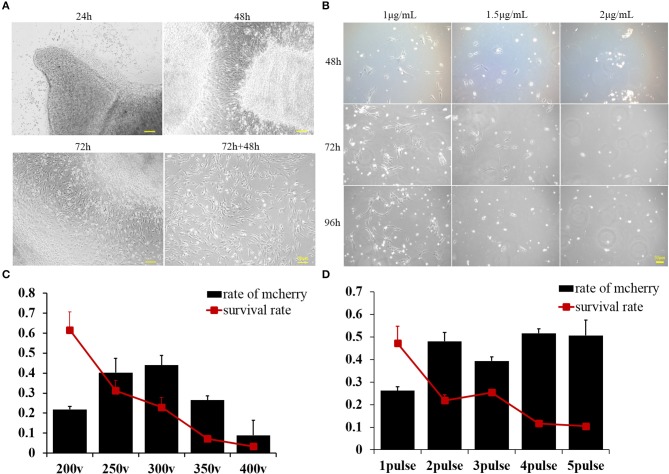
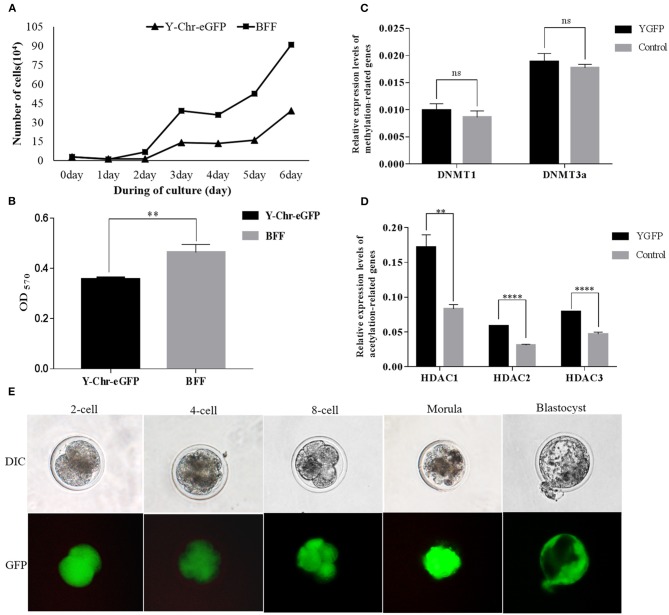
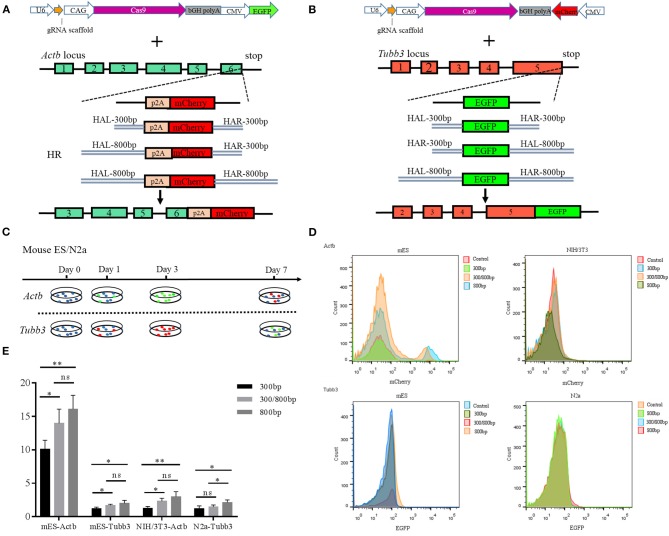
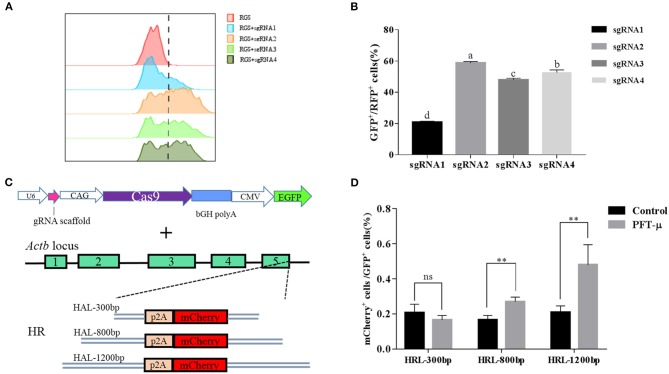
Sex control technology is of great significance in the production of domestic animals, especially for rapidly breeding water buffalo (bubalus bubalis), which served as a research model in the present study. We have confirmed that a fluorescence protein integrated into the Y chromosome is fit for sexing pre-implantation embryos in the mouse. Firstly, we optimized the efficiency of targeted integration of exogenous gene encoding enhanced green fluorescent protein (eGFP) and mCherry in Neuro-2a cells, mouse embryonic stem cells, mouse embryonic cells (NIH3T3), buffalo fetal fibroblast (BFF) cells. The results showed that a homology arm length of 800 bp on both sides of the target is more efficient that 300 bp or 300 bp/800 bp. Homology-directed repair (HDR)-mediated knock-in in BFF cells was also significantly improved when cells were supplemented with pifithrin-μ, which is a small molecule that inhibits the binding of p53 to mitochondria. Three pulses at 250 V resulted in the most efficient electroporation in BFF cells and 1.5 μg/mL puromycin was found to be the optimal concentration for screening. Moreover, Y-Chr-eGFP transgenic BFF cells and cloned buffalo embryos were successfully generated using CRISPR/Cas9-mediated gene editing combined with the somatic cell nuclear transfer (SCNT) technique. At passage numbers 6-8, the growth rate and cell proliferation rate were significantly lower in Y-Chr-eGFP transgenic than in non-transgenic BFF cells; the expression levels of the methylation-related genes and were similar; however, the expression levels of the acetylation-related genes , and were significantly higher (p < 0.05) in Y-Chr-eGFP transgenic BFF cells compared with non-transgenic cells. Y-Chr-eGFP transgenic BFFs were used as donors for SCNT, the results showed that eGFP reporter is suitable for the visualization of the sex of embryos. The blastocyst rates of cloned buffalo embryos were similar; however, the cleavage rates of transgenic cloned embryos were significantly lower compared with control. In summary, we optimized the protocol for generating transgenic BFF cells and successfully generated Y-Chr-eGFP transgenic embryos using these cells as donors.
性别控制技术在家畜生产中具有重要意义,特别是对于快速繁殖水牛(Bubalus bubalis)而言,本研究以水牛作为研究模型。我们已经证实,整合到Y染色体上的荧光蛋白适用于对小鼠植入前胚胎进行性别鉴定。首先,我们优化了编码增强型绿色荧光蛋白(eGFP)和mCherry的外源基因在Neuro-2a细胞、小鼠胚胎干细胞、小鼠胚胎细胞(NIH3T3)、水牛胎儿成纤维细胞(BFF)中的靶向整合效率。结果表明,靶点两侧800 bp的同源臂长度比300 bp或300 bp/800 bp更有效。当细胞补充pifithrin-μ(一种抑制p53与线粒体结合的小分子)时,BFF细胞中同源定向修复(HDR)介导的敲入也显著改善。250 V的三个脉冲在BFF细胞中产生了最有效的电穿孔,发现1.5 μg/mL嘌呤霉素是筛选的最佳浓度。此外,使用CRISPR/Cas9介导的基因编辑结合体细胞核移植(SCNT)技术成功产生了Y-Chr-eGFP转基因BFF细胞和克隆水牛胚胎。在第6 - 8代时,Y-Chr-eGFP转基因细胞的生长速率和细胞增殖速率显著低于非转基因BFF细胞;甲基化相关基因的表达水平相似;然而,与非转基因细胞相比,Y-Chr-eGFP转基因BFF细胞中乙酰化相关基因、和的表达水平显著更高(p < 0.05)。将Y-Chr-eGFP转基因BFF用作SCNT的供体,结果表明eGFP报告基因适用于胚胎性别的可视化。克隆水牛胚胎的囊胚率相似;然而,转基因克隆胚胎的分裂率与对照相比显著更低。总之,我们优化了产生转基因BFF细胞的方案,并使用这些细胞作为供体成功产生了Y-Chr-eGFP转基因胚胎。