Meador Travis B, Schoffelen Niels, Ferdelman Timothy G, Rebello Osmond, Khachikyan Alexander, Könneke Martin
MARUM Center for Marine Environmental Sciences and Dept. of Geosciences, University of Bremen, Bremen, Germany.
Department of Biogeochemistry, Max Planck Institute for Marine Microbiology, Bremen, Germany.
Sci Adv. 2020 May 8;6(19):eaba1799. doi: 10.1126/sciadv.aba1799. eCollection 2020 May.
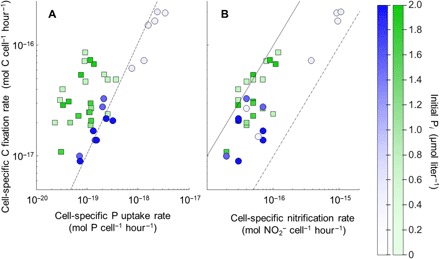
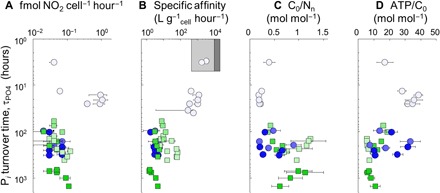
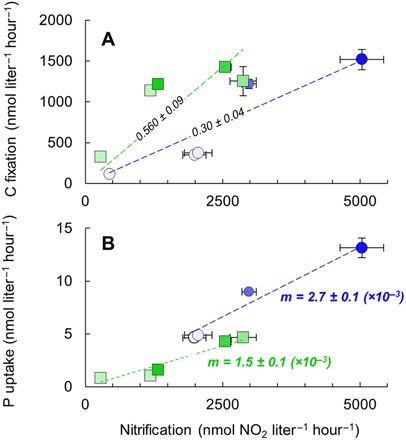
Thaumarchaeotal nitrifiers are among the most abundant organisms in the ocean, but still unknown is the carbon (C) yield from nitrification and the coupling of these fluxes to phosphorus (P) turnover and release of metabolites from the cell. Using a dual radiotracer approach, we found that fixed roughly 0.3 mol C, assimilated 2 mmol P, and released ca. 10 mol C and 10 mol P as dissolved organics (DOC and DOP) per mole ammonia respired. Phosphate turnover may influence assimilation fluxes by nitrifiers in the euphotic zone, which parallel those of the dark ocean. Collectively, marine nitrifiers assimilate up to 2 Pg C year and 0.05 Pg P year and thereby recycle roughly 5% of mineralized C and P into marine biomass. Release of roughly 50 Tg DOC and 0.2 Tg DOP by thaumarchaea each year represents a small but fresh input of reduced substrates throughout the ocean.
奇古菌硝化菌是海洋中数量最为丰富的生物之一,但目前仍不清楚硝化作用产生的碳(C)产量,以及这些通量与磷(P)周转和细胞代谢产物释放之间的耦合关系。通过双放射性示踪剂方法,我们发现每摩尔氨呼吸时,奇古菌硝化菌大约固定0.3摩尔C,同化2毫摩尔P,并释放约10摩尔C和10摩尔P作为溶解有机物(DOC和DOP)。磷酸盐周转可能会影响真光层中硝化菌的同化通量,这与黑暗海洋中的情况相似。总体而言,海洋硝化菌每年同化高达2Pg C和0.05Pg P,从而将大约5%的矿化C和P再循环到海洋生物量中。奇古菌每年释放约50Tg DOC和0.2Tg DOP,这在整个海洋中代表了少量但新鲜的还原底物输入。