Tabor Edyta, Dedecek Jiri, Mlekodaj Kinga, Sobalik Zdenek, Andrikopoulos Prokopis C, Sklenak Stepan
J. Heyrovský Institute of Physical Chemistry, The Czech Academy of Sciences, Dolejskova 3, 18223 Prague, Czech Republic.
Sci Adv. 2020 May 13;6(20):eaaz9776. doi: 10.1126/sciadv.aaz9776. eCollection 2020 May.
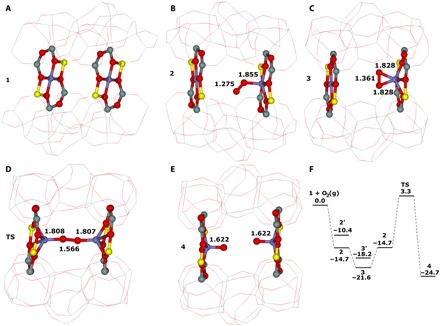
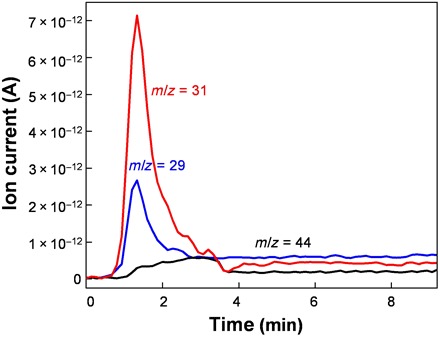
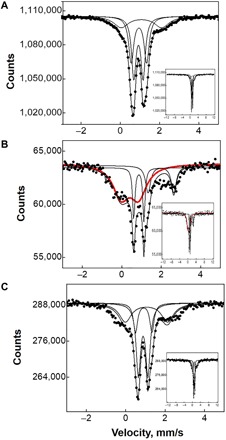
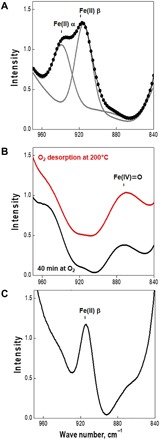
Activation of dioxygen attracts enormous attention due to its potential for utilization of methane and applications in other selective oxidation reactions. We report a cleavage of dioxygen at room temperature over distant binuclear Fe(II) species stabilized in an aluminosilicate matrix. A pair of formed distant α-oxygen species [i.e., (Fe(IV)═O)] exhibits unique oxidation properties reflected in an outstanding activity in the oxidation of methane to methanol at room temperature. Designing a man-made system that mimicks the enzyme functionality in the dioxygen activation using both a different mechanism and structure of the active site represents a breakthrough in catalysis. Our system has an enormous practical importance as a potential industrial catalyst for methane utilization because (i) the Fe(II)/Fe(IV) cycle is reversible, (ii) the active Fe centers are stable under the reaction conditions, and (iii) methanol can be released to gas phase without the necessity of water or water-organic medium extraction.
由于二氧的活化在甲烷利用及其他选择性氧化反应中的应用潜力,其活化受到了广泛关注。我们报道了在室温下,稳定于硅铝酸盐基质中的远距离双核铁(II)物种对二氧的裂解。一对形成的远距离α-氧物种[即(Fe(IV)═O)]展现出独特的氧化特性,表现为在室温下将甲烷氧化为甲醇时具有出色的活性。设计一种利用不同的活性位点机制和结构来模拟二氧活化中酶功能的人造系统,代表了催化领域的一项突破。我们的系统作为甲烷利用的潜在工业催化剂具有巨大的实际重要性,因为(i)Fe(II)/Fe(IV)循环是可逆的,(ii)活性铁中心在反应条件下稳定,以及(iii)甲醇可以释放到气相中,无需水或水-有机介质萃取。