McPeake Joanne, Boehm Leanne M, Hibbert Elizabeth, Bakhru Rita N, Bastin Anthony J, Butcher Brad W, Eaton Tammy L, Harris Wendy, Hope Aluko A, Jackson James, Johnson Annie, Kloos Janet A, Korzick Karen A, MacTavish Pamela, Meyer Joel, Montgomery-Yates Ashley, Quasim Tara, Slack Andrew, Wade Dorothy, Still Mary, Netzer Giora, Hopkins Ramona O, Mikkelsen Mark E, Iwashyna Theodore J, Haines Kimberley J, Sevin Carla M
Glasgow Royal Infirmary, NHS Greater Glasgow and Clyde, Scotland, United Kingdom.
School of Medicine, Dentistry and Nursing, University of Glasgow, Scotland, United Kingdom.
Crit Care Explor. 2020 Apr 29;2(4):e0088. doi: 10.1097/CCE.0000000000000088. eCollection 2020 Apr.
To understand from the perspective of patients who did, and did not attend ICU recovery programs, what were the most important components of successful programs and how should they be organized.
International, qualitative study.
Fourteen hospitals in the United States, United Kingdom, and Australia.
We conducted 66 semi-structured interviews with a diverse group of patients, 52 of whom had used an ICU recovery program and 14 whom had not.
None.
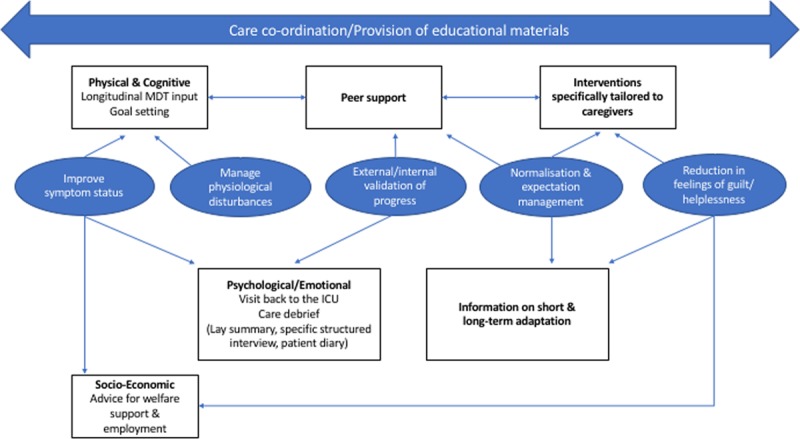
Using content analysis, prevalent themes were documented to understand what improved their outcomes. Contrasting quotes from patients who had not received certain aspects of care were used to identify perceived differential effectiveness. Successful ICU recovery programs had five key components: 1) Continuity of care; 2) Improving symptom status; 3) Normalization and expectation management; 4) Internal and external validation of progress; and 5) Reducing feelings of guilt and helplessness. The delivery of care which achieved these goals was facilitated by early involvement (even before hospital discharge), direct involvement of ICU staff, and a focus on integration across traditional disease, symptom, and social welfare needs.
In this multicenter study, conducted across three continents, patients identified specific and reproducible modes of benefit derived from ICU recovery programs, which could be the target of future intervention refinement.
从参与和未参与重症监护病房康复计划的患者角度出发,了解成功计划的最重要组成部分以及应如何组织这些计划。
国际性定性研究。
美国、英国和澳大利亚的14家医院。
我们对不同群体的患者进行了66次半结构化访谈,其中52人使用过重症监护病房康复计划,14人未使用过。
无。
采用内容分析法记录普遍存在的主题,以了解哪些因素改善了他们的康复结果。通过对比未接受某些护理方面的患者的引述,来确定感知到的不同效果。成功的重症监护病房康复计划有五个关键组成部分:1)护理连续性;2)改善症状状态;3)正常化和期望管理;4)对进展的内部和外部验证;5)减轻内疚和无助感。早期参与(甚至在出院前)、重症监护病房工作人员的直接参与以及关注传统疾病、症状和社会福利需求的整合,有助于实现这些目标的护理实施。
在这项横跨三大洲进行的多中心研究中,患者确定了重症监护病房康复计划带来的具体且可重复的受益模式,这可能成为未来干预改进的目标。