Departamento de Odontologia Restauradora, Faculdade de Odontologia de Piracicaba, Universidade Estadual de Campinas, Piracicaba, SP, Brasil.
Departamento de Ciências Fisiológicas, Faculdade de Odontologia de Piracicaba, Universidade Estadual de Campinas, Piracicaba, SP, Brasil.
J Appl Oral Sci. 2020;28:e20190720. doi: 10.1590/1678-7757-2019-0720. Epub 2020 May 18.
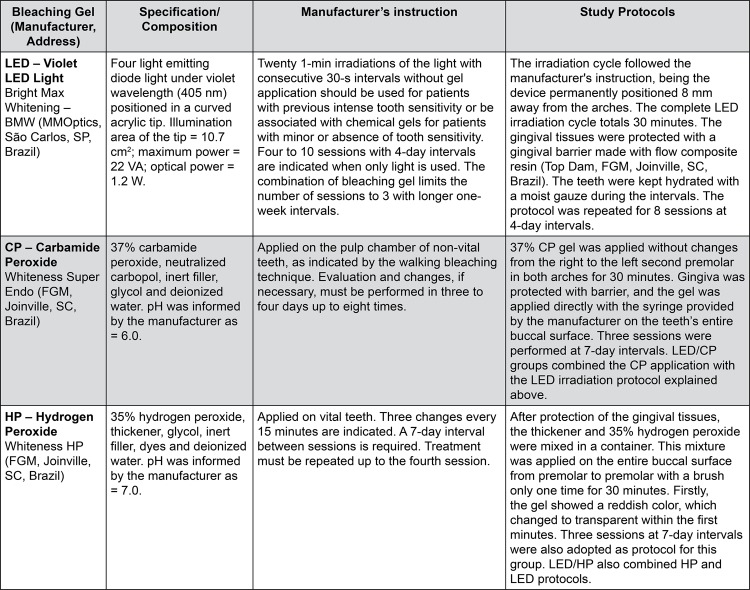
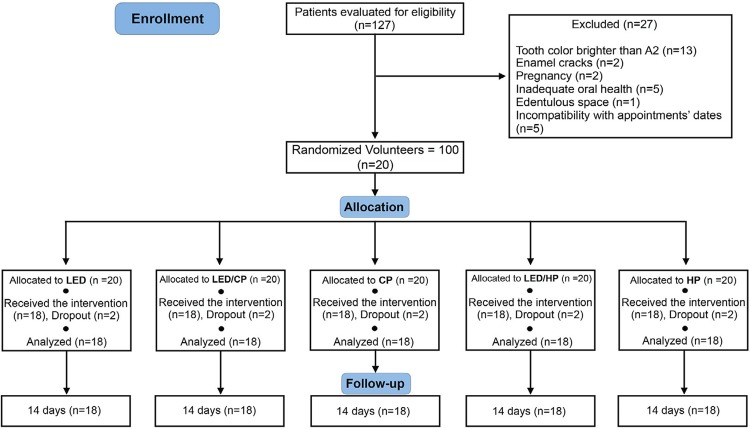
Objective This study evaluated the clinical effect of violet LED light on in-office bleaching used alone or combined with 37% carbamide peroxide (CP) or 35% hydrogen peroxide (HP). Methodology A total of 100 patients were divided into five groups (n=20): LED, LED/CP, CP, LED/HP and HP. Colorimetric evaluation was performed using a spectrophotometer (ΔE, ΔL, Δa, Δb) and a visual shade guide (ΔSGU). Calcium (Ca)/phosphorous (P) ratio was quantified in the enamel microbiopsies. Measurements were performed at baseline (T 0 ), after bleaching (T B ) and in the 14-day follow-up (T 14 ). At each bleaching session, a visual scale determined the absolute risk (AR) and intensity of tooth sensitivity (TS). Data were evaluated by one-way (ΔE, Δa, ΔL, Δb), two-way repeated measures ANOVA (Ca/P ratio), and Tukey post-hoc tests. ΔSGU and TS were evaluated by Kruskal-Wallis and Mann-Whitney, and AR by Chi-Squared tests (a=5%). Results LED produced the lowest ΔE (p<0.05), but LED/HP promoted greater ΔE, ΔSGU and Δb (T 14 ) than HP (p<0.05). No differences were observed in ΔE and ΔSGU for LED/CP and HP groups (p>0.05). ΔL and Δa were not influenced by LED activation. After bleaching, LED/CP exhibited greater Δb than CP (p>0.05), but no differences were found between these groups at T 14 (p>0.05). LED treatment promoted the lowest risk of TS (16%), while HP promoted the highest (94.4%) (p<0.05). No statistical differences of risk of TS were found for CP (44%), LED/CP (61%) and LED/HP (88%) groups (p>0.05). No differences were found in enamel Ca/P ratio among treatments, regardless of evaluation times. Conclusions Violet LED alone produced the lowest bleaching effect, but enhanced HP bleaching results. Patients treated with LED/CP reached the same efficacy of HP, with reduced risk and intensity of tooth sensitivity and none of the bleaching protocols adversely affected enamel mineral content.
目的 本研究评估了单独使用紫光 LED 光或与 37%过氧化脲(CP)或 35%过氧化氢(HP)联合使用对诊室漂白的临床效果。
方法 将 100 名患者分为五组(n=20):LED、LED/CP、CP、LED/HP 和 HP。使用分光光度计(ΔE、ΔL、Δa、Δb)和目视比色板(ΔSGU)进行比色评估。在釉质微生物活检中定量钙(Ca)/磷(P)比值。在基线(T0)、漂白后(TB)和 14 天随访(T14)时进行测量。在每次漂白过程中,使用视觉量表确定绝对风险(AR)和牙齿敏感(TS)的强度。通过单向(ΔE、Δa、ΔL、Δb)、双向重复测量方差分析(Ca/P 比值)和 Tukey 事后检验对数据进行评估。通过 Kruskal-Wallis 和 Mann-Whitney 检验评估 ΔSGU 和 TS,通过卡方检验(α=5%)评估 AR。
结果 LED 产生的 ΔE 最低(p<0.05),但 LED/HP 在 T14 时比 HP 产生更大的 ΔE、ΔSGU 和 Δb(p<0.05)。LED/CP 和 HP 组的 ΔE 和 ΔSGU 无差异(p>0.05)。LED 激活后,ΔL 和 Δa 不受影响。漂白后,LED/CP 比 CP 产生更大的 Δb(p>0.05),但在 T14 时两组之间无差异(p>0.05)。LED 治疗组的 TS 风险最低(16%),而 HP 治疗组的 TS 风险最高(94.4%)(p<0.05)。CP(44%)、LED/CP(61%)和 LED/HP(88%)组的 TS 风险无统计学差异(p>0.05)。无论评估时间如何,各组处理后的釉质 Ca/P 比值均无差异。
结论 单独使用紫光 LED 产生的漂白效果最低,但增强了 HP 的漂白效果。用 LED/CP 治疗的患者达到了与 HP 相同的疗效,降低了牙齿敏感的风险和强度,且任何一种漂白方案均未对釉质矿物质含量产生不利影响。