Sangondimath Gururaj, Mallepally Abhinandan Reddy, Mascharenhas Amrithlal, Chhabra Harvinder Singh
Department of Spine Services, Indian Spinal Injuries Centre, New Delhi, India.
Asian Spine J. 2020 Dec;14(6):782-789. doi: 10.31616/asj.2019.0305. Epub 2020 May 21.
Retrospective cohort study.
To analyze the clinical and sphincteric outcomes and the extent of sexual dysfunction (SD) in subjects with cauda equina syndrome (CES) and to assess their correlation with patient-reported and clinical/urodynamic parameters.
Despite vast literature present for CES, extent of the problem of SD in CES patients has not received enough attention as reflected by the limited information in literature. Little is known about exact prevalence at presentation or about the recovery. A better understanding of SD and bladder dysfunction in CES secondary to lumbar disc herniation is essential as it commonly occurs in the sexually active age group.
All cases of cauda equine syndrome secondary to lumbar disc herniation were recruited. Biographical and clinical data, history, examination findings, operative variables, recovery, and SD were noted. Water cystometry and uroflowmetry were done pre- and postoperatively. The International Index of Erectile Function questionnaire and Female Sexual Function Index were used to assess SD among the men and women, respectively.
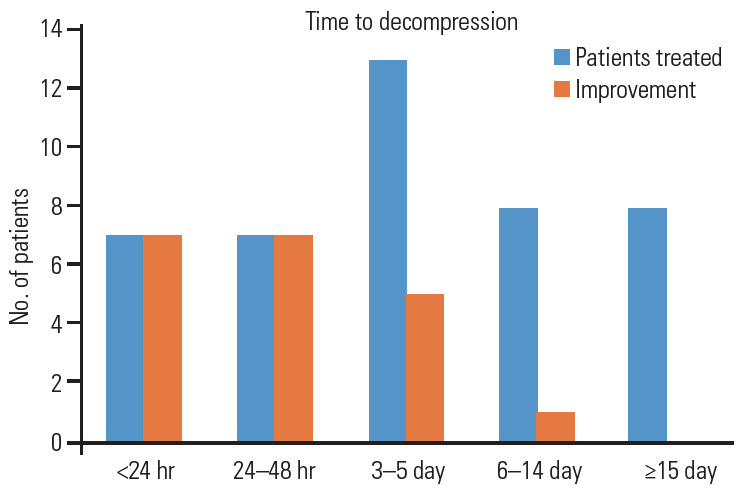
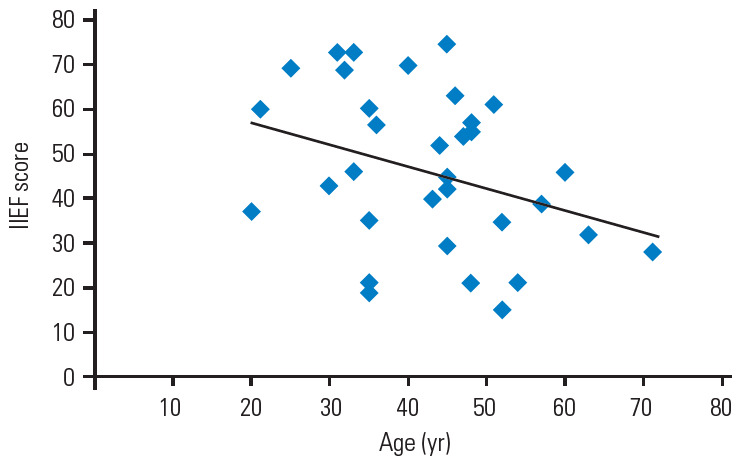
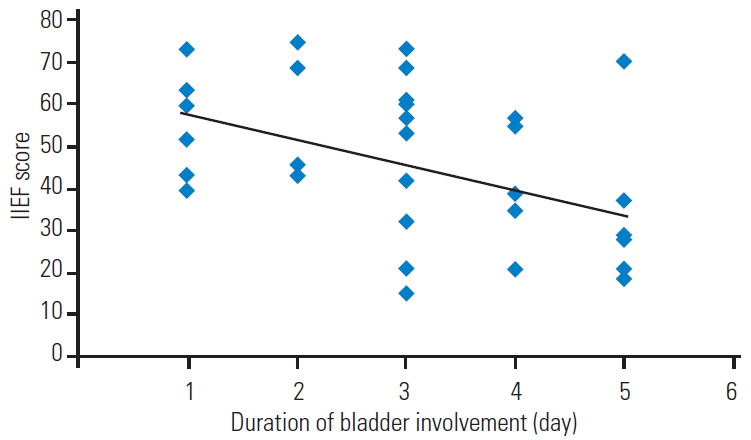
A total of 43 patients with up to 2.94-year follow-up were included. Urodynamic studies were found to correlate significantly with age, days of bladder involvement, perianal numbness, and motor weakness (p<0.01). In step-wise regression analysis, perianal sensation and overall motor weakness were bladder function determinants. Bladder function recovery was directly related to the number of delay days (t=2.30, p<0.05) and with unilateral leg pain (t=2.15, p<0.05). Significant correlation between SD with age and days of bladder involvement before surgery was found (p<0.01).
Surgery timing is related to patient's functional and sexual outcomes. Patients with unilateral leg pain and hypocontractile bladder have better outcomes. SD is a remarkable problem in CES.
回顾性队列研究。
分析马尾综合征(CES)患者的临床和括约肌功能结局以及性功能障碍(SD)的程度,并评估其与患者报告的参数以及临床/尿动力学参数之间的相关性。
尽管有大量关于CES的文献,但CES患者中SD问题的严重程度并未得到足够关注,文献中的信息有限即反映了这一点。对于发病时的确切患病率或恢复情况知之甚少。更好地了解腰椎间盘突出症继发的CES中的SD和膀胱功能障碍至关重要,因为它常见于性活跃年龄组。
纳入所有因腰椎间盘突出症继发马尾综合征的病例。记录患者的个人信息、临床数据、病史、检查结果、手术变量、恢复情况和SD情况。术前和术后均进行水囊测压和尿流率测定。分别使用国际勃起功能指数问卷和女性性功能指数评估男性和女性的SD。
共纳入43例患者,随访时间长达2.94年。发现尿动力学研究与年龄、膀胱受累天数、肛周麻木和运动无力显著相关(p<0.01)。在逐步回归分析中,肛周感觉和整体运动无力是膀胱功能的决定因素。膀胱功能恢复与延迟天数(t=2.30,p<0.05)和单侧腿痛(t=2.15,p<0.05)直接相关。发现SD与年龄和术前膀胱受累天数之间存在显著相关性(p<0.01)。
手术时机与患者的功能和性功能结局相关。患有单侧腿痛和膀胱收缩功能减退的患者预后较好。SD是CES中的一个显著问题。