
帕金森病患者当前及期望的生活质量:卡尔曼差距随抑郁加重而增大。
Current and Desired Quality of Life in People with Parkinson's Disease: the Calman Gap Increases with Depression.
作者信息
Prell Tino, Teschner Ulrike, Witte Otto W, Kunze Albrecht
机构信息
Department of Neurology, Jena University Hospital, 07747 Jena, Germany.
Center for Healthy Ageing, Jena University Hospital, 07747 Jena, Germany.
出版信息
J Clin Med. 2020 May 15;9(5):1496. doi: 10.3390/jcm9051496.
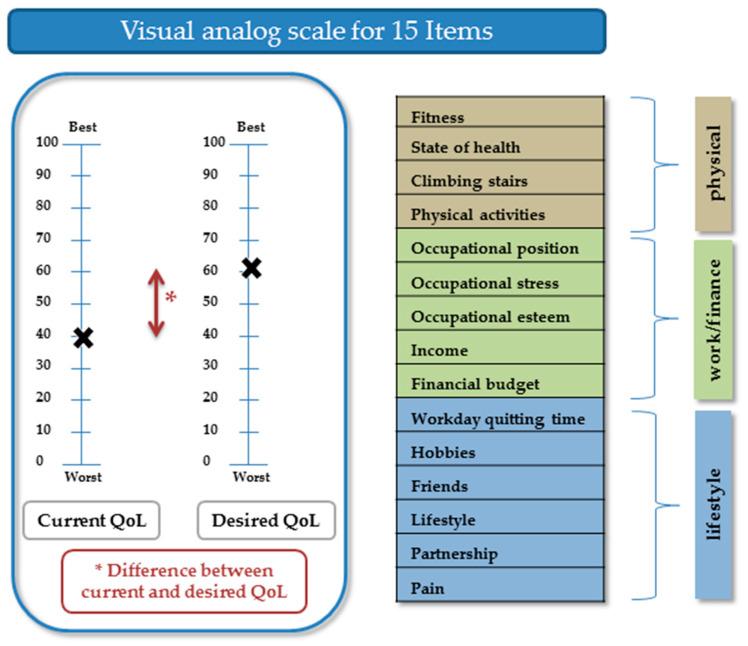
Hopes and expectations often differ from current experiences. This so-called Calman gap influences quality of life (QoL). We investigated this gap in 77 elderly patients with Parkinson's disease (PD), 25 patients with epilepsy, and 39 age-matched healthy older adults using a novel QoL questionnaire, where current and desired states were marked on a visual analogue scale. We studied the relationships between (1) epidemiological factors, (2) current and desired QoL, as well as the difference between the latter two. Current QoL was determined by depression, education level, living situation, and condition (PD, epilepsy, control). In contrast, desired QoL was essentially determined by the presence of a disease (condition), education level, and age, but not by depression. In particular, the presence of PD, lower education level, and higher age was correlated with lower expectations. In patients with PD, the gap between the current and desired QoL was largest for pain and physical functions. Accordingly, the significant effects of depression were observed only for mean current QoL, but not for desired QoL. Therefore, depression mainly influences current but not desired QoL in patients with PD. Depressed patients with PD had significantly worse QoL than PD patients without depression, although they both had almost the same desired QoL and hence, depressed PD patients had a larger Calman gap between current and desired QoL.
希望和期望往往与当前的体验不同。这种所谓的卡尔曼差距会影响生活质量(QoL)。我们使用一种新颖的生活质量问卷,对77例帕金森病(PD)老年患者、25例癫痫患者和39例年龄匹配的健康老年人进行了此项差距调查,该问卷通过视觉模拟量表来标记当前状态和期望状态。我们研究了(1)流行病学因素、(2)当前和期望的生活质量以及后两者之间的差异之间的关系。当前的生活质量由抑郁、教育水平、生活状况和病情(帕金森病、癫痫、对照组)决定。相比之下,期望的生活质量主要由疾病(病情)的存在、教育水平和年龄决定,而不是由抑郁决定。特别是,帕金森病的存在、较低的教育水平和较高的年龄与较低的期望相关。在帕金森病患者中,当前和期望的生活质量之间的差距在疼痛和身体功能方面最大。因此,仅在平均当前生活质量方面观察到抑郁的显著影响,而在期望的生活质量方面未观察到。因此,抑郁主要影响帕金森病患者当前的而非期望的生活质量。患有抑郁症的帕金森病患者的生活质量明显比没有抑郁症的帕金森病患者差,尽管他们的期望生活质量几乎相同,因此,患有抑郁症的帕金森病患者当前和期望的生活质量之间的卡尔曼差距更大。


 Zotero 插件