Department of Neurology, Affiliated Children's Hospital of Capital Institute of Pediatrics, Beijing, 100020, China.
Kaiumph Medical Diagnostics Co,Ltd, Beijing, 100102, China.
BMC Med Genomics. 2020 May 19;13(1):70. doi: 10.1186/s12920-020-0726-x.
Intellectual disability (ID) is a heterogeneous neurodevelopmental disorder with a complex genetic underpinning in its etiology. Chromosome microarray (CMA) is recommended as the first-tier diagnostic test for ID due to high detection rate of copy number variation (CNV).
To identify an appropriate clinical detection scheme for ID in Han Chinese patients, whole genome low-coverage sequencing was performed as the first-tier diagnostic test, and medical exome sequencing (MES) as the second-tier diagnostic test for patients with negative results of CNVs.
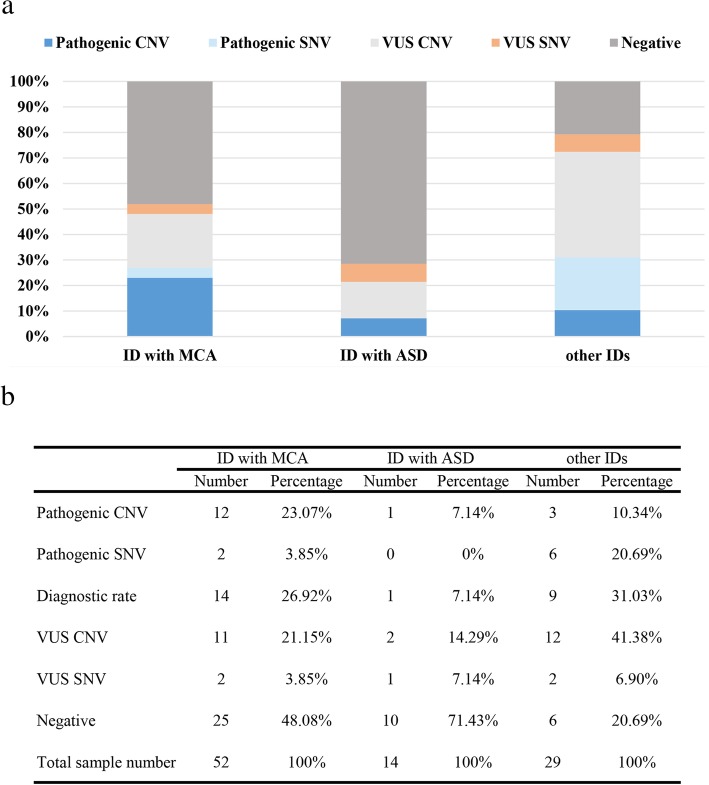
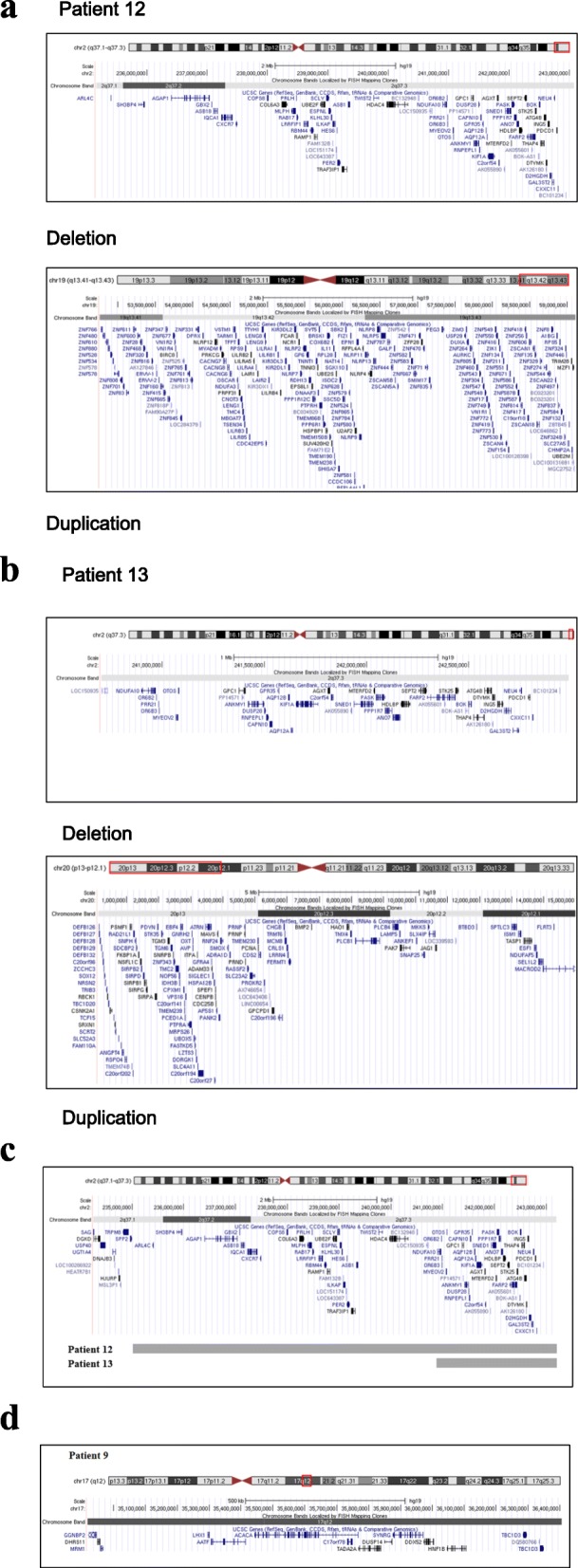
A total of 19 pathogenic CNVs in 16/95(16.84%) ID patients and 10 pathogenic single-nucleotide variations (SNVs), including 6 novel mutations in 8/95(8.42%) ID patients were identified on whom no pathogenic CNVs were discovered. The detection rate of CNVs in ID with multiple congenital anomalies (MCA) subgroup was significantly higher than ID with autism spectrum disorders and other IDs subgroups. And the single-nucleotide variations showed a higher occurrence rate in the other IDs subgroup.
There were differences in the diagnostic yields of different variation types among the three ID subgroups. Our findings provided a new perspective on appropriate clinical detection scheme in different ID subgroups based on statistically significant differences among the three ID subgroups. The application of whole genome low-coverage sequencing as the first-tier diagnostic test for ID with MCA subgroup and MES as the first-tier diagnostic test for other ID subgroup was considered as an efficient clinical detection scheme.
智力障碍(ID)是一种异质性神经发育障碍,其病因具有复杂的遗传基础。由于拷贝数变异(CNV)的高检测率,染色体微阵列(CMA)被推荐作为 ID 的一线诊断测试。
为了确定汉族患者 ID 的适当临床检测方案,我们首先进行全基因组低覆盖测序作为一线诊断测试,如果 CNV 结果为阴性,则进行医学外显子组测序(MES)作为二线诊断测试。
在 95 例 ID 患者中,共发现 16 例(16.84%)患者存在 19 种致病性 CNV,8 例(8.42%)患者存在 10 种致病性单核苷酸变异(SNV),包括 6 种新突变,这些患者未发现致病性 CNV。伴有多发先天畸形(MCA)亚组的 ID 患者中 CNV 的检出率明显高于伴有自闭症谱系障碍和其他 ID 亚组的患者。而单核苷酸变异在其他 ID 亚组中发生率更高。
三种 ID 亚组之间不同变异类型的诊断率存在差异。我们的研究结果基于三个 ID 亚组之间的统计学显著差异,为不同 ID 亚组提供了适当的临床检测方案的新视角。对于伴有 MCA 亚组的 ID,将全基因组低覆盖测序作为一线诊断测试,对于其他 ID 亚组,将 MES 作为一线诊断测试,可作为一种有效的临床检测方案。