Stessman Holly A F, Xiong Bo, Coe Bradley P, Wang Tianyun, Hoekzema Kendra, Fenckova Michaela, Kvarnung Malin, Gerdts Jennifer, Trinh Sandy, Cosemans Nele, Vives Laura, Lin Janice, Turner Tychele N, Santen Gijs, Ruivenkamp Claudia, Kriek Marjolein, van Haeringen Arie, Aten Emmelien, Friend Kathryn, Liebelt Jan, Barnett Christopher, Haan Eric, Shaw Marie, Gecz Jozef, Anderlid Britt-Marie, Nordgren Ann, Lindstrand Anna, Schwartz Charles, Kooy R Frank, Vandeweyer Geert, Helsmoortel Celine, Romano Corrado, Alberti Antonino, Vinci Mirella, Avola Emanuela, Giusto Stefania, Courchesne Eric, Pramparo Tiziano, Pierce Karen, Nalabolu Srinivasa, Amaral David G, Scheffer Ingrid E, Delatycki Martin B, Lockhart Paul J, Hormozdiari Fereydoun, Harich Benjamin, Castells-Nobau Anna, Xia Kun, Peeters Hilde, Nordenskjöld Magnus, Schenck Annette, Bernier Raphael A, Eichler Evan E
Department of Genome Sciences, University of Washington, Seattle, Washington, USA.
Department of Forensic Medicine and Institute of Brain Research, Tongji Medical College, Huazhong University of Science and Technology, Wuhan, China.
Nat Genet. 2017 Apr;49(4):515-526. doi: 10.1038/ng.3792. Epub 2017 Feb 13.
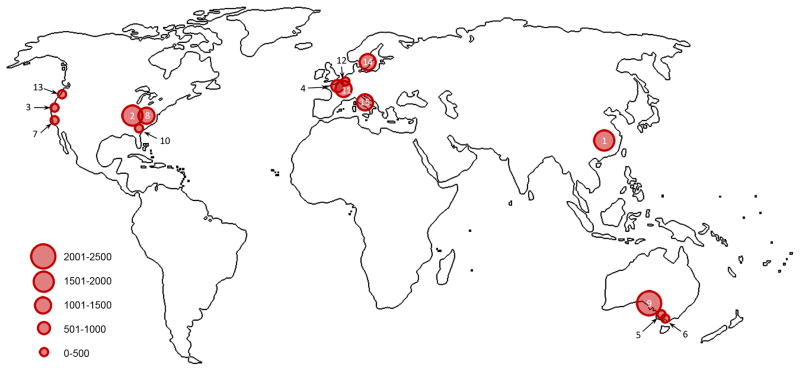
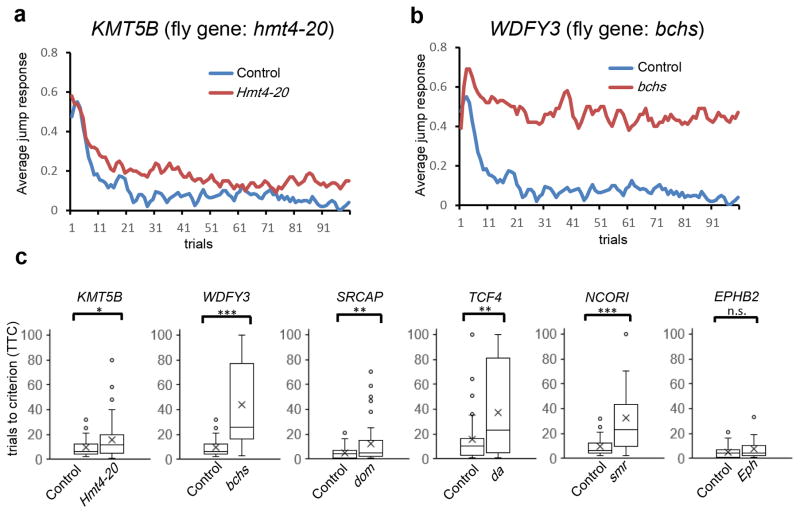
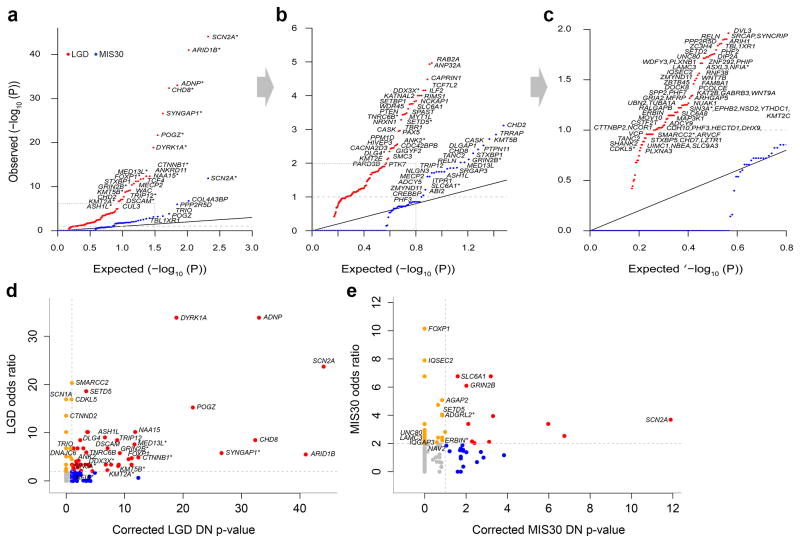
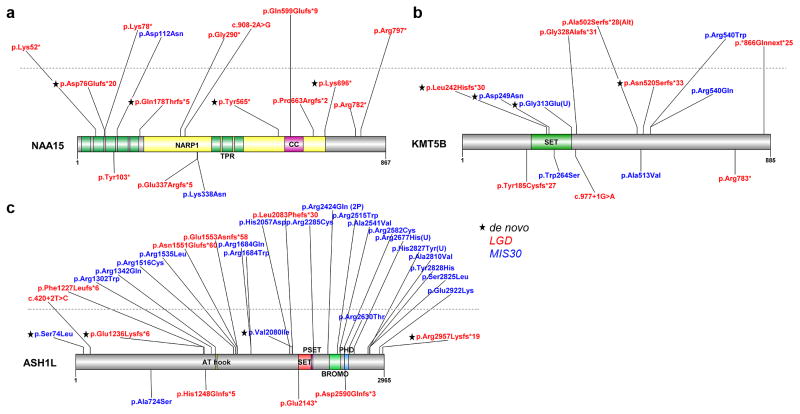
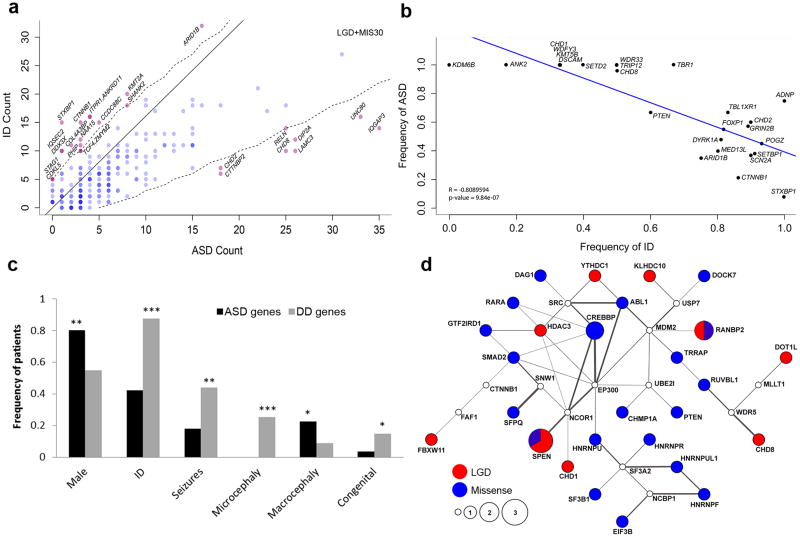
Gene-disruptive mutations contribute to the biology of neurodevelopmental disorders (NDDs), but most of the related pathogenic genes are not known. We sequenced 208 candidate genes from >11,730 cases and >2,867 controls. We identified 91 genes, including 38 new NDD genes, with an excess of de novo mutations or private disruptive mutations in 5.7% of cases. Drosophila functional assays revealed a subset with increased involvement in NDDs. We identified 25 genes showing a bias for autism versus intellectual disability and highlighted a network associated with high-functioning autism (full-scale IQ >100). Clinical follow-up for NAA15, KMT5B, and ASH1L highlighted new syndromic and nonsyndromic forms of disease.
基因破坏突变与神经发育障碍(NDDs)的生物学机制有关,但大多数相关致病基因尚不清楚。我们对来自11730多例病例和2867多例对照的208个候选基因进行了测序。我们鉴定出91个基因,包括38个新的NDD基因,在5.7%的病例中存在过量的新生突变或私人破坏突变。果蝇功能试验揭示了一部分与NDDs关联增加的基因。我们鉴定出25个在自闭症和智力障碍方面存在偏向性的基因,并突出了一个与高功能自闭症(全量表智商>100)相关的网络。对NAA15、KMT5B和ASH1L的临床随访突出了新的综合征型和非综合征型疾病形式。