Division of Respirology, Western University, London, Ontario, Canada.
Diagnostica per Immagini e Radiologia Interventistica, Policlinico Tor Vergata, University of Rome "Tor Vergata", Rome, Italy.
Respir Res. 2020 May 19;21(1):119. doi: 10.1186/s12931-020-01371-7.
Progression of the disease in idiopathic pulmonary fibrosis (IPF) is difficult to predict, due to its variable and heterogenous course. The relationship between radiographic progression and functional decline in IPF is unclear. We sought to confirm that a simple HRCT fibrosis visual score is a reliable predictor of mortality in IPF, when longitudinally followed; and to ascertain which pulmonary functional variables best reflect clinically significant radiographic progression.
One-hundred-twenty-three consecutive patients with IPF from 2 centers were followed for an average of 3 years. Longitudinal changes of HRCT fibrosis scores, forced vital capacity (FVC), total lung capacity and diffusing lung capacity for carbon monoxide were considered. HRCTs were scored by 2 chest radiologists. The primary outcome was lung transplant (LTx)-free survival after the follow-up HRCT.
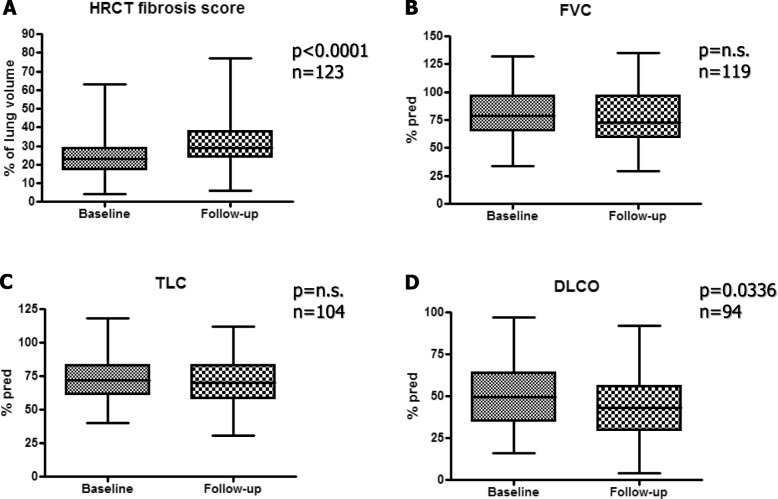
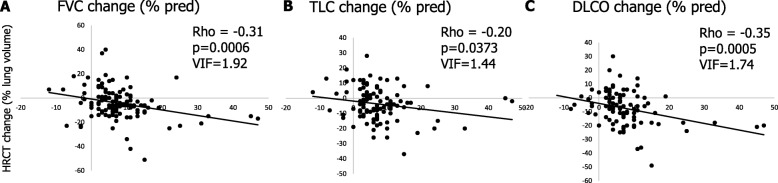
During the follow-up period, 43 deaths and 11 LTx occurred. On average, the HRCT fibrosis score increased significantly, and a longitudinal increase > 7% predicted LTx-free survival significantly, with good specificity, but limited sensitivity. The correlation between radiographic and functional progression was moderately significant. HRCT progression and FVC decline predicted LTx-free survival independently and significantly, with better sensitivity, but worse specificity for a ≥ 5% decline of FVC. However, the area under the curve towards LTx-survival were only 0.61 and 0.62, respectively.
The HRCT fibrosis visual score is a reliable and responsive tool to detect clinically meaningful disease progression. Although no individual pulmonary function test closely reflects radiographic progression, a longitudinal FVC decline improves sensitivity in the detection of clinically significant disease progression. However, the accuracy of these methods remains limited, and better prognostication models need to be found.
特发性肺纤维化(IPF)的疾病进展难以预测,因为其病程多变且异质。IPF 中的放射学进展与功能下降之间的关系尚不清楚。我们试图证实,当进行纵向随访时,简单的 HRCT 纤维化视觉评分是 IPF 死亡率的可靠预测指标;并确定哪些肺功能变量最能反映临床上有意义的放射学进展。
来自 2 个中心的 123 例连续 IPF 患者平均随访 3 年。考虑了 HRCT 纤维化评分、用力肺活量(FVC)、总肺活量和一氧化碳弥散量的纵向变化。HRCT 由 2 位胸部放射科医生进行评分。主要结局是随访 HRCT 后的肺移植(LTx)无生存。
在随访期间,有 43 例死亡和 11 例 LTx。平均而言,HRCT 纤维化评分显著增加,纵向增加>7%显著预测 LTx 无生存,特异性较好,但敏感性有限。放射学和功能进展之间的相关性中度显著。HRCT 进展和 FVC 下降独立且显著预测 LTx 无生存,对于 FVC 下降≥5%,敏感性更好,但特异性更差。然而,曲线下面积仅分别为 0.61 和 0.62。
HRCT 纤维化视觉评分是一种可靠且敏感的工具,可用于检测有临床意义的疾病进展。尽管没有单一的肺功能测试能密切反映放射学进展,但 FVC 的纵向下降提高了检测临床显著疾病进展的敏感性。然而,这些方法的准确性仍然有限,需要找到更好的预后模型。