Department of Biosciences, University of Salzburg, Hellbrunner Str. 34, A-5020, Salzburg, Austria.
Laboratory of Immunochemistry, WPI Immunology Frontier Research Center, Osaka University, Suita, Japan.
Curr Allergy Asthma Rep. 2020 May 19;20(7):25. doi: 10.1007/s11882-020-00918-4.
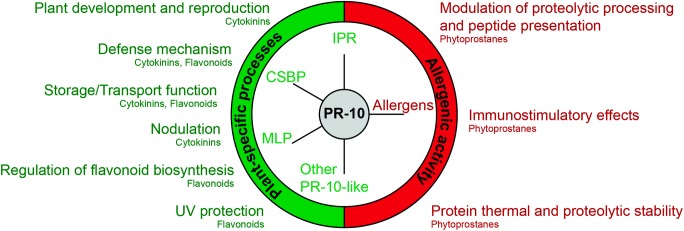
Pathogenesis-related class 10 (PR-10) proteins are highly conserved plant proteins, which are induced in response to abiotic and biotic stress factors. To date, no unique biological function could be assigned to them. Rather a more general role of PR-10 in plant development and defense mechanisms has been proposed. In addition, some PR-10 proteins act as allergens by triggering allergic symptoms in sensitized individuals. Regardless of the diversity of reported activities, all PR-10 proteins share a common fold characterized by a solvent-accessible hydrophobic cavity, which serves as a binding site for a myriad of small-molecule ligands, mostly phytohormones and flavonoids.
Most of available data relate to the ligand binding activity of allergenic PR-10, particularly for those belonging to Bet v 1 family of allergens. Bet v 1 and its homologues were shown to bind flavonoids with high affinity, but the specificity appears to differ between homologues from different species. The flavonoid Q3O-(Glc)-Gal was shown to specifically bind to hazelnut Cor a 1 but not to Bet v 1. Similarly, Q3OS bound only to the major isoform Bet v 1.0101 and not to other closely related isoforms. In contrast, Bet v 1 and hazelnut Cor a 1 showed very similar binding behavior towards other flavonoids such as quercetin, genistein, apigenin, daidzein, and resveratrol. Recent research findings highlighted the importance of more precise knowledge of ligand binding for understanding the functional diversification of PR-10 proteins.
病程相关蛋白 10(PR-10)是高度保守的植物蛋白,可响应非生物和生物胁迫因素诱导。迄今为止,尚未为其分配独特的生物学功能。而是提出了 PR-10 在植物发育和防御机制中的更普遍作用。此外,一些 PR-10 蛋白作为变应原起作用,通过在致敏个体中引发过敏症状。无论报道的活性多样性如何,所有 PR-10 蛋白都具有共同的折叠结构,其特征是溶剂可及的疏水性腔,该腔充当多种小分子配体(主要是植物激素和类黄酮)的结合位点。
大多数现有数据都与变应原 PR-10 的配体结合活性有关,特别是与属于 Bet v 1 家族的变应原有关。已显示 Bet v 1 及其同源物与类黄酮具有高亲和力结合,但同种异体之间的特异性似乎有所不同。类黄酮 Q3O-(Glc)-Gal 被证明特异性结合榛子 Cor a 1,但不与 Bet v 1 结合。同样,Q3OS 仅与主要同工型 Bet v 1.0101 结合,而不与其他密切相关的同工型结合。相比之下,Bet v 1 和榛子 Cor a 1 对其他类黄酮(如槲皮素、染料木黄酮、芹菜素、大豆苷元和白藜芦醇)表现出非常相似的结合行为。最近的研究结果强调了更准确地了解配体结合对于理解 PR-10 蛋白功能多样化的重要性。