Health Service and Population Research, The Institute of Psychiatry, Psychology and Neuroscience, King's College London, David Goldberg Building, 16 De Crespigny Park, London, SE5 8AF, UK.
Psychological Medicine, The Institute of Psychiatry, Psychology and Neuroscience, King's College London, London, UK.
J Immigr Minor Health. 2020 Oct;22(5):1055-1064. doi: 10.1007/s10903-020-01025-2.
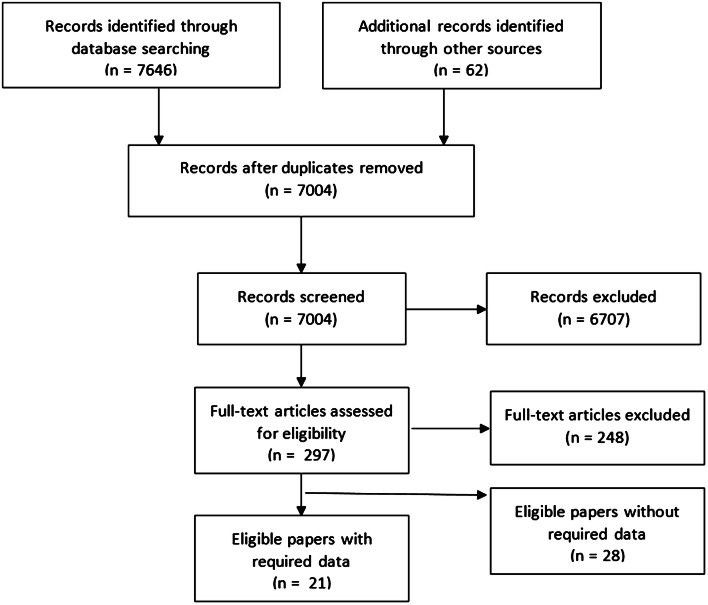
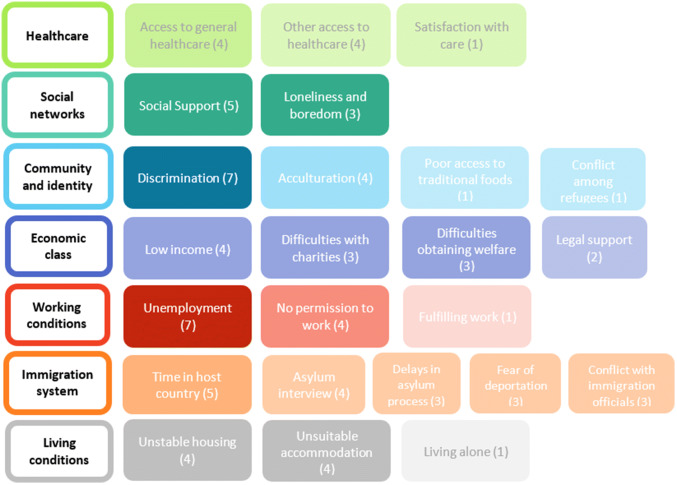
People seeking asylum are at an increased risk of mental disorder compared to refugees and other migrants. This paper aims to understand the impact of postmigration social-environmental factors to help inform efforts to reduce rates of mental disorder. We conducted a systematic review searching 11 databases, as well as 6 government and nongovernment websites. We asked 5 experts for recommendations, and carried out forwards and backwards citation tracking. From 7004 papers 21 were eligible and had the appropriate data. Narrative synthesis was conducted. 24 Social-environmental factors were identified and categorised into 7 themes: working conditions, social networks, economic class, living conditions, healthcare, community and identity, and the immigration system. Evidence suggests that discrimination and post-migration stress are associated with increased rates of mental disorder. The post-migration environment influences the mental health of people seeking asylum. Discrimination and post-migration stress are key factors, warranting further research and public attention.
与难民和其他移民相比,寻求庇护者患精神障碍的风险更高。本文旨在了解后移民社会环境因素的影响,以帮助减少精神障碍的发生率。我们进行了系统的文献检索,检索了 11 个数据库,以及 6 个政府和非政府网站。我们向 5 位专家征求了建议,并进行了追溯和回溯引文追踪。从 7004 篇论文中,有 21 篇符合条件并具有适当的数据。进行了叙述性综合。确定了 24 个社会环境因素,并将其分为 7 个主题:工作条件、社交网络、经济阶层、生活条件、医疗保健、社区和身份以及移民制度。有证据表明,歧视和后移民压力与精神障碍发生率的增加有关。后移民环境会影响寻求庇护者的心理健康。歧视和后移民压力是关键因素,值得进一步研究和引起公众关注。