1Neglected Tropical Diseases and Other Parasitic Diseases Unit, Rwanda Biomedical Center, Ministry of Health, Kigali, Rwanda.
2Malaria and Other Parasitic Diseases Division, Rwanda Biomedical Center, Ministry of Health, Kigali, Rwanda.
Am J Trop Med Hyg. 2020 Jul;103(1):315-324. doi: 10.4269/ajtmh.19-0866. Epub 2020 May 14.
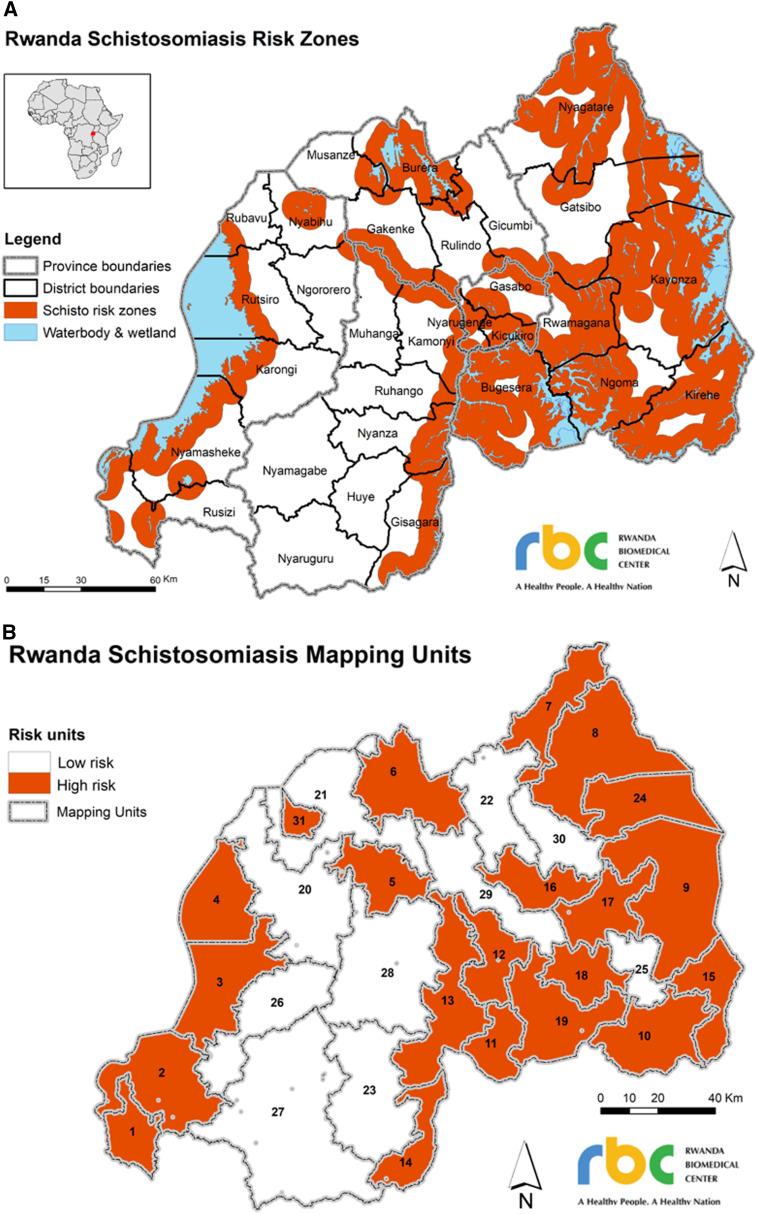
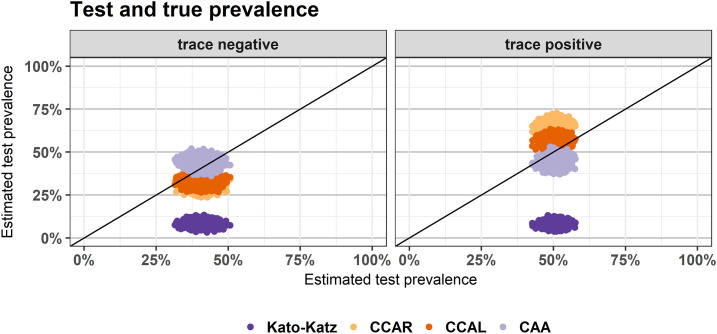
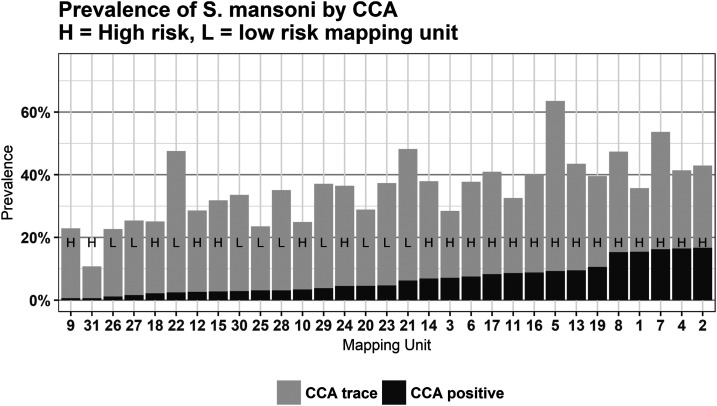
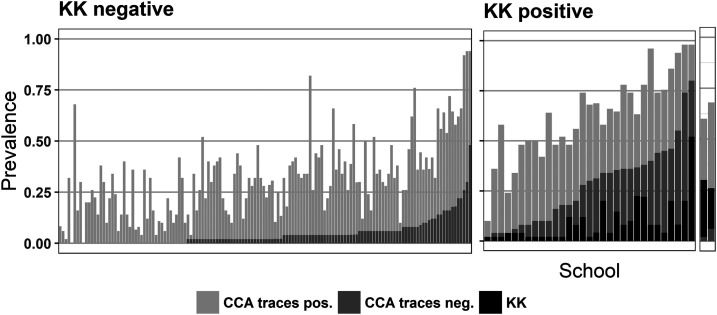
The field standard for the detection of infection is Kato-Katz (KK), although it misses many active infections, especially light infections. In 2014, a reassessment of prevalence was conducted in Rwanda using the more sensitive point-of-care circulating cathodic antigen (POC-CCA) rapid assay. A total of 19,371 children from 399 schools were selected for testing for single urine CCA. Of these, 8,697 children from 175 schools were also tested with single stool double-slide KK. Samples from eight of these 175 schools were tested again with CCA and additionally with the highly specific and sensitive up-converting phosphor-lateral flow circulating anodic antigen (UCP-LF CAA) assay. Latent class analysis was applied to all four test results to assess sensitivity and specificity of POC-CCA and estimate the proportion of trace results from Rwanda likely to be true infections. The overall prevalence of infection in Rwanda when CCA trace results were considered negative was 7.4% (school interquartile range [IQR] 0-8%) and 36.1% (school IQR 20-47%) when trace was considered positive. Prevalence by KK was 2.0% with a mean intensity of infection of 1.66 eggs per gram. The proportion of active infections among children diagnosed with CCA trace was estimated by statistical analysis at 61% (Bayesian credibility interval: 50-72%). These results indicate that infection is still widespread in Rwanda and prevalence is much underestimated by KK testing. Circulating cathodic antigen is an affordable alternative to KK and more suitable for measuring prevalence in low-intensity regions.
检测感染的现场标准是加藤厚涂片法(KK),尽管它错过了许多活动性感染,尤其是轻度感染。2014 年,卢旺达使用更敏感的即时循环阴极抗原(POC-CCA)快速检测法对患病率进行了重新评估。从 399 所学校中选择了 19371 名儿童进行单次尿 CCA 检测。其中,来自 175 所学校的 8697 名儿童还接受了单次粪便双涂片 KK 检测。从这 175 所学校中的 8 所再次对样本进行了 CCA 检测,并另外使用高度特异和敏感的上转换磷侧向流动循环阳极抗原(UCP-LF CAA)检测法进行了检测。将潜类别分析应用于所有四个检测结果,以评估 POC-CCA 的敏感性和特异性,并估计来自卢旺达的痕量结果中可能真正感染的比例。当将 CCA 痕量结果视为阴性时,卢旺达的总体感染率为 7.4%(学校四分位距 [IQR] 0-8%),当痕量结果视为阳性时,感染率为 36.1%(学校 IQR 20-47%)。KK 的感染率为 2.0%,感染强度的平均值为每克 1.66 个卵。通过统计分析估计,CCA 痕量诊断的儿童中活跃感染的比例为 61%(贝叶斯可信度区间:50-72%)。这些结果表明,感染在卢旺达仍然很普遍,KK 检测大大低估了感染率。循环阴极抗原是 KK 的一种经济实惠的替代品,更适合在低强度地区测量感染率。