Decarolis Francesco, Polyakova Maria, Ryan Stephen P
Universita Bocconi and IGIER.
Stanford University, CESifo, and NBER.
J Polit Econ. 2020 May;128(5):1712-1752. doi: 10.1086/705550. Epub 2020 Mar 18.
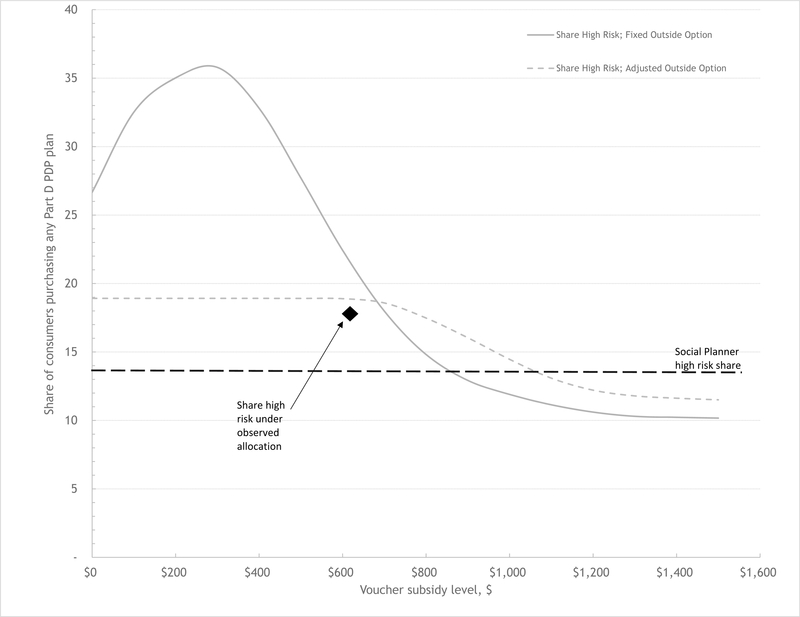
The efficiency of publicly-subsidized, privately-provisioned social insurance programs depends on the interaction between strategic insurers and the subsidy mechanism. We study this interaction in the context of Medicare's prescription drug coverage program. We find that the observed mechanism is successful in keeping "raise-the-subsidy" incentives relatively low, acts much like a flat voucher, and obtains a level of welfare close to the optimal voucher. Across a range of counterfactuals, we find that more efficient subsidy mechanisms share three features: they retain the marginal elasticity of demand, limit the exercise of market power, and preserve the link between prices and marginal costs.
公共补贴、私人提供的社会保险计划的效率取决于战略保险公司与补贴机制之间的相互作用。我们在医疗保险的处方药覆盖计划背景下研究这种相互作用。我们发现,观察到的机制成功地将“提高补贴”的激励措施保持在相对较低水平,其作用类似于统一凭证,并获得了接近最优凭证的福利水平。在一系列反事实情况下,我们发现更有效的补贴机制具有三个特征:它们保留了需求的边际弹性,限制了市场力量的行使,并保持了价格与边际成本之间的联系。