Hu Jiaojiao, Zheng Qiuling
Key Laboratory of Drug Metabolism and Pharmacokinetics, State Key Laboratory of Natural Medicines, Department of Pharmaceutical Analysis, School of Pharmacy, China Pharmaceutical University, Nanjing, China.
Front Chem. 2020 May 5;8:324. doi: 10.3389/fchem.2020.00324. eCollection 2020.
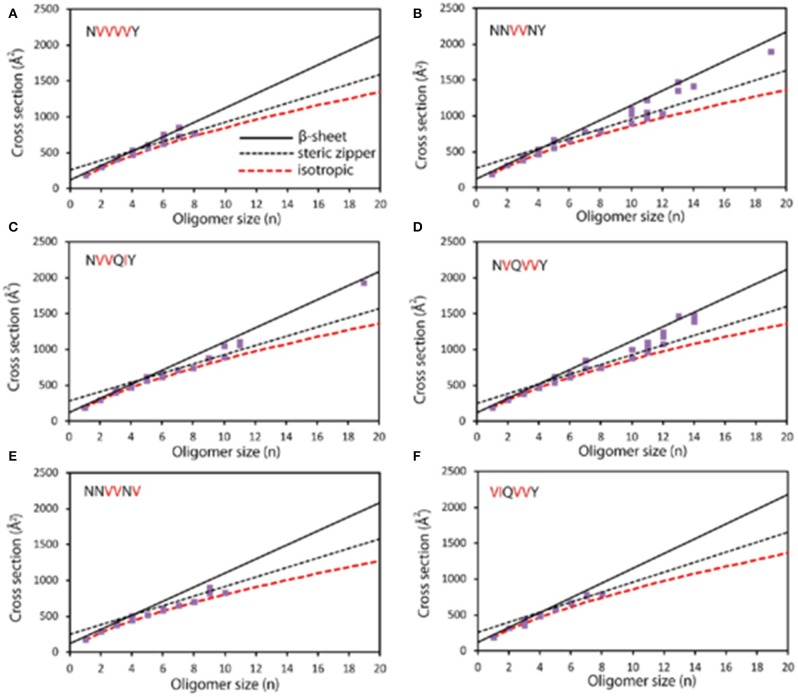
Amyloid fibril formation is a hallmark of diverse neurodegenerative and metabolic diseases, such as Alzheimer's disease (AD), Parkinson's disease (PD), and type 2 diabetes mellitus (T2DM). Conventional diagnosis is based on the appearance of fibrils or plaques, while neglects the role of early-stage oligomers in the disease progression. Recent studies have uncovered that it is the early-stage oligomer, rather than the mature fibril, that greatly contributes cytotoxicity. The formation of oligomers involves complicate structural conversions and it is essential to investigate their conformational changes for a better understanding of aggregation mechanism. The coexistence of soluble early-stage oligomers, intermediates, and pre-fibril species makes it difficult to be differentiate by morphological methods, and only average structural information is provided as they lack the ability of separation. Therefore, mass spectrometry (MS) becomes an alternative technique that presents new and complementary insights into the onset of amyloid fibrils. This review highlights the hotspots and important achievements by MS in the field of amyloid formation mechanism, including the direct detection and differentiation of soluble oligomers (native MS), unambiguous identification of interacted sites involved in the onset of aggregation [hydrogen/deuterium exchange (HDX) and chemical cross-linking (CX)], and conformational switch that leads to fibrilization [collision cross section (CCS) regularity by ion mobility (IM)].
淀粉样纤维形成是多种神经退行性疾病和代谢性疾病的标志,如阿尔茨海默病(AD)、帕金森病(PD)和2型糖尿病(T2DM)。传统诊断基于纤维或斑块的出现,而忽视了早期寡聚体在疾病进展中的作用。最近的研究发现,是早期寡聚体而非成熟纤维对细胞毒性有很大贡献。寡聚体的形成涉及复杂的结构转变,研究其构象变化对于更好地理解聚集机制至关重要。可溶性早期寡聚体、中间体和前纤维物种的共存使得通过形态学方法难以区分,并且由于它们缺乏分离能力,只能提供平均结构信息。因此,质谱(MS)成为一种替代技术,为淀粉样纤维的形成提供了新的补充见解。本综述重点介绍了质谱在淀粉样形成机制领域的热点和重要成果,包括可溶性寡聚体的直接检测和区分(天然质谱)、明确识别聚集起始过程中涉及的相互作用位点[氢/氘交换(HDX)和化学交联(CX)]以及导致纤维化的构象转换[通过离子淌度(IM)的碰撞截面(CCS)规律]。