Analytical Chemistry-Center for Electrochemical Sciences (CES), Faculty of Chemistry and Biochemistry, Ruhr University Bochum, Universitätsstr. 150, 44780, Bochum, Germany.
Max Planck Institute for Chemical Energy Conversion, Stiftstrasse 34-36, 45470, Mülheim an der Ruhr, Germany.
Angew Chem Int Ed Engl. 2020 Sep 14;59(38):16506-16510. doi: 10.1002/anie.202006824. Epub 2020 Jul 21.
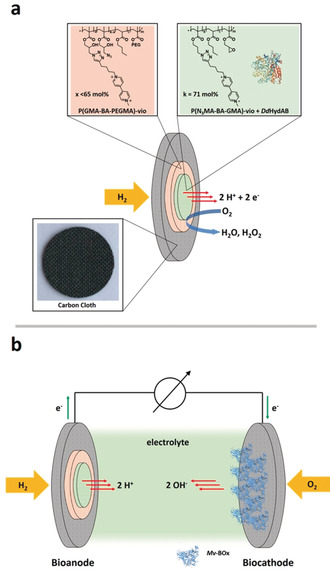
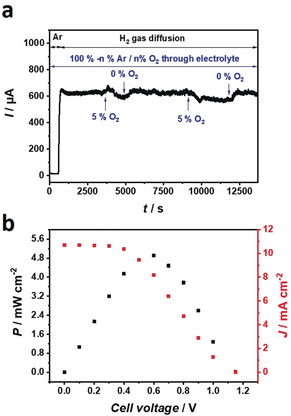
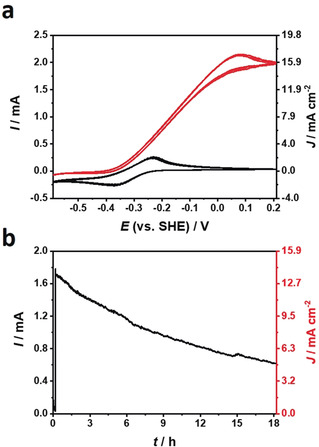
The incorporation of highly active but also highly sensitive catalysts (e.g. the [FeFe] hydrogenase from Desulfovibrio desulfuricans) in biofuel cells is still one of the major challenges in sustainable energy conversion. We report the fabrication of a dual-gas diffusion electrode H /O biofuel cell equipped with a [FeFe] hydrogenase/redox polymer-based high-current-density H -oxidation bioanode. The bioanodes show benchmark current densities of around 14 mA cm and the corresponding fuel cell tests exhibit a benchmark for a hydrogenase/redox polymer-based biofuel cell with outstanding power densities of 5.4 mW cm at 0.7 V cell voltage. Furthermore, the highly sensitive [FeFe] hydrogenase is protected against oxygen damage by the redox polymer and can function under 5 % O .
将高活性但也高度敏感的催化剂(例如来自脱硫弧菌的 [FeFe]氢化酶)纳入生物燃料电池仍然是可持续能源转化的主要挑战之一。我们报告了一种配备 [FeFe]氢化酶/氧化还原聚合物的高电流密度 H -氧化生物阳极的双气体扩散电极 H / O 生物燃料电池的制造。生物阳极的电流密度约为 14 mA cm,相应的燃料电池测试显示出基于氢化酶/氧化还原聚合物的生物燃料电池的基准,在 0.7 V 电池电压下具有出色的功率密度为 5.4 mW cm。此外,高度敏感的 [FeFe]氢化酶受到氧化还原聚合物的保护,免受氧气的损害,并且可以在 5% O 下运行。