Department of Internal Medicine, Inha University Hospital, Inha University School of Medicine, Incheon, South Korea.
Department of Biomedical Sciences, College of Medicine, Inha University, Incheon, South Korea.
Sci Rep. 2020 May 20;10(1):8347. doi: 10.1038/s41598-020-65460-9.
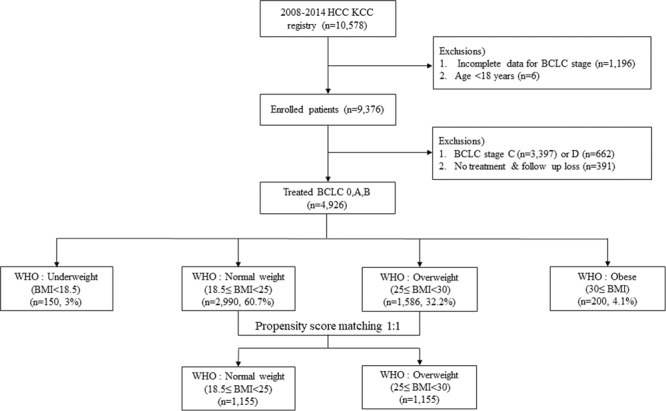
Body mass index (BMI) is known to be closely related to the prognosis and mortality of various diseases. The aim of our study was to evaluate differences in post-treatment overall survival (OS) according to BMI with hepatocellular carcinoma (HCC) and to understand the meaning of BMI. Among the records of 10,578 HCC patients registered at the Korean Central Cancer Registry from 2008 through 2014, we selected Barcelona Clinic Liver Cancer (BCLC) 0, A, and B staged HCC patients (n = 4,926). HCC patients showed a good prognosis in the order of overweight, normal weight, obesity, and underweight. However, comparing normal-weight (BMI 18.5-24.9 kg/m) to overweight (BMI 25-29.9 kg/m) after propensity score matching (PSM), there was no significant difference in OS (p = 0.153). Overweight males had a better prognosis than normal-weight males (p = 0.014), but, normal-weight females had a better prognosis than overweight. To determine the gender-specific OS differences, we examined the differences according to the HCC treatment type. In males, overweight patients had better OS after transarterial chemoembolization (TACE) (p = 0.039) than normal-weight, but not after surgical resection (p = 0.618) nor radiofrequency ablation (p = 0.553). However, in females, all of those HCC treatments resulted in significantly better OS in normal-weight patients than overweight. In patients with HCC of BCLC stages 0-B, unlike females, overweight males had a better prognosis than normal-weight, especially among TACE-treated patients. Our results carefully suggest that the meaning of normal BMI in patients with HCC may have gender difference.
体重指数(BMI)与各种疾病的预后和死亡率密切相关。本研究旨在评估与肝细胞癌(HCC)的 BMI 相关的治疗后总生存期(OS)差异,并了解 BMI 的意义。在 2008 年至 2014 年期间,从韩国中央癌症登记处登记的 10578 名 HCC 患者的记录中,我们选择了巴塞罗那临床肝癌(BCLC)0、A 和 B 期 HCC 患者(n=4926)。HCC 患者的预后按超重、正常体重、肥胖和体重不足的顺序较好。然而,在倾向评分匹配(PSM)后,与正常体重(BMI 18.5-24.9kg/m)相比,超重(BMI 25-29.9kg/m)的 OS 没有显著差异(p=0.153)。超重男性的预后好于正常体重男性(p=0.014),但正常体重女性的预后好于超重女性。为了确定性别特异性 OS 差异,我们根据 HCC 治疗类型检查了差异。在男性中,超重患者在经动脉化疗栓塞(TACE)后 OS 更好(p=0.039),而不是正常体重(p=0.618)或手术切除(p=0.553)。然而,在女性中,所有这些 HCC 治疗在正常体重患者中的 OS 都明显好于超重患者。在 BCLC 分期 0-B 的 HCC 患者中,与女性不同,超重男性的预后好于正常体重男性,尤其是 TACE 治疗患者。我们的结果表明,正常 BMI 在 HCC 患者中的意义可能存在性别差异。