Department of Emergency, Peking Union Medical College Hospital, Peking Union Medical College and Chinese Academy of Medical Sciences, Beijing, 100730, China.
Department of Cardiology, Fuwai Hospital, National Center for Cardiovascular Disease, Chinese Academy of Medical Sciences and Peking Union Medical College, Beijing, 100037, China.
Sci Rep. 2020 May 20;10(1):8359. doi: 10.1038/s41598-020-65128-4.
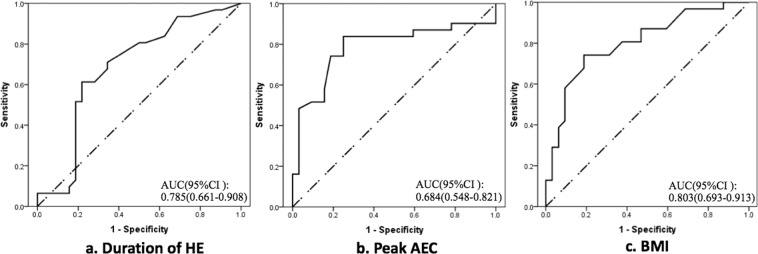
Idiopathic hypereosinophilia (IHE) and hypereosinophilic syndrome (HES) are benign haematological disorders. Studies have suggested that venous thromboembolism (VTE) is a rare but sometimes fatal complication of hypereosinophilia; however, data are limited. We retrospectively analysed clinical features and short-term outcomes of 63 consecutive patients (82.5% men; mean age, 40.92 ± 10.89 years) with IHE or HES with concurrent VTE from January 1998 through December 2018. Risk factors for pulmonary embolism (PE) were explored by multivariate logistic analysis. DVT and/or PE was detected by imaging in all patients. Independent risk factors for PE were a body mass index of >24.1 kg/m (odds ratio [OR]: 5.62, 95% confidence interval [CI]: 1.21-26.13, P = 0.028), peak absolute eosinophil count of >6.3 × 10/L (OR: 5.55, 95% CI: 1.292-23.875, P = 0.021), and >13.9-month duration of hypereosinophilia (OR: 4.51, 95% CI: 1.123-18.09, P = 0.034). All patients were treated with corticosteroids and anticoagulants. The short-term hypereosinophilia remission rate was 100%; no recurrent VTE or major bleeding was observed. Hypereosinophilia is a potential risk factor for VTE. PE in patients with IHE/HES and DVT is associated with a higher body mass index, higher peak absolute eosinophil count, and longer duration of hypereosinophilia. Corticosteroids and anticoagulants provided effective short-term control of hypereosinophilia and VTE.
特发性嗜酸性粒细胞增多症(IHE)和嗜酸性粒细胞增多症综合征(HES)是良性血液系统疾病。研究表明,静脉血栓栓塞症(VTE)是嗜酸性粒细胞增多症的一种罕见但有时致命的并发症;然而,相关数据有限。我们回顾性分析了 1998 年 1 月至 2018 年 12 月期间 63 例 IHE 或 HES 合并 VTE 的连续患者(82.5%为男性;平均年龄 40.92±10.89 岁)的临床特征和短期结局。通过多变量逻辑分析探讨了肺栓塞(PE)的危险因素。所有患者均通过影像学检查检测到 DVT 和/或 PE。PE 的独立危险因素为 BMI>24.1kg/m(比值比[OR]:5.62,95%置信区间[CI]:1.21-26.13,P=0.028)、绝对嗜酸性粒细胞计数峰值>6.3×10/L(OR:5.55,95% CI:1.292-23.875,P=0.021)和嗜酸性粒细胞增多持续时间>13.9 个月(OR:4.51,95% CI:1.123-18.09,P=0.034)。所有患者均接受了皮质类固醇和抗凝治疗。短期内嗜酸性粒细胞增多症缓解率为 100%;未观察到 VTE 复发或大出血。嗜酸性粒细胞增多症是 VTE 的潜在危险因素。IHE/HES 合并 DVT 的患者发生 PE 与更高的 BMI、更高的绝对嗜酸性粒细胞计数峰值和更长的嗜酸性粒细胞增多持续时间有关。皮质类固醇和抗凝治疗为嗜酸性粒细胞增多症和 VTE 提供了有效的短期控制。