Department of Systematics, Biodiversity and Evolution of Plants, Albrecht-von-Haller Institute for Plant Sciences, University of Goettingen, Untere Karspuele 2, 37073, Goettingen, Germany.
Georg-August University School of Science, University of Goettingen, Goettingen, Germany.
Sci Rep. 2020 May 20;10(1):8319. doi: 10.1038/s41598-020-64982-6.
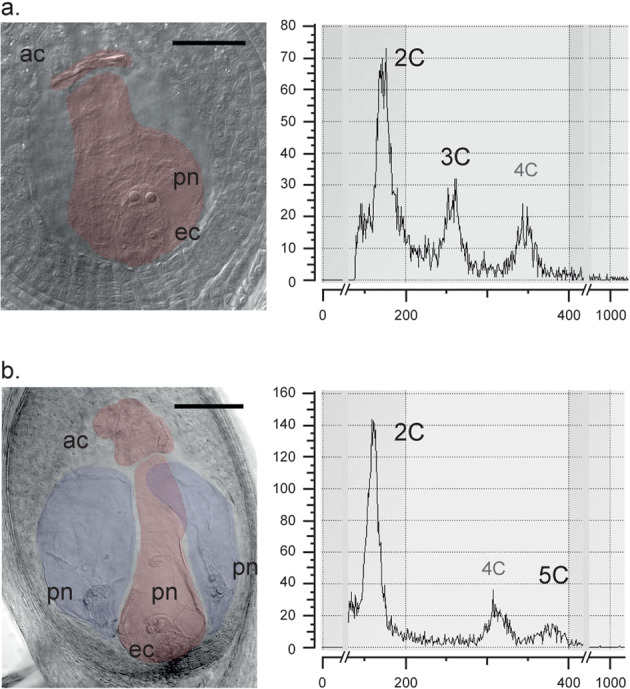
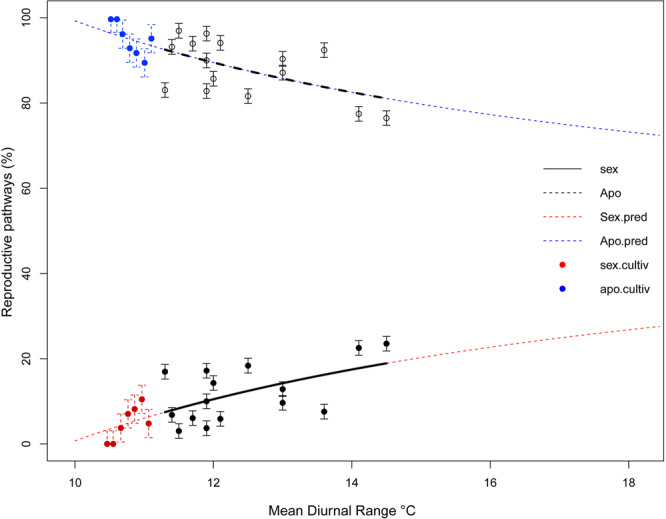
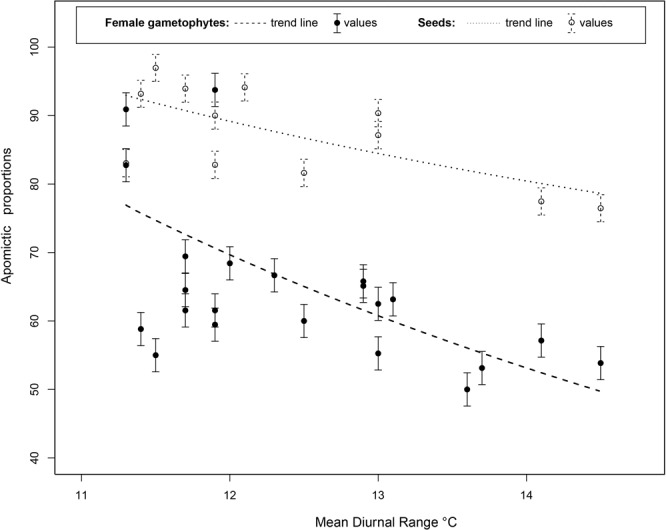
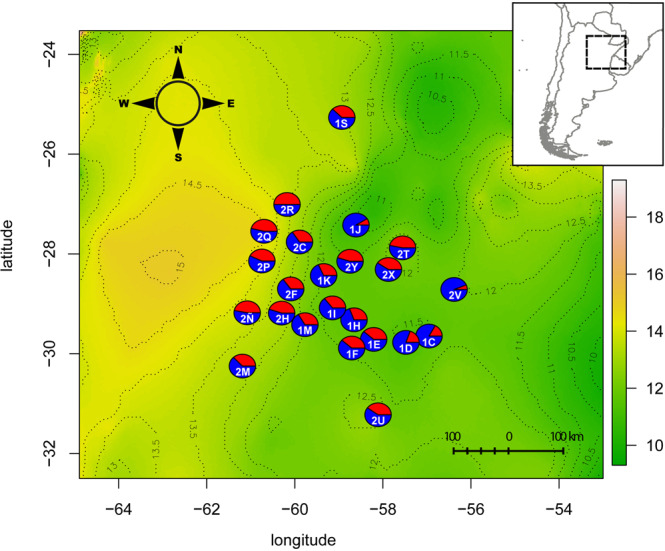
In systems alternating between sexual and asexual reproduction, sex increases under unfavorable environmental conditions. In plants producing sexual and asexual (apomictic) seeds, studies on the influence of environmental factors on sex are equivocal. We used Paspalum intermedium to study environmental effects on the expression of sexual and apomictic developments, and on resulting reproductive fitness variables. Flow cytometric and embryological analyses were performed to characterize ploidy and reproductive modes, and effects of local climatic conditions on sexual and apomictic ovule and seed frequencies were determined. Seed set and germination data were collected and used to estimate reproductive fitness. Frequencies of sexual and apomictic ovules and seeds were highly variable within and among populations. Apomictic development exhibited higher competitive ability but lower overall fitness. Frequencies of sexual reproduction in facultative apomictic plants increased at lower temperatures and wider mean diurnal temperature ranges. We identified a two-fold higher fitness advantage of sexuality and a Tug of War between factors intrinsic to apomixis and environmental stressors promoting sexuality which influence the distribution of sex in apomictic populations. This points toward a crucial role of local ecological conditions in promoting a reshuffling of genetic variability that may be shaping the adaptative landscape in apomictic P. intermedium plants.
在有性生殖和无性生殖交替的系统中,性在不利的环境条件下会增加。在产生有性和无性(无融合生殖)种子的植物中,关于环境因素对性的影响的研究结果并不一致。我们使用中间雀稗来研究环境对有性和无融合生殖发育的表达以及由此产生的生殖适应性变量的影响。通过流式细胞术和胚胎学分析来表征倍性和生殖方式,并确定当地气候条件对有性和无融合生殖胚珠和种子频率的影响。收集种子设置和发芽数据,并用于估计生殖适应性。有性和无性胚珠和种子的频率在种群内和种群间都存在高度的可变性。无融合生殖发育表现出更高的竞争力,但整体适应性较低。在兼性无融合生殖植物中,有性生殖的频率随着温度的降低和平均昼夜温差的增大而增加。我们发现,有性生殖的适应性高出两倍,而无融合生殖内在因素与促进有性生殖的环境胁迫因素之间存在着拔河比赛,这影响了无融合生殖群体中性的分布。这表明当地生态条件在促进遗传变异性的重新组合方面起着至关重要的作用,这种变异性可能正在塑造无融合生殖中间雀稗植物的适应景观。