Odum School of Ecology, University of Georgia, Athens, Georgia, United States of America.
Center for the Ecology of Infectious Diseases, University of Georgia, Athens, Georgia, United States of America.
PLoS Biol. 2020 May 20;18(5):e3000697. doi: 10.1371/journal.pbio.3000697. eCollection 2020 May.
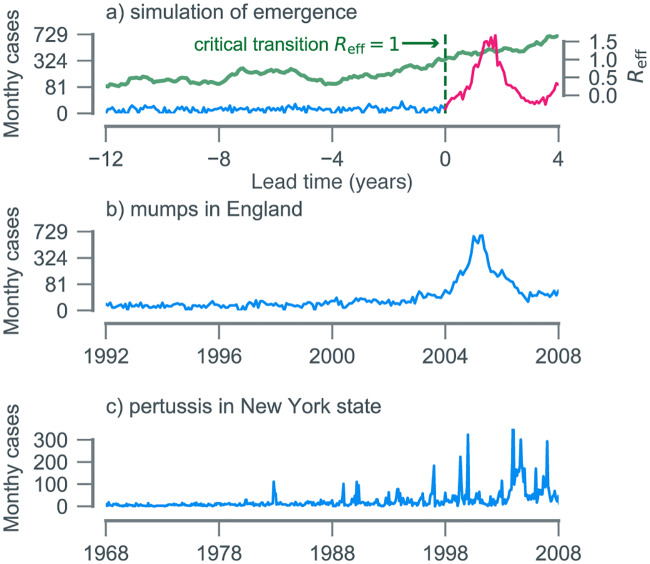
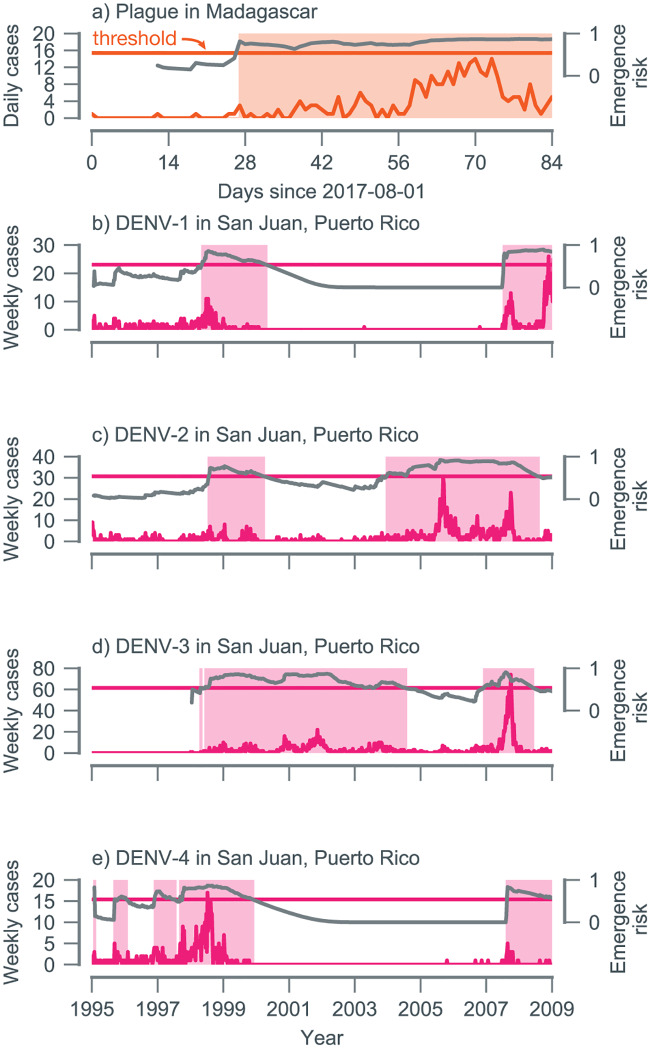
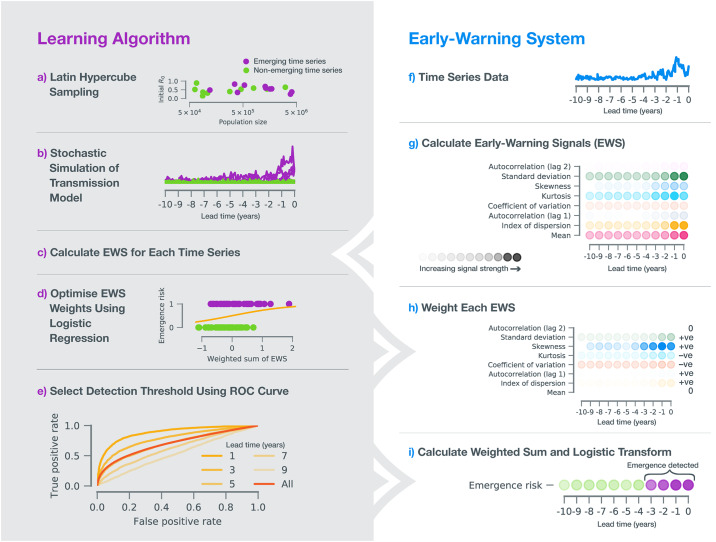
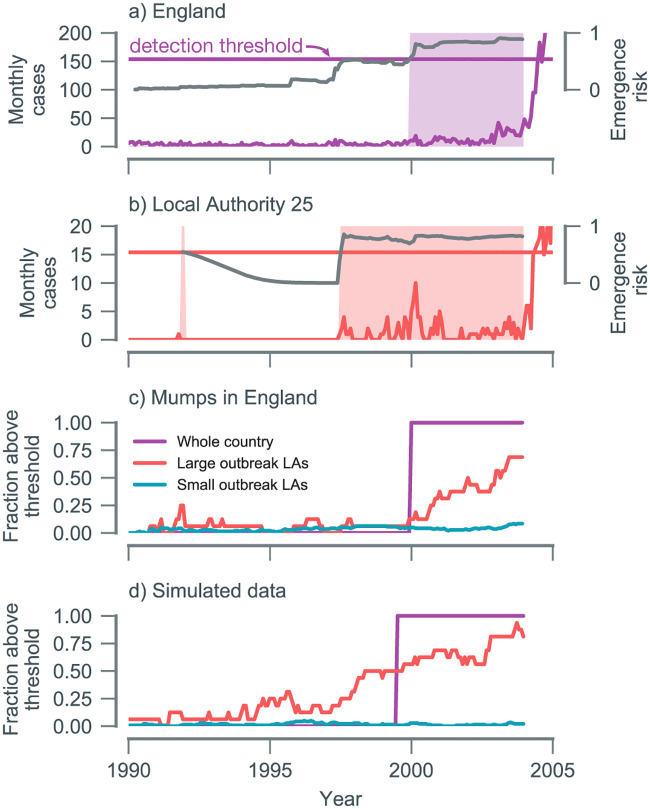
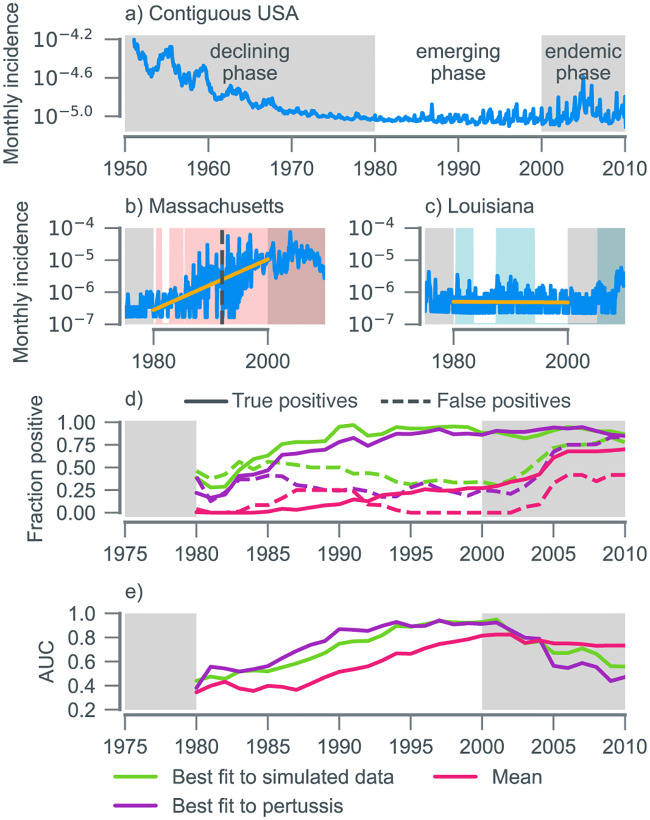
Developing methods for anticipating the emergence or reemergence of infectious diseases is both important and timely; however, traditional model-based approaches are stymied by uncertainty surrounding the underlying drivers. Here, we demonstrate an operational, mechanism-agnostic detection algorithm for disease (re-)emergence based on early warning signals (EWSs) derived from the theory of critical slowing down. Specifically, we used computer simulations to train a supervised learning algorithm to detect the dynamical footprints of (re-)emergence present in epidemiological data. Our algorithm was then challenged to forecast the slowly manifesting, spatially replicated reemergence of mumps in England in the mid-2000s and pertussis post-1980 in the United States. Our method successfully anticipated mumps reemergence 4 years in advance, during which time mitigation efforts could have been implemented. From 1980 onwards, our model identified resurgent states with increasing accuracy, leading to reliable classification starting in 1992. Additionally, we successfully applied the detection algorithm to 2 vector-transmitted case studies, namely, outbreaks of dengue serotypes in Puerto Rico and a rapidly unfolding outbreak of plague in 2017 in Madagascar. Taken together, these findings illustrate the power of theoretically informed machine learning techniques to develop early warning systems for the (re-)emergence of infectious diseases.
开发预测传染病出现或再现的方法既重要又及时;然而,传统的基于模型的方法受到潜在驱动因素不确定性的阻碍。在这里,我们展示了一种基于临界减速理论的预警信号(EWS)的疾病(再)出现的操作、机制无关的检测算法。具体来说,我们使用计算机模拟来训练一个监督学习算法,以检测流行病学数据中(再)出现的动态足迹。然后,我们的算法被挑战来预测在 21 世纪中期英格兰发生的腮腺炎缓慢显现、空间复制的再现和美国 1980 年后百日咳的再现。我们的方法成功地提前 4 年预测了腮腺炎的再现,在此期间可以采取缓解措施。自 1980 年以来,我们的模型以越来越高的准确性识别出复苏状态,从而从 1992 年开始可靠地进行分类。此外,我们还成功地将检测算法应用于 2 个基于向量的案例研究,即波多黎各的登革热血清型爆发和 2017 年马达加斯加迅速爆发的鼠疫。总之,这些发现说明了理论上有依据的机器学习技术在开发传染病(再)出现的早期预警系统方面的强大功能。