Medicine, Division of Rheumatology, University of Washington, Seattle, Washington, USA
Medicine, Division of Rheumatology, University of Washington, Seattle, Washington, USA.
RMD Open. 2020 May;6(1). doi: 10.1136/rmdopen-2020-001225.
In axial spondyloarthritis (axSpA), higher body mass index (BMI) is associated with worse outcomes including response to biologics. Further clarity is needed on whether BMI is associated with disease activity overall, independent of treatment response. We performed a systematic review and meta-analysis to assess the association between BMI and disease activity as reported by the Bath Ankylosing Spondylitis Disease Activity Index (BASDAI) or Ankylosing Spondylitis Disease Activity Score (ASDAS) in axSpA.
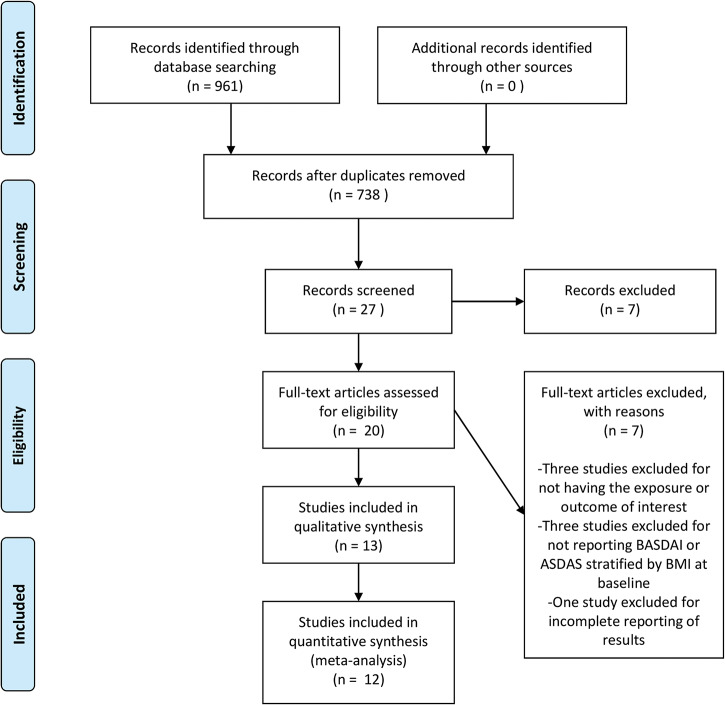
We systematically searched for studies evaluating BMI and disease activity as the exposure and outcome of interest, respectively, in axSpA. Using random effects models, we estimated summary standardised mean differences (SMDs) and 95% CIs of BASDAI or ASDAS, comparing obese (BMI>30 kg/m) or overweight/obese (BMI>25 kg/m) individuals to those with normal BMI (18.5-24.9 kg/m).
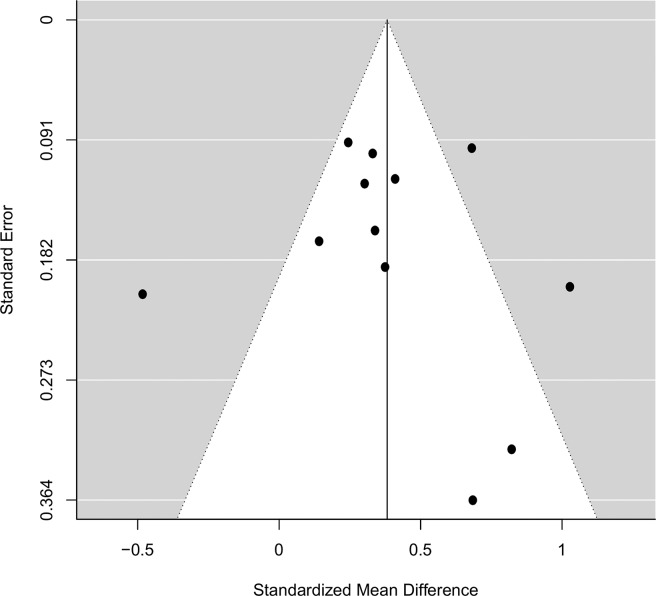
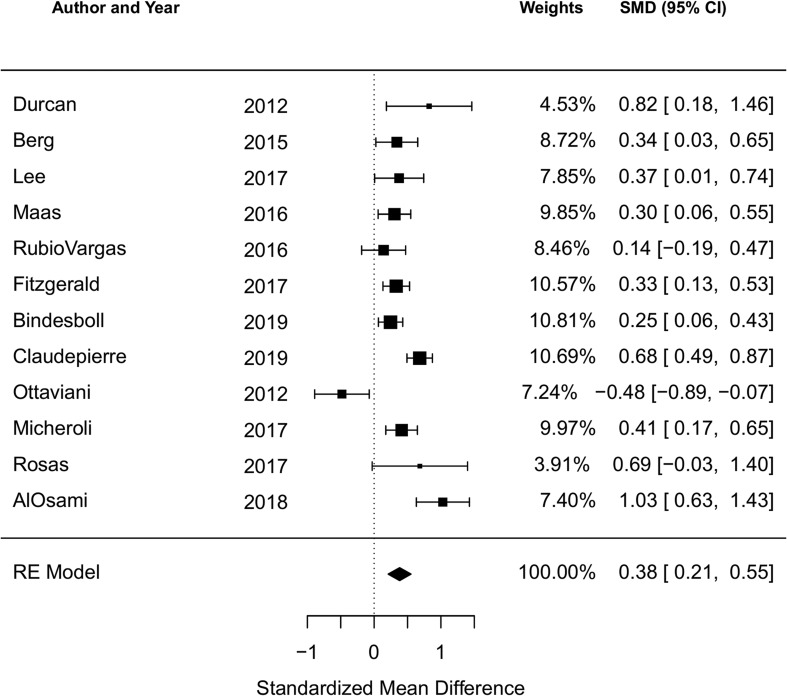
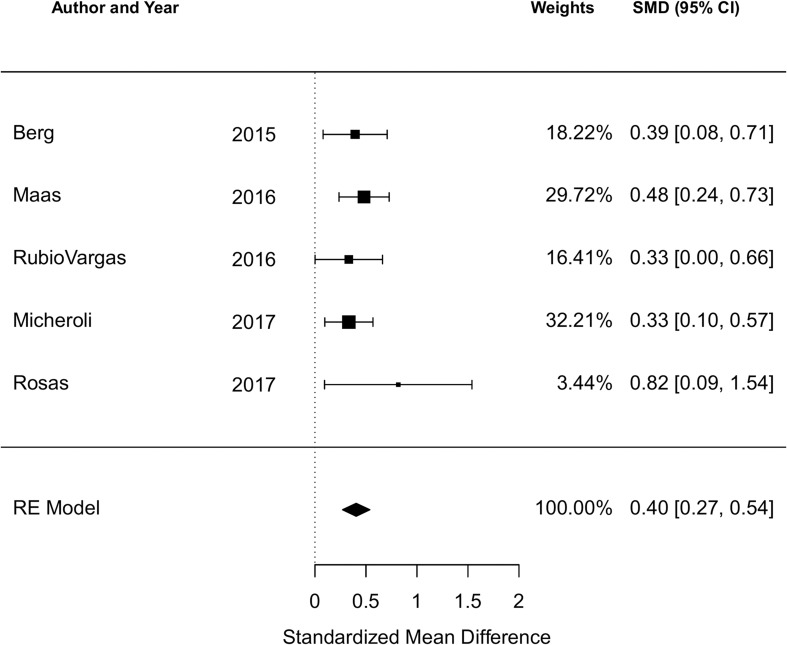
Twelve studies were included in the meta-analysis. Among all studies reporting the BASDAI at baseline, the pooled SMD of the BASDAI for those with an obese or overweight/obese BMI compared to a normal BMI was 0.38 (95% CI 0.21 to 0.55, I =75.2%), indicating a significant association of higher BMI with higher BASDAI score. The pooled SMD of the ASDAS for those with an obese or overweight/obese BMI compared to a normal BMI was 0.40 (95% CI 0.27 to 0.54, I=0%). Findings were robust across subgroup analyses.
These results demonstrate an association between an overweight/obese BMI and higher disease activity in studies of axSpA. Future longitudinal studies of BMI and disease activity should assess how this association changes over time.
在中轴型脊柱关节炎(axSpA)中,较高的体重指数(BMI)与较差的结局相关,包括对生物制剂的反应。需要进一步明确 BMI 是否与疾病活动相关,而与治疗反应无关。我们进行了一项系统评价和荟萃分析,以评估 axSpA 中 BMI 与 Bath 强直性脊柱炎疾病活动指数(BASDAI)或强直性脊柱炎疾病活动评分(ASDAS)报告的疾病活动之间的关联。
我们系统地检索了评估 BMI 和疾病活动作为暴露和感兴趣的结局的研究。使用随机效应模型,我们估计了 BASDAI 或 ASDAS 的汇总标准化均数差(SMD)和 95%置信区间(CI),比较肥胖(BMI>30 kg/m)或超重/肥胖(BMI>25 kg/m)个体与 BMI 正常(18.5-24.9 kg/m)个体。
共有 12 项研究纳入荟萃分析。在所有报告基线 BASDAI 的研究中,与 BMI 正常的个体相比,肥胖或超重/肥胖个体的 BASDAI 汇总 SMD 为 0.38(95%CI 0.21 至 0.55,I=75.2%),表明 BMI 较高与 BASDAI 评分较高存在显著关联。与 BMI 正常的个体相比,肥胖或超重/肥胖个体的 ASDAS 汇总 SMD 为 0.40(95%CI 0.27 至 0.54,I=0%)。亚组分析结果稳健。
这些结果表明,超重/肥胖 BMI 与 axSpA 研究中的疾病活动较高有关。未来 BMI 和疾病活动的纵向研究应评估这种关联随时间的变化。