Baruselli Pietro Sampaio, Catussi Bruna Lima Chechin, de Abreu Laís Ângelo, Elliff Flavia Morag, da Silva Laísa Garcia, Batista Emiliana de Oliveira Santana
Departamento de Reprodução Animal, Faculdade de Medicina Veterinária e Zootecnia, Universidade de São Paulo, São Paulo, SP, Brasil.
Anim Reprod. 2019 Oct 22;16(3):364-375. doi: 10.21451/1984-3143-AR2019-0050.
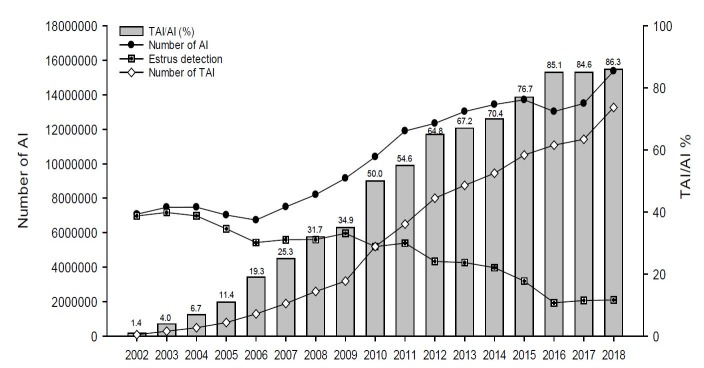
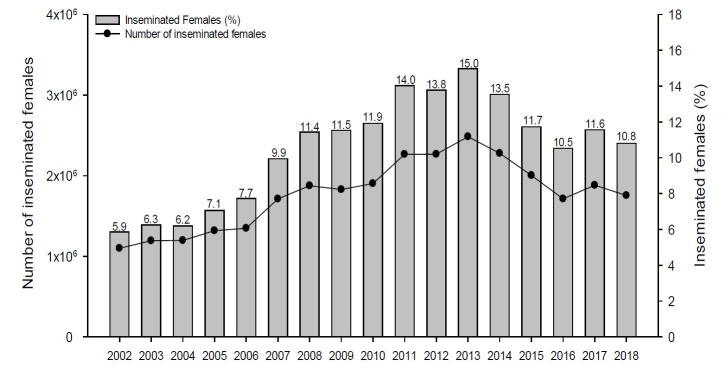
Artificial insemination (AI) and embryo transfer (ET) are the most widely used biotechnologies in the world with the goal of increasing genetic gain and improving reproductive efficiency of beef and dairy herds. The protocols for ovulation synchronization for timed AI (TAI) or ET (TET) are tools that allow artificial insemination or transfer of a high number of embryos in a pre-established moment and without the necessity of estrous detection. Currently, 86% of inseminations in Brazil are performed using TAI (13.6 million TAI out of a total of 15.4 million doses of semen marketed in 2018). With the use of TAI, it was possible to verify that the percentage of artificially inseminated females in Brazil went from 5.8% in 2002 to 13.1% in 2018. The ET market also presented considerable growth in the last 20 years. There was an increase of approximately 8 fold in the number of produced embryos, escalating from 50,000 in 1999 to 375,000 in 2017. In this period, there was a significant increase on the embryo production, which represented 92.1% of embryos produced in Brazil in 2017. Also, in this period, there was an increase on the embryo production of dairy breeds and reduction on the embryo production of zebu breeds in comparison to data from the early 2000's. TET increases significantly the number of recipients suitable to receive an embryo. After synchronization, 75 to 85% of recipients present a suitable CL for ET without estrous detection. Currently, many synchronization and resynchronization protocols for TAI/TET have been studied to attend different managements, breeds and animal categories, with predictable and satisfactory results. With the intensification of the use of these biotechnologies, it is possible to obtain elevated reproductive efficiency with increase on the genetic gain, which determines greater productivity and economic return for dairy and beef farms. However, the challenge to keep the market growing in the next decade could depend on some factors, such as: increase of the extension services for producers and of the extension training for specialists, improvement of the technological advances to develop more efficient and cost-effective products and practical protocols, increase the integration between universities, research institutes, veterinarians and industries and also, asses market demand for production of animal protein with higher quality, efficiency and environmental and economic sustainability.
人工授精(AI)和胚胎移植(ET)是世界上应用最广泛的生物技术,旨在提高肉牛和奶牛群的遗传增益并改善繁殖效率。定时人工授精(TAI)或定时胚胎移植(TET)的排卵同步方案是一些工具,可在预先确定的时间进行大量人工授精或胚胎移植,而无需进行发情检测。目前,巴西86%的授精采用TAI(2018年销售的1540万剂精液中,有1360万次TAI)。通过使用TAI,可以证实巴西人工授精母牛的比例从2002年的5.8%上升到了2018年的13.1%。在过去20年中,ET市场也有显著增长。生产的胚胎数量增加了约8倍,从1999年的50000个增加到2017年的375000个。在此期间,胚胎产量显著增加,2017年占巴西生产胚胎的92.1%。此外,与21世纪初的数据相比,在此期间奶牛品种的胚胎产量增加,瘤牛品种的胚胎产量减少。TET显著增加了适合接受胚胎的受体数量。同步后,75%至85%的受体在未进行发情检测的情况下呈现适合胚胎移植的黄体。目前,已经研究了许多用于TAI/TET的同步和再同步方案,以适应不同的管理、品种和动物类别,并取得了可预测且令人满意的结果。随着这些生物技术使用的强化,可以通过提高遗传增益来获得更高的繁殖效率,这将为奶牛场和肉牛场带来更高的生产力和经济回报。然而,未来十年保持市场增长的挑战可能取决于一些因素,例如:增加对生产者的推广服务和对专家的推广培训,改进技术进步以开发更高效、更具成本效益的产品和实用方案,加强大学、研究机构、兽医和行业之间的整合,以及评估市场对更高质量、效率以及环境和经济可持续性的动物蛋白生产的需求。