Huang Xing, Li Enliang, Shen Hang, Wang Xun, Tang Tianyu, Zhang Xiaozhen, Xu Jian, Tang Zengwei, Guo Chengxiang, Bai Xueli, Liang Tingbo
Zhejiang Provincial Key Laboratory of Pancreatic Disease, The First Affiliated Hospital, School of Medicine, Zhejiang University, Hangzhou, China.
Department of Hepatobiliary and Pancreatic Surgery, The First Affiliated Hospital, School of Medicine, Zhejiang University, Hangzhou, China.
Front Cell Dev Biol. 2020 May 6;8:152. doi: 10.3389/fcell.2020.00152. eCollection 2020.
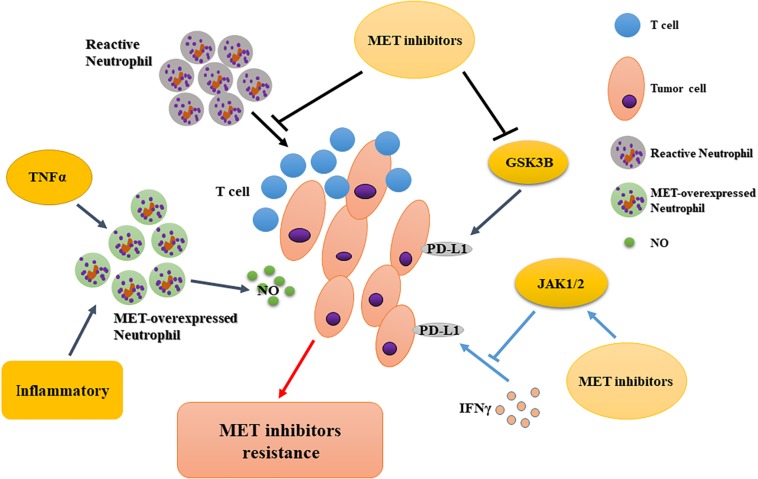
Among hundreds of thousands of signal receptors contributing to oncogenic activation, tumorigenesis, and metastasis, the hepatocyte growth factor (HGF) receptor - also called tyrosine kinase MET - is a promising target in cancer therapy as its axis is involved in several different cancer types. It is also associated with poor outcomes and is involved in the development of therapeutic resistance. Several HGF/MET-neutralizing antibodies and MET kinase-specific small molecule inhibitors have been developed, resulting in some context-dependent progress in multiple cancer treatments. Nevertheless, the concomitant therapeutic resistance largely inhibits the translation of such targeted drug candidates into clinical application. Until now, numerous studies have been performed to understand the molecular, cellular, and upstream mechanisms that regulate HGF/MET-targeted drug resistance, further explore novel strategies to reduce the occurrence of resistance, and improve therapeutic efficacy after resistance. Intriguingly, emerging evidence has revealed that, in addition to its conventional function as an oncogene, the HGF/MET axis stands at the crossroads of tumor autophagy, immunity, and microenvironment. Based on current progress, this review summarizes the current challenges and simultaneously proposes future opportunities for HGF/MET targeting for therapeutic cancer interventions.
在成百上千种促成致癌激活、肿瘤发生和转移的信号受体中,肝细胞生长因子(HGF)受体——也称为酪氨酸激酶MET——是癌症治疗中一个很有前景的靶点,因为其信号轴涉及多种不同癌症类型。它还与不良预后相关,并参与治疗抗性的产生。几种HGF/MET中和抗体和MET激酶特异性小分子抑制剂已被研发出来,在多种癌症治疗中取得了一些依情况而定的进展。然而,随之而来的治疗抗性在很大程度上阻碍了这类靶向候选药物转化为临床应用。到目前为止,已经开展了大量研究来了解调节HGF/MET靶向药物抗性的分子、细胞和上游机制,进一步探索减少抗性发生的新策略,并在出现抗性后提高治疗效果。有趣的是,新出现的证据表明,除了其作为癌基因的传统功能外,HGF/MET信号轴处于肿瘤自噬、免疫和微环境的交叉点。基于目前的进展,本综述总结了当前的挑战,同时提出了针对HGF/MET进行癌症治疗干预的未来机遇。